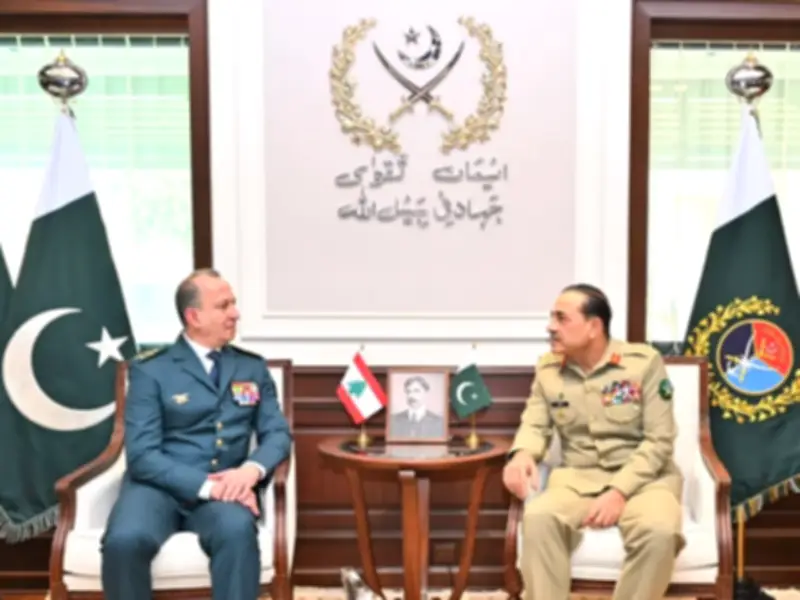
Pakistan and Lebanon discussed regional security, defence cooperation, and prospects for strengthening bilateral military ties during talks between Chief of Defence Forces and Chief of Army Staff, Field Marshal Asim Munir, and Lebanese Armed Forces Commander-in-Chief, General Rodolphe Haykal, the military's media wing said on Tuesday.
Guard of Honour at GHQ
According to the Inter-Services Public Relations (ISPR), the two army chiefs met at the General Headquarters (GHQ) in Rawalpindi. "The visiting dignitary was presented guard of honour by a smartly turned-out Tri Services contingent upon his arrival at GHQ," the ISPR statement read.
Discussions on Regional Security and Defence Cooperation
"During the meeting, both dignitaries exchanged views on matters of mutual interest, evolving regional security environment, defence cooperation and prospects for enhancing bilateral military relations," the statement added. The discussions focused on strengthening professional interactions, training cooperation and institutional linkages between the armed forces of the two countries.

Pakistan's Commitment to Lebanon
"CDF Munir reaffirmed the importance Pakistan attaches to its longstanding and cordial relations with Lebanon and underscored Pakistan Army's commitment to expanding defence collaboration with the Lebanese Armed Forces," said ISPR. General Rodolphe Haykal appreciated the professionalism and operational excellence of the Pakistan Armed Forces and acknowledged their contributions to regional peace, stability and international peacekeeping efforts.
"The visit reflected the shared commitment of both armed forces to fostering closer military-to-military cooperation," the statement concluded.
Context of Regional Tensions
The meeting comes amid ongoing conflict in Lebanon, where Israel invaded in March after Hezbollah fired rockets and drones across the border. Lebanon and Israel agreed to a ceasefire on June 3 following negotiations in Washington. However, Israel struck the outskirts of Beirut on Sunday for the first time since the US announced a truce plan for Lebanon, and an Iranian lawmaker threatened retaliation, putting talks to end the wider war into new jeopardy.
Iran has long said any peace deal with the United States would depend on a ceasefire also holding in Lebanon. The US has leaned on Israel to scale back its campaign in Lebanon to allow room for a peace deal with Iran. After a phone call with US President Donald Trump, Israeli Prime Minister Benjamin Netanyahu called off air strikes on Beirut and agreed to the latest truce plan with the Lebanese government. However, Israel has not fully halted its campaign, which has killed thousands and displaced hundreds of thousands.
Hezbollah, not party to the truce and expected to be dismantled under its terms, has continued attacks and insists it will not give up weapons unless Israel halts fighting and withdraws. The wider war remains stalemated since the US and Israel paused attacks on Iran in early April, with Tehran blocking most shipping through the Strait of Hormuz. Washington has imposed its own blockade of Iranian ports. Though both sides claim to be close to a preliminary agreement to reopen the strait, they have repeatedly traded strikes, including recent attacks on nearby Arab states hosting US bases.