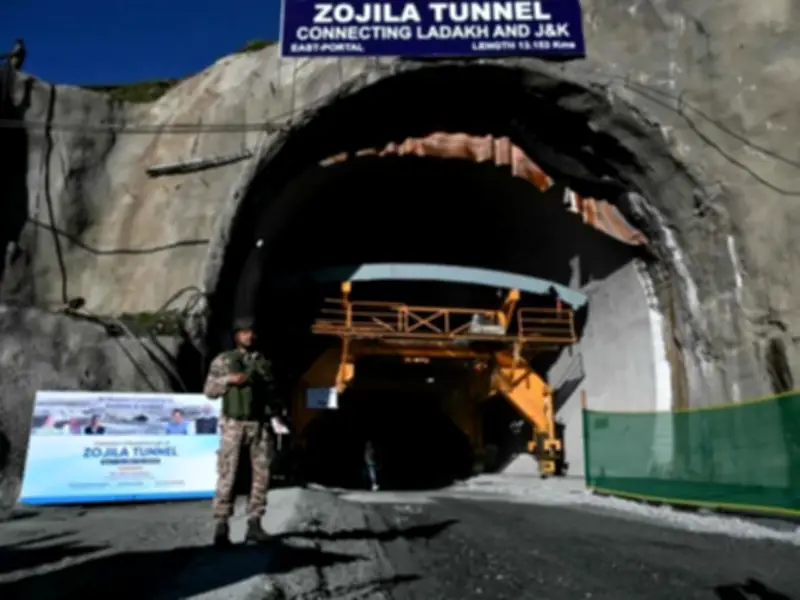
Indian engineers achieved a major breakthrough on Tuesday by breaking through the final rock section of the strategic Zojila tunnel, a key milestone in providing all-weather access to the frontier Ladakh region bordering China. The tunnel is part of India's broader infrastructure push to improve connectivity to its northern borders.
Strategic significance of the Zojila tunnel
The tunnel, located in the Himalayan mountains, will enable year-round movement of troops, supplies, and trade between Srinagar in Indian-administered Kashmir and Leh in Ladakh. Currently, the route is blocked during winter due to heavy snowfall, often exceeding the height of a truck. The 13.14-kilometer tunnel passes beneath the 3,528-meter Zojila Pass and will be India's longest road tunnel once completed.
India and China, the world's two most populous nations, are intense rivals competing for strategic influence across South Asia. Although ties have thawed since a 2020 border clash, their 3,500-kilometer frontier remains a perennial source of tension. The tunnel forms part of a broader network of roads and railways designed to rapidly improve connectivity from India's lowland plains to the soaring icy border zones.

Breakthrough ceremony and project details
India's Minister of Roads, Nitin Gadkari, presided over a breakthrough ceremony on Tuesday, pressing a button to remotely trigger the final blast that connected tunnels dug from both sides. “This is not just a tunnel but a lifeline,” Gadkari said during the event. More than 3,000 workers have been involved in excavating the tunnel since 2020.
Project engineer Manmohan Singh told AFP, “We have worked for this tunnel day and night in challenging weather conditions, and completed it without any accident.” The project is part of a broader network of four major tunnels, including the 6.5-kilometer Sonamarg tunnel, a $712-million initiative expected to be fully operational by 2028.
Broader infrastructure push in the region
India has also developed a $3.9-billion railway line connecting the lowland plains with Indian-administered Kashmir, including the construction of the Chenab Rail Bridge, currently the highest of its kind in the world. Prime Minister Narendra Modi opened the railway route in June 2025. The 272-kilometer railway begins in the garrison city of Udhampur, headquarters of the army's northern command, and runs through Srinagar.
Kashmir has been divided between India and Pakistan since their independence from British rule in 1947, and both claim the Himalayan territory in full. Freedom fighter groups demand independence for the territory or its merger with Pakistan.