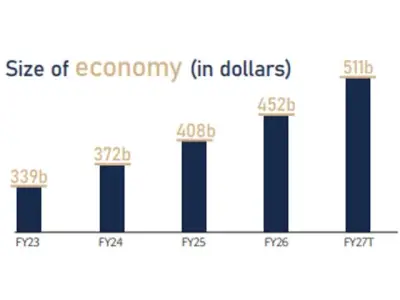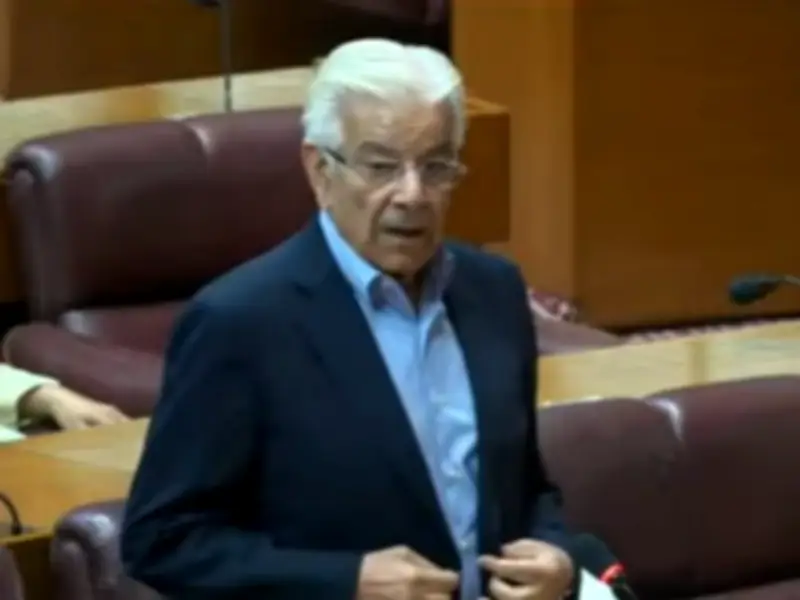
Defence Minister Khawaja Asif on Tuesday declared that Pakistan's economy had moved “out of the ICU” and is now exhibiting signs of recovery, expressing optimism that the country could achieve 6–7% growth in the coming years.
Economic Recovery and Budget
Addressing the National Assembly, Asif stated, “Whatever time we are living in is a time of celebration; we also have successes.” He recalled that in the first budget tabled by the Pakistan Muslim League-Nawaz government three years ago, the economy was “insolvent” before being stabilised with support from the International Monetary Fund under “strict conditions.”
“We were suffering, but from insolvency we are now solvent,” he said, adding that the economy was now “breathing” after a period of severe stress. Asif clarified he was not claiming full recovery but argued that indicators pointed towards gradual improvement.

“Our trajectory shows that in one or two years Pakistan will reach a growth rate of 6–7%,” he asserted. He noted that inflation and global energy prices remained linked to international markets, and expectations of lower domestic fuel prices were constrained by global trends. “When people say petrol prices should come down, do be aware that prices in the international markets have not come down yet,” he remarked.
Turning to taxation, the defence minister said the current system contained multiple layers of levies. “We know there are problems with the levy, there are multiple taxes—25 different types— and they have been built into every purchase,” he explained. Asif emphasised that the broader goal should be to expand the tax base rather than increase pressure on existing taxpayers. “The only way is that all 250 million people pay taxes,” he said, adding that people often find ways to avoid taxation. “We need to create an atmosphere in which people pay taxes with pride,” he added.
US-Iran Breakthrough
The defence minister hailed Pakistan’s role in facilitating the recent understanding between the United States and Iran, stating that the development enhanced the country’s international standing and should be celebrated as a national achievement. Asif congratulated the nation on what he described as a major diplomatic success and praised the efforts of Pakistan’s civil and military leadership.
“Pakistan’s role was recognised in the world,” he said, adding that Pakistan had played a part in achieving the breakthrough. “These moments in a country’s life come after centuries and become golden moments,” he told lawmakers. “No matter what complaints exist, these moments of jubilation should be celebrated as a nation, as one entity.”
The minister expressed gratitude to “the field marshal and the entire team that was working”, adding that “the whole country should thank them”. “They steered a situation that was impossible and made the impossible possible,” he said.
Asif noted that Indian Prime Minister Narendra Modi had congratulated US President Donald Trump on the development but had not acknowledged Pakistan’s role. Regarding regional implications, he said recent improvements in Pakistan-Iran relations and the easing of sanctions on Tehran could create economic opportunities for Pakistan. “With Iran, our relations have seen good developments in the past few months. Sanctions are being relaxed, their oil and gas exports [are increasing],” he said. “Pakistan can benefit immensely from this change, and the biggest beneficiary will be Balochistan,” he added. “Let’s see how we can proceed in this direction.”
Afghanistan Engagement
Responding to criticism that Islamabad had not sufficiently engaged with Kabul, Asif said Pakistan had repeatedly engaged with the Afghan Taliban multiple times but failed to secure guarantees that Afghan territory would not be used for attacks inside Pakistan. He said senior political, military and intelligence officials had held extensive talks with Taliban authorities over several years.
“Lots of people complained that we should negotiate with them, and maybe our approach is impersonal, that we are not directly approaching them,” he said. “But this Afghanistan issue is directly linked to terrorism. Whether in Balochistan or Khyber-Pakhtunkhwa, the origin of the terrorism comes from Afghanistan.”

Rejecting suggestions that Pakistan had not pursued dialogue, the minister said he had personally travelled to Afghanistan twice as part of high-level delegations. “This complaint that we didn’t talk — I went twice myself. Both times senior delegation members were there, and I had the DG ISI with me,” he said. “They would agree to everything but would refuse anything in writing,” he added.
The minister disclosed that Afghan authorities had sought financial assistance from Pakistan during the discussions. “They asked us for $10 billion. We agreed, but we told them that terrorists residing in Afghanistan will not come back to Pakistan,” he said. “Apart from Kabul, I also met them in Turkey and Qatar. Negotiations would go on day and night, with high-powered delegations, but there was no conclusion,” he added. “We were ready to do anything, but we wanted a guarantee that their land would not be used against us. That’s all we wanted.”
The defence minister said Pakistan had exhausted diplomatic channels in seeking cooperation from the Taliban government. Asif also reflected on Pakistan’s role in past regional conflicts, arguing that decisions taken during the Cold War and the US-led war in Afghanistan had left lasting consequences.
“I don’t say that our policies of the 1980s and the first two decades of this century, when we were American proxies, were correct,” he said. “We thought we would win a lottery by being an American proxy. Pakistan became a battleground,” he added. The minister further said that those [Americans] who “came here used us and then went home,” leaving behind their arms and terror. “We are still suffering the consequences, and God knows for how long we will continue to suffer,” he added.
Calling for a practical approach, the minister said Pakistan remained open to further engagement but expected tangible outcomes. “My companions should conduct talks and go there. We are ready, but don’t come back without results,” he said. “Two generations have already suffered, and it seems the coming generations will also suffer.”
Local Politics and Balochistan
Speaking on the security situation in Balochistan, Asif said that the crisis in the province “was not born yesterday” and that responsibility for it was shared across political forces over many decades. “Many colleagues have rightly discussed the situation in Balochistan. This situation was not born yesterday; many people have contributed to it,” he said, adding that he would avoid naming individuals because “it would become partisan”.
He further said terrorism in Balochistan and K-P should be treated as a national issue rather than a party issue. “If roads are not safe in Balochistan, if terrorists have made highways unsafe and acts of terrorism occur, I understand this is the collective responsibility of this House,” he said. He rejected the idea that political parties should trade accusations over the crisis. “Should I accuse them or should they accuse us?” he asked, adding that the roots of the problem stretched back to the 1950s, when agreements made with tribal communities were later broken.
“We need a collective solution. If Balochistan faces terrorism, then responsibility is collective, and there must be a solution that the people of Balochistan accept,” he said. Asif also spoke emotionally about the human cost of the insurgency and counterterrorism conflict, saying he had attended “21 funerals in the last few days”. “Small children are being orphaned. People are told, just days after their weddings, that they must report to the border,” he said, adding that many personnel request transfers because they fear postings to Balochistan and conflict zones. “These soldiers standing on the borders of Balochistan and K-P are young men with families. Their sacrifices will bear fruit and will not be wasted,” he said.
Criticism of Political Hypocrisy
The minister also criticised what he described as hypocrisy across the political spectrum regarding the role of the establishment. “We complain that power centres have shifted elsewhere, but they have shifted because of us,” he said. Asif said, “I am given establishment taunts. Tell me one party that is innocent.” He added that the soldiers being killed in attacks should not be reduced to political labels. “These are not martyrs of a party; they are martyrs of the army, which we call the establishment,” he said.
The defence minister urged lawmakers to speak “the language of the federation” rather than narrow provincial or partisan politics. “This is the whole of Pakistan’s House,” he said. “Do not come here with political angling and posturing that makes the common man lose trust in this House.” Asif also accused political parties of selectively forgetting their own dealings with the establishment while criticising opponents for similar conduct.
Referring to former National Assembly speaker Asad Qaiser, he said he had attended legislative meetings at Qaiser's residence during the Pakistan Tehreek-e-Insaf's tenure, where politicians from the Pakistan Peoples Party (PPP) and individuals linked to the intelligence services were present. “Asad Qaiser, whom I respect, in his room I attended meetings at his house on legislation. PPP would sit there, ISI people sent by General [retd] Faiz would sit there, and they would monitor our conversations and, where they wanted, they would decide our direction,” Asif alleged.
The defence minister claimed he was disclosing this to “lower the burden on my conscience”, arguing that politicians often ignored their own past conduct when attacking rivals. “When you pound your chest and taunt us, do you forget that under your roof the Anti-Money Laundering Bill and NAB law were discussed there under the watchful gaze of people sent by Gen Faiz at that time?” he stated, adding, “This is our problem. In politics, there are grey areas, but we expand them with new levels of hypocrisy.”