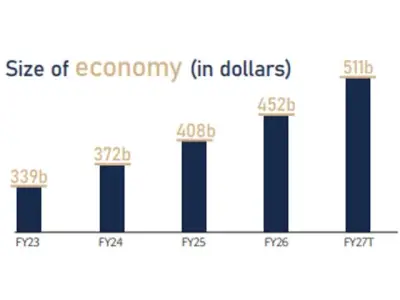
Pakistani business leaders and investors said on Saturday that the tax relief measures announced in the Federal Budget 2026-27 could help the government achieve its 4 percent economic growth target and significantly boost the country's exports, given that energy prices become competitive.
Budget Overview
Pakistan on Friday unveiled an Rs18.8 trillion ($67.5 billion) annual fiscal plan, raising defense spending and setting ambitious revenue targets as the government seeks to sustain an International Monetary Fund-backed economic recovery amid regional tensions and pressure on public finances.
Industry Reactions
Business leaders from the Federation of Pakistan Chambers of Commerce & Industry (FPCCI) welcomed the tax incentives, including reductions in transaction taxes to support housing and construction, and measures aimed at boosting agricultural productivity.

“Their (government’s) targets will be fulfilled. Our exports, which have stopped growing for the past four years, will increase. This is a very big incentive,” FPCCI President Atif Ikram Sheikh told Arab News on Saturday. “The industry will run, employment will increase, and revenue will be generated.”
Export Targets
Islamabad aims to expand the economy by boosting exports to $32.9 billion and keeping imports at around $70 billion in the next fiscal year, according to budget documents. The new fiscal plan reduced advance income tax and minimum tax on exports from 2 percent to 1.25 percent and abolished the 1-7 percent ‘super tax’ on six slabs for medium-sized businesses earning between Rs150 million ($539,209) and Rs500 million ($1.8 million) annually.
Construction Sector Stimulus
The government has also announced plans to build 150,000 affordable and climate-resilient housing units across Pakistan under its sustainable urban development program. To stimulate construction activity, withholding tax on property transfers has been reduced from 2.5 percent to 1.25 percent for buyers and from 5.5 percent to 2.75 percent for sellers.
Other measures include a 4.5 percent cut in withholding tax on international transactions made through bank credit and debit cards, the abolition of capital value tax on foreign assets, and a fixed Rs25,000 tax for retailers with annual sales of up to Rs200 million ($718,945).
Asked which measure was most significant, Sheikh pointed to the construction package. “The biggest package is construction. Sixty industries are allied to it. All those industries are [currently] closed. Steel, cement, tiles, ceramic, I don’t know what else. So, all those will start running,” he said.
Energy Costs Concerns
The FPCCI chief said exports could exceed target if the government addressed energy costs. According to global fuel price tracking data shared by the country’s energy ministry last month, Pakistan recorded the world’s second-highest surge in domestic fuel prices since the start of the United States-Iran war that widely disrupted global cargo and energy supplies passing through the Strait of Hormuz, with petrol and diesel soaring 56 percent at one point in Pakistan.
The surge was second only to Myanmar’s 90 percent increase and far exceeded hikes in the United States, Britain and several regional countries, though the government has since announced multiple reductions in fuel prices amid a ceasefire and ongoing negotiations between the US and Iran to end their war.
“If the energy price becomes competitive, then we can do $40 billion or even $80 billion in exports,” said Sheikh, who thinks the government’s 4 percent growth target was achievable despite regional tensions. “I think we will achieve that.”
Investor Perspectives
Investors also viewed the tax relief package positively. “I think the relief that they have given is, firstly, the super tax relief is a very good relief which is positive for small businesses,” Mohammad Shoaib, chief executive officer of Lucky Investment Ltd. that manages Rs125 billion ($449 million) in assets, told Arab News.

“Secondly, there is a lot of focus on exports. They have given benefits to the exporters. Thirdly, they have given some benefits to the real estate sector to stimulate the construction sector,” he said. “All in all, all three small things together have a positive impact. It will have a positive impact on growth.”
Shoaib, however, cautioned that a 4 percent growth rate would not be sufficient to address Pakistan’s long-term economic challenges. “You need to grow from 6-7 percent for the next 5-10 years to improve the living standard of the people and to grow the economy,” he said. Still, the Lucky Investments Ltd. CEO said, the budget had a “positive approach in difficult circumstances.”
Economist Views
Amreen Soorani, head of research at Al-Meezan Investments Management Limited, Pakistan’s largest Shariah-compliant mutual fund managing more than Rs700 billion ($2.5 billion) in assets, said the government had targeted sectors with greatest potential to support growth.
“While the 4 percent growth target is certainly ambitious given regional tensions and trade disruptions at the Afghan border, the budget strategically fuels areas that may deliver,” she said. “By locking in major tax breaks for the booming IT sector, slashing super taxes for corporate exporters, and easing the tax burden on salaried professionals, the government seems to give a path for private sector expansion to some extent.”
Pakistan’s trade with Afghanistan has been suspended for months amid heightened tensions and sporadic cross-border skirmishes between the neighbors over a surge in militancy in Pakistan’s western regions that border Afghanistan. The proposed tax relief might not directly contribute to the economic growth, however, it might continue to run “the economic wheel,” according to Soorani. “We might not deviate much from the [4 percent growth] target,” the economist added.