

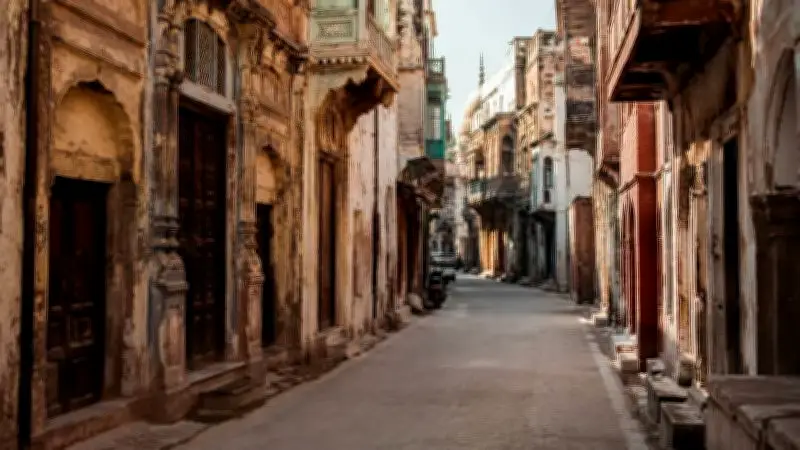
Earlier this month, the Punjab government announced the restoration of several historic names in Lahore, including Krishan Nagar, Sant Nagar, Dharampura, and Jain Mandir Road. For a brief moment, it seemed as though the city was being allowed to publicly acknowledge some of the older histories still quietly embedded within its contemporary identity. Yet within days, the decision was reportedly reversed following criticism from religious groups and sections of social media discourse. What initially appeared to be an attempt to publicly acknowledge Lahore's layered historical and cultural inheritance quickly evolved into a wider public debate about historical memory, religious identity, and belonging.
The Emotional Power of Place Names
But perhaps the controversy itself reveals something deeper. Why do names provoke such emotional reactions? Why does the restoration of an old neighbourhood name suddenly become entangled with religion, nationalism, and belonging? And why do certain names survive in ordinary speech even after disappearing from official maps?
Cities often remember themselves through names. A road, mohalla, marketplace, or bus stop can quietly carry centuries of migration, coexistence, trauma, trade, and cultural exchange within it. People repeat these names casually while giving directions, recalling childhoods, telling stories, or describing parts of the city they once knew. Over time, names become more than geographical markers. They become fragments of cultural memory.

Lahore's Layered History
This is especially true in cities like Lahore, where history survives less as a straight timeline and more as overlapping layers. Mughal Lahore, Sikh Lahore, colonial Lahore, Partition-era Lahore, and contemporary Lahore continue to exist simultaneously within the emotional geography of the city. Sometimes these histories survive through architecture, shrines, food, rituals, oral traditions, and inherited memory. But often, they survive simply through everyday language. Roads are archives. Mohallas are memory sites. Place names are folk records. Cities are living manuscripts.
Folklore scholars often describe this through the idea of placelore: the stories, meanings, myths, and emotional associations attached to places. Placelore explains why neighbourhoods continue feeling historically alive even when their original communities no longer exist there in the same form. A place carries traces of those who once inhabited it.
Defending the Right to Remember
To protect historical names, therefore, is not simply to preserve heritage. It is to defend the city's right to remember itself in its full complexity. This is why names matter more than they initially appear to. A name such as Krishan Nagar or Jain Mandir Road does more than identify a location. It quietly reminds the city that other communities once lived, traded, worshipped, and belonged there, too. Such names become reminders of a layered past that refuses to disappear completely.
And for societies increasingly shaped by religious polarisation and ideological purification, these reminders can begin to feel uncomfortable. Extremist thinking rarely feels comfortable with historical complexity. It prefers purified identities, singular narratives, and carefully controlled versions of belonging. Historical complexity becomes threatening because it reminds societies that cities were never culturally pure spaces to begin with. They were always shared, layered, and evolving.
The Vulnerability of Cultural Memory
This is where cultural memory becomes vulnerable. Erasure does not always happen dramatically. Sometimes it begins quietly through discomfort. Certain names disappear from signboards. Others slowly vanish from textbooks, maps, and eventually, everyday speech. Over time, future generations inherit the geography of a city without inheriting its memory. And once names disappear from language, entire histories begin weakening with them.

In South Asia, particularly, place names often preserve traces of coexistence that survived long before contemporary political divisions hardened into permanent identities. A single neighbourhood may carry memories of migration, Partition, colonialism, shrines, trade routes, Sikh history, Hindu mercantile communities, or older Persian influences simultaneously. Old names interrupt simplified versions of history because they remind societies that identity was never singular.
Perhaps this is why such debates feel emotionally larger than the names themselves. What is ultimately being negotiated is not simply geography, but remembrance itself. Which histories deserve visibility? Which memories are considered acceptable? And who gets to remain present within the symbolic imagination of the city, even after they are physically gone?
How Cities Resist Erasure
Yet, despite these pressures, cities rarely forget completely. An elderly resident still gives directions using an old neighbourhood name. A bus conductor unknowingly preserves fragments of historical geography through habit. Shopkeepers continue repeating inherited names without consciously realising that they are carrying pieces of cultural memory within ordinary speech. Perhaps this is how cities resist complete erasure. States preserve memory through archives, museums, and official records. Cities often preserve memory through repetition, through accents, inherited speech, roadside conversations, and everyday language.
A name survives because somebody continues saying it aloud. But this survival is fragile. A forgotten name is not merely the loss of a word. It is the disappearance of a way of remembering. Over time, cities can remain physically intact while becoming emotionally thinner and less capable of remembering the many worlds that once coexisted within them.
Cultural Honesty in Urban Identity
Preserving historical names is therefore not merely an act of nostalgia. It is an act of cultural honesty. Cities do not become weaker by acknowledging the many communities, faiths, and histories that shaped them. They become historically mature. Lahore does not lose its identity by remembering Krishan Nagar, Jain Mandir Road, or Dharampura. If anything, it becomes more fully itself.
Religious extremism thrives by shrinking memory into a single authorised narrative. Folklore, however, resists such narrowing. It preserves traces of coexistence, migration, shared spaces, and layered belonging long after official histories attempt to simplify them. To protect historical names, therefore, is not simply to preserve heritage. It is to defend the city's right to remember itself in its full complexity.
