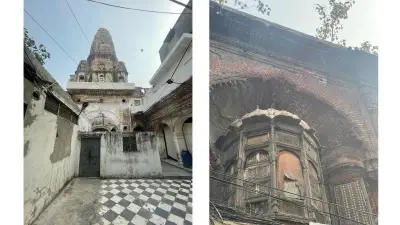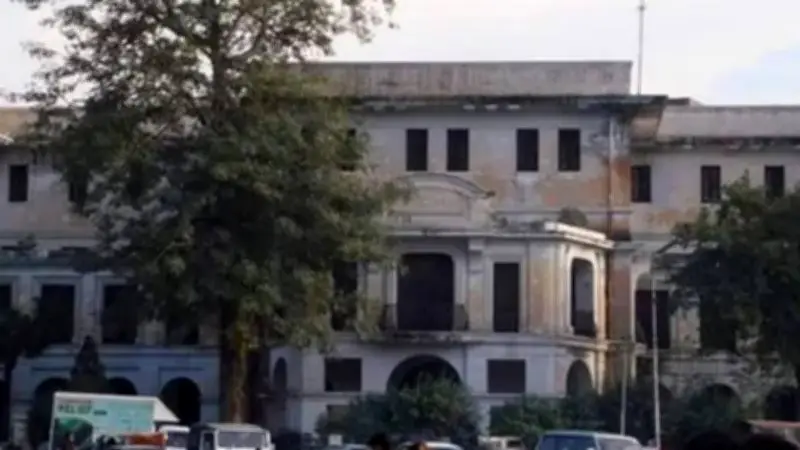
On Friday evening, hundreds of Christians gathered on the Mall, the grand artery at the heart of colonial Lahore, to protest a seizure that has shaken one of Pakistan’s oldest educational communities. Days earlier, the Punjab Enforcement and Regulatory Authority, the powerful new agency Chief Minister Maryam Nawaz launched in 2024 to clear encroachments and tame the markets, had taken over Ewing Hall, a heritage building belonging to Forman Christian College. A force built to pull down illegal structures had, the protesters charged, turned on the lawful property of an institution founded in 1864.
The hall stands near the Nila Gumbad, in the old Anarkali quarter, on the college’s former downtown campus. Built in 1916 as a boys’ hostel, it carries the name of Sir James Caruthers Rhea Ewing, the American missionary who led Forman for three decades and gave it international standing. In continuous use for most of the past century, it has sat largely empty in recent years, tucked away down a narrow walkway along the wall of King Edward Medical University. The wider Nila Gumbad area, named for the blue-tiled tomb of Sheikh Abdur Razzaq, is already being remade: an underground car park has been dug in front of the hall, and old trees and roadside shops cleared in the name of progress.
Forman Christian College is no ordinary institution. Founded in 1864 by the Rev. Charles William Forman, a Presbyterian missionary from Kentucky who began by teaching four boys under a banyan tree in 1849 and turned the school into a college in 1864, it was the first missionary college not only in Punjab but in the whole of North India. The school made its first home in the Rang Mahal palace in the Walled City. Forman welcomed Indian teachers as the equals of foreigners, helped shape new schools across central Punjab, and built a faculty whose students rose to lead in business, government and the professions. It began admitting women in 1902. In 1940, the college left its old downtown quarters for its present home on the canal, off Ferozepur Road. Its alumni include two presidents of Pakistan and two prime ministers of India.

Ewing Hall and Its Namesake
Ewing himself was a figure of rare distinction. Principal of Forman from 1888 to 1917, he also served as vice-chancellor of the University of the Punjab and, by the college’s own account, was the only American ever knighted by the British for his educational leadership — the honour that made him “Sir James”. The hall that bears his name is among the last surviving fragments of the college’s old downtown campus near the Nila Gumbad.
The college’s current rector, Jonathan Addleton, knows the stakes intimately. Born in Pakistan in 1957 to American missionaries from Georgia, he went on to a long career in diplomacy and development, serving five times as a USAID mission director and, later, as US ambassador to Mongolia — before returning to the country of his childhood to lead Forman. Since the takeover, he has spent his days knocking on the doors of the chief minister, the chief secretary and anyone in authority who will hear his plea, but to no avail.
Financial and Political Dimensions
The dispute has deepened over money, too: the college says its lease on the site, valid until 2048, was abruptly cancelled, and the Revenue Department, under pressure to show the IMF it means business, sharply increased the fees. The administration has called the move both surprising and a matter of grave concern. The timing has sharpened an older grievance. Lahore’s Christians, who number in the millions across Punjab and dwarf the province’s few tens of thousands of Sikhs, have long pressed for stronger political representation. Yet the dedicated minorities portfolio sits with Ramesh Singh Arora, the first Sikh ever to serve as a Punjab minister, whose days are largely taken up with Sikh pilgrim affairs and the Kartarpur Corridor. So far, as the controversy unfolds, no Christian member of the assembly has publicly stepped in.

Expert Views and Possible Solutions
Yaqoob Khan Bangash, a historian and dean of social sciences at IBA, urges caution before assuming the worst. “There must have been some miscommunication and confusion on both sides, leading to the current situation,” he says. Because the hall has stood empty for years, he believes the state may simply have misread the silence. “Since Ewing Hall has not been used for a decade, the government must have thought that FC College had lost interest in the property, and that resuming it would enable the government to redevelop it as a heritage site.”
As for whispers that the building was being torn down, Bangash is unconvinced. The government preserves sites of far less value, he points out, and razing Ewing Hall would serve no purpose; the demolition talk, he suspects, is merely a rumour. He sees, instead, an outcome that could serve everyone. “The best way forward is for FC College and the government to work together to restore Ewing Hall to its former shape,” he says — using it as both a hostel and a historical site, “with space dedicated to public interaction through exhibits, talks and the like.” Named for a man who once helped build Punjab’s universities, the hall still holds great value for the city and its people, Bangash argues — if only the two sides can stop talking past each other.