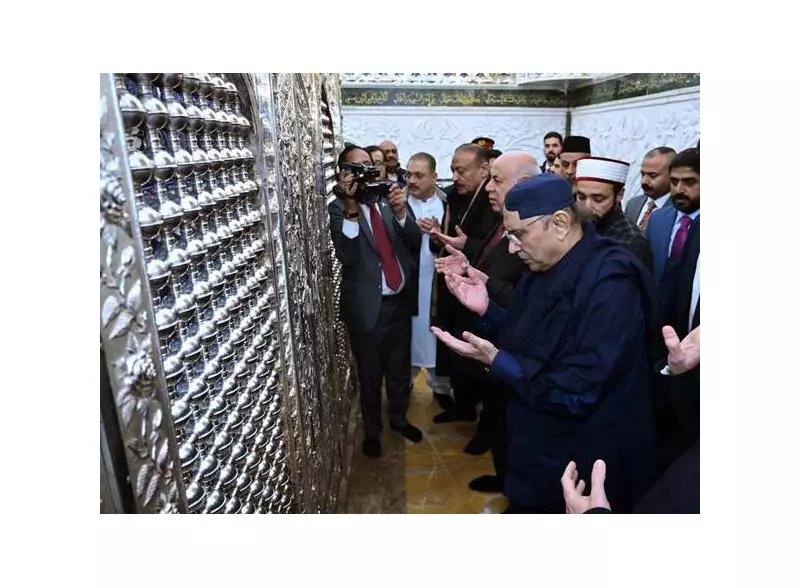
President Asif Ali Zardari embarked on a significant spiritual journey during his official four-day visit to Iraq, paying homage at several of the most revered holy shrines in the Islamic world. His itinerary underscored a deep personal and national reverence for the legacy of the Ahl al-Bayt and great Islamic scholars.
Pilgrimage to Baghdad and Kazimiya Shrines
On Monday, the President began his pilgrimage in Baghdad. His first stop was the shrine of the esteemed Sufi saint, Sheikh Abdul Qadir Jilani (RA). Following this, he visited the resting place of Imam-e-Azam Abu Hanifa (RA), the founder of the Hanafi school of Islamic jurisprudence, which is widely followed in Pakistan.
President Zardari then proceeded to the Kazimiya area of Baghdad. There, he paid his respects at the shrines of Imam Musa al-Kazim (AS) and Imam Muhammad al-Taqi al-Jawad (AS). At each location, he offered Fateha, praying earnestly for the peace, unity, and security of the entire Muslim Ummah.

Reflections on Eternal Teachings
A poignant moment of the visit occurred at the Kazimiya shrine, where President Zardari recorded his thoughts in the official visitors' book. He reflected on the profound and timeless wisdom of the Imams, describing their teachings as an eternal source of knowledge, patience, wisdom, and moral strength. This act highlighted the spiritual and intellectual significance of the pilgrimage beyond ceremonial respects.
Throughout these visits, the President engaged directly with the custodians and preachers at the shrines, holding meetings to acknowledge their role in preserving these sacred sites.
Journey to Najaf and Karbala
Continuing his spiritual tour, President Zardari also traveled to the cities of Najaf and Karbala. In Najaf, he planned to visit the shrine of Hazrat Ali (AS). In Karbala, his itinerary included paying homage at the shrines of Hazrat Imam Hussain (AS) and Hazrat Abbas ibn Ali (AS).
Upon his arrival at the Najaf Airport, he was formally received by Governor Najaf Yousuf Makki Kanawi. The two leaders seized the opportunity for a brief meeting at the airport, where they discussed matters of bilateral interest, weaving diplomatic engagement into the fabric of the spiritual visit.
This four-day journey by Pakistan's head of state stands as a powerful symbol of the nation's deep religious and cultural ties with Iraq and its commitment to fostering unity within the global Muslim community.