Pakistan's education debate has long remained confined to a narrow framework of literacy rates, enrolment figures and infrastructure deficits. Yet the latest insights from the World Bank's 2026 economic analysis compel a fundamental rethinking of education — not merely as a social sector but as the backbone of economic survival and structural transformation.
The report frames education as a human capital crisis rather than a simple schooling problem. Across the MENAP region, 18 out of 19 national development plans place human capital at the core of their strategy, reflecting a global recognition that education is central to growth, resilience and competitiveness in an increasingly uncertain world.
Pakistan's education challenge, therefore, assumes a far more critical dimension. It is no longer an academic concern alone; it is fundamentally a question of economic survival. The country faces a deep and persistent mismatch between its education system and the demands of a modern economy.

While universities produce graduates in large numbers, the economy struggles to absorb them productively. This disconnect reflects a structural weakness — an education system that is largely supply-driven, theoretical and examination-oriented, functioning in isolation from industry and market realities.
The consequences are visible in low productivity growth, limited private sector dynamism and persistent labour market inefficiencies. In short, the system produces degrees rather than skills, while the economy requires a dynamic, demand-driven skills ecosystem.
This structural fragility is further exposed by recent economic developments. Pakistan's modest recovery in late 2025, supported by industrial improvement and improved business confidence, offered some hope. However, this progress proved short-lived as rising global energy prices and geopolitical uncertainty weakened growth prospects.
Pakistan's dependence on imported energy amplifies this vulnerability. Without a strong base of skilled human capital, economic growth remains episodic and highly sensitive to external shocks.
The broader regional context reinforces this concern. The World Bank report highlights that conflict and instability can reverse decades of development, reducing per capita income by as much as 45 per cent over seven years. Such shocks directly affect education — poverty raises dropout rates, displacement disrupts learning continuity and inflation erodes the affordability of schooling.
Educational decline, in such conditions, is not merely caused by failing institutions but by a deteriorating broader economic environment. These converging pressures point to a deeper structural deficit: low productivity and inadequate investment in skills development.
The absence of robust technical education, vocational training and innovation-based learning continues to limit Pakistan's economic potential. As global industrial policy places growing demand on skilled labour, the failure to align education with workforce needs makes industrial progress increasingly difficult. In this sense, economic development and educational capability are inseparable.
Sindh's Education Challenge
For Sindh, these insights carry particular weight. As one of the most populous and economically significant provinces, Sindh holds considerable human potential — especially in its young population and expanding urban centres such as Karachi and Hyderabad. Yet this potential remains underutilised due to weak skill alignment, uneven education quality and gaps in policy implementation.
The real challenge is not only to expand access to education but to redefine its purpose. The traditional focus on enrolment and literacy must shift towards skills, employability and productivity. This requires aligning curricula with industry needs, promoting technical and vocational education and building stronger connections between institutions and the labour market.
Developing sector-specific skills in information technology, agriculture and manufacturing can significantly improve economic outcomes.

Governance and Female Education
Governance remains equally critical. The World Bank report makes clear that even well-designed policies fail under weak institutions. The education challenge is therefore not only about funding but about effective implementation, accountability and teacher quality. Without addressing these factors, increased spending alone is unlikely to yield meaningful results.
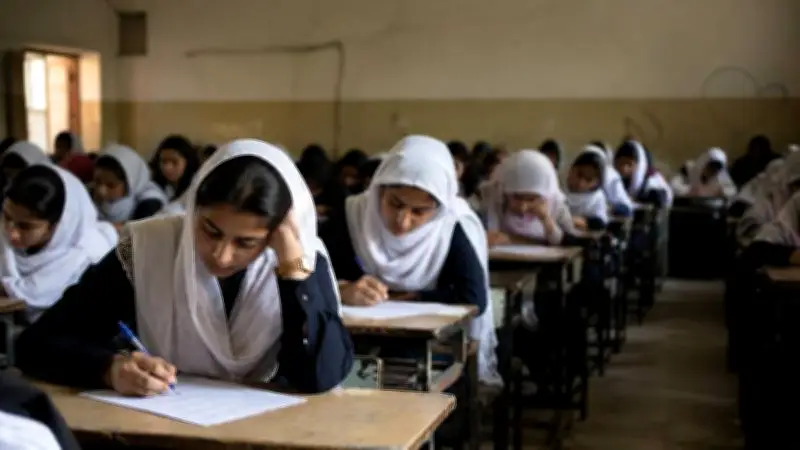
One often overlooked strength of Sindh lies in female education. Research consistently shows that investing in women's education generates significant economic and social returns, including improved productivity and better outcomes for future generations. Where girls are already demonstrating resilience and commitment to learning, focused investment in female education can produce transformative results.
Ultimately, the question is not whether education reform is needed but whether it can be pursued with the urgency the moment demands. In a world reshaped by technological change, evolving labour markets and geopolitical uncertainty, countries that fail to invest in human capital risk falling behind permanently.
For Sindh, the path forward lies in a comprehensive, skills-oriented vision of education that connects schools, universities and industry within a unified system — converting demographic strength into sustainable economic progress and long-term stability.