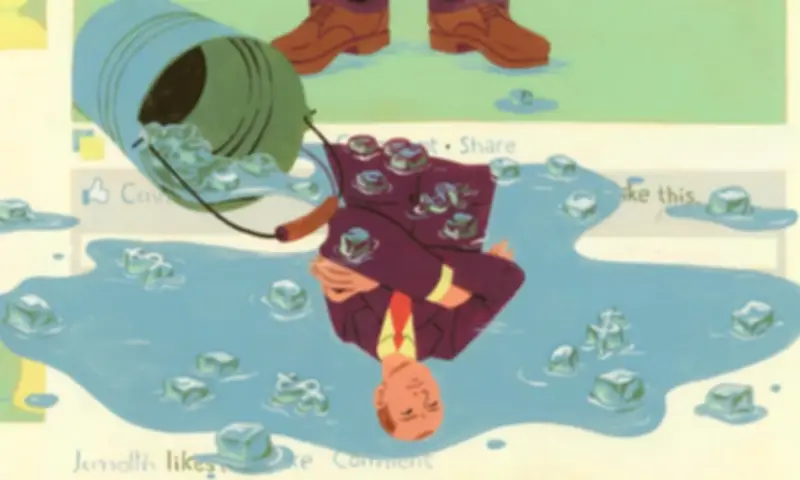
In the scorching summer of 2014, Bill Gates stood in his garden, beaming, and tugged on a candy cane-colored rope that dumped a barrel of icy cold water over his head. He had just challenged Elon Musk, Ryan Seacrest, and Chris Anderson of TED to do the same. This was the ice bucket challenge, a viral social media trend that raised money for amyotrophic lateral sclerosis (ALS) research. Gates had been challenged by Mark Zuckerberg, who was challenged by then-New Jersey Gov. Chris Christie. The challenge quickly spread to tens of millions worldwide, including Jeff Bezos, Justin Bieber, David Lynch, and Donald Trump. It was a moment of global unity that seems impossible today.
Today, the ice bucket challenge and its grainy videos are a time capsule of a bygone internet era. In the early 2010s, platforms like Facebook were seen as potential marketplaces of ideas, not existential threats to mental health and democracy. Generosity was trendy for both the one percent and the 99 percent. Bill Gates, Melinda French Gates, and Warren Buffett launched the Giving Pledge in 2010, convincing many billionaires to donate at least half their fortunes. At its peak, about one in seven American billionaires signed on, promising a new golden age of philanthropy. Meanwhile, everyday Americans flocked to viral clicktivism campaigns, wearing TOMS shoes and (PRODUCT)RED iPod nanos.
But today's billionaires appear more cynical, and the rest of us seem to be too. Fewer Americans give to charity each year, and most billionaires give a diminishing share of their wealth. The Giving Pledge has lost steam and faced attacks from techno-cynics like Peter Thiel. The internet's Earnest Era, which propelled a culture of giving, has been replaced by a fractured, algorithm-driven landscape that rarely rewards mass earnestness. Generosity has become cringe.

The Rise of Viral Giving
2010 was a transformative year for generosity. The economy was recovering from the Great Recession, and for the first time, more Americans were on social media than off it. Surveys showed young people were stubbornly optimistic despite underemployment. Mark Zuckerberg, then 26, was named Time's person of the year for building a platform that changed how the internet feels.
Social media made the world feel smaller. When a devastating earthquake struck Haiti in January 2010, it became the first major live-tweeted natural disaster. Celebrities solicited donations, and within a week, Wyclef Jean's charity raised $2 million, while the Red Cross raised $8 million. Americans gave 15.3 percent more to international aid that year. People publicly shared their good deeds, creating a charitable daisy chain.
Then, on June 16, 2010, Bill Gates, Melinda French Gates, and Warren Buffett announced the Giving Pledge. One week later, Travie McCoy and Bruno Mars' song 'Billionaire' peaked at No. 4 on the Billboard Hot 100, an ode to getting rich to give it all away. By 2014, the Giving Pledge had 130 signatories. 'People signed it because it was the cool thing to do,' said Aaron Dorfman, CEO of the National Committee for Responsive Philanthropy.
How Social Media Fueled Generosity
Facebook and other platforms inspired a boom in viral kindness. GivingTuesday launched in 2012 and quickly crossed algorithmic bubbles, raising at least $10 million in 24 hours. Movember raised over $100 million for men's health. Charity: Water gained a huge following by flying tech entrepreneurs to Ethiopia and convincing celebrities to share birthday fundraisers. By 2013, it had raised over $100 million.
The ice bucket challenge began in July 2014 when Chris Kennedy poured ice water on his head for the ALS Association and challenged his cousin. The videos snowballed, reaching Pat Quinn and Pete Frates, both ALS advocates. Over 17 million people participated that summer. For eight straight days, the ALS Association raised over $10 million daily. In total, it raised about $115 million in eight weeks, funding 130 research projects in 12 countries. But medical research is slow, and by the time treatments emerged, most donors had forgotten the disease.

The Turning Point: Ferguson and the Fracturing Internet
The ice bucket challenge was the last major do-gooder trend. A week after it started, a police officer in Ferguson, Missouri, shot and killed Michael Brown, sparking grief and outrage on social media. The hashtags #IceBucketChallenge and #IfTheyGunnedMeDown spread simultaneously but separately, highlighting a fractured internet. Digital attention became a precious commodity, monetized and stretched thin.
The viral monoculture of the early 2010s fractured, replaced by hyper-targeted algorithms. 'I don't think people feel empowered by these tools anymore,' said Ethan Zuckerman, a digital media scholar. 'They feel trapped by them.' The internet's new feeds rarely rewarded mass earnestness. Asha Curran, co-founder of GivingTuesday, said, 'I'm not sure that a Giving Tuesday could work if it were launched today.'
The Decline of Generosity
Fewer than half of American households donate today, down from 66 percent in 2000. Those who do give give an average of 1.2 percent of their income, down from 2 percent in 2017. While America's richest families have given more in total dollars, as a percentage of their wealth, most billionaires give less. Rising inequality and a belief that the wealthy should donate explain part of the decline, but it also reflects a broader move away from performing generosity online.
'It's not in my feed. You're not getting hit up for charities from your friends the same way you were,' said Scott Harrison, founder of Charity: Water. 'These platforms were really used as a force for good, and now are used as a force to sell more stuff.' GivingTuesday now raises about $4 billion annually, but it's no longer primarily a social media phenomenon. Americans increasingly give through individualized channels like GoFundMe, which started in 2010 but exploded in popularity recently.
Where Have the Billionaires Gone?
Billionaires have been accumulating wealth far faster than they give it away. Mark Zuckerberg, who once critiqued philanthropists for waiting until old age, has seen his wealth increase by over 4,000 percent since signing the Giving Pledge. His $100 million donation to Newark schools is now widely regarded as a failure. Last year, he donated $608 million, but that was just 0.3 percent of his fortune.
Peter Thiel has actively denigrated the Giving Pledge, calling it an 'Epstein-adjacent, fake Boomer club.' He has encouraged people to unsign it. As the nation has become more partisan, so have billionaires. Apolitical promises like the Giving Pledge no longer hold allure. 'Peter Thiel used to be an outlier, but now many tech billionaires are coming together around this radical anti-social worldview,' said Chuck Collins of the Institute for Policy Studies.
Performance Isn't All Bad
Craig Newmark, founder of Craigslist, signed the Giving Pledge last December, partly for the humor. 'Seeing other billionaires pull away from giving now is disappointing,' he said. 'The world needs people who have too much money to pitch in.' The Giving Pledge was always performative. While some signatories like MacKenzie Scott have been extraordinarily generous, most have given away less than 5 percent of their fortunes. Only about one-fifth of ice bucket challenge participants actually donated to ALS research.
But virtue signaling isn't all bad. Philanthropy can do good regardless of intention. An internet where people do charity stunts for clout is better than one that rewards self-harm. Last year, University of South Carolina undergraduates revived the ice bucket challenge for youth mental health, raising over $500,000 for Active Minds. It never reached the original's popularity, but it revived a sense of earnest do-gooderism.
Millennial optimism was born from nostalgia for a naive internet culture. There's no indication of a sustained resurgence, but as MGMT would say, maybe now it's time to pretend.