There are certain memories which do not merely belong to the past; they continue to breathe softly somewhere in the dim corridors of the soul, like an old gramophone playing a forgotten melody in a deserted drawing room. One such memory takes me back to the bustling Main Market of Lahore—a place where life moved with the impatience of a railway engine, where rickshaws coughed smoke like old chain-smokers, and where shopkeepers possessed the rare art of speaking continuously without ever saying anything meaningful.
In those days, I used to accompany my father to Main Market quite regularly, primarily for the solemn academic duty of photocopying and binding my college assignments at the famous Pak Photocopy Shop. That establishment, to my youthful mind, appeared no less than a factory of intellectual survival. Students stood there in serpentine queues clutching loose papers as though their entire future depended upon spiral binding and transparent plastic covers—which, in fairness, perhaps it did.
While I remained engaged in the noble struggle of selecting paper quality, arranging pages, and ensuring that the title page appeared sufficiently scholarly to deceive professors, my father would quietly drift away like an explorer in search of a lost civilisation. He possessed an extraordinary penchant for antiques and relics of bygone eras. Old videos, gramophones, copper mantelpieces, statues, clocks, pianos, and vintage curiosities fascinated him endlessly. “Old things,” he often said with a smile, “have manners. New things merely have price tags.” Thus, while I wrestled with photocopy machines that jammed precisely when one was in a hurry—as Murphy’s Law faithfully dictates—my father would saunter through old furniture shops, peering lovingly at dusty objects abandoned by time but not yet forsaken by dignity.

My father, not being a man of means, could never afford those expensive antique objects. At most, he managed to acquire a few modest and inexpensive pieces, which he fondly displayed in our drawing room with great pride and affection. Yet, although he could not indulge his passion as fully as he wished, he quietly passed that fascination on to me—a cherished inheritance that I continue to treasure to this day.
The Discovery of a Hidden Shop
Then came that peculiar afternoon which now rests in my memory like an old sepia photograph. We were walking down the same familiar road when, almost by accident, we noticed a hidden corner completely camouflaged beneath the thick foliage of gigantic centuries-old banyan trees. The place was so concealed that one could pass it a hundred times without noticing it. It looked less like a shop and more like a secret that Lahore had carefully hidden from the modern world. Curiosity, that delightful destroyer of schedules, compelled us to explore further.
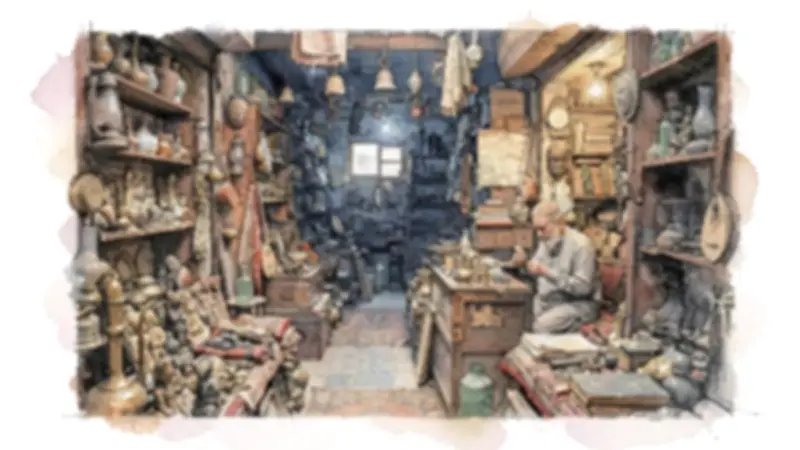
Behind the curtain of hanging roots and shadows stood a decrepit three-room structure which must once have been somebody’s home. Time had gnawed at its walls; plaster peeled away like old parchment, and the wooden doors sighed with exhaustion. Yet inside—ah!—inside lay an astonishing treasure trove. Ancient gramophones stood proudly beside Victorian statues. Dust-covered pianos rested like tired aristocrats. Vintage televisions with swollen backs stared blankly into eternity. Old videos, brass lamps, copper mantelpieces, clocks from distant lands, paintings, porcelain figures, and mysterious mechanical contraptions occupied every conceivable corner. The air carried the intoxicating smell of old wood, metal, paper, and forgotten stories. One almost expected Sherlock Holmes himself to emerge from behind a cupboard carrying a pipe and a complaint about modern civilisation.
As we wandered in amazement, a voice suddenly emerged behind us: “Careful with that gramophone, sir. It is older than our democracy.” We turned around and found a young man, probably in his early twenties, bulky in build yet remarkably agile in manner. He wore antique pendants around his neck, hefty rings on every finger and thumb, and a long Chester coat which gave him the appearance of a philosopher who had accidentally wandered into a rock band.

With an infectious smile he introduced himself. “Hamza,” he said theatrically, extending his hand. “Owner, caretaker, collector, philosopher, unpaid dust cleaner, and occasionally psychologist to confused customers.” My father instantly liked him. Hamza possessed that rare gift of conversation which can make even silence enjoyable. He spoke of antiques not as objects but as living witnesses of vanished worlds. According to him, every item carried a soul, every scratch had history, and every crack was merely “time’s autograph.” He claimed to source his treasures from “all around the world,” though one suspected that at least a few had probably travelled no farther than old Lahore’s storerooms. Yet such suspicions were irrelevant, for the boy narrated stories with such charm that one willingly surrendered disbelief.
Pointing toward an ancient clock, he declared: “This came from England.” “And does it still work?” I asked. “No,” he replied gravely. “But neither does the English Empire.” Even my father burst into laughter. We spent hours there that day—though it felt like minutes. The world outside continued rushing breathlessly toward modernity, but beneath those ancient banyan trees time itself seemed to slow down, sit quietly in an old armchair, and sip tea from cracked porcelain cups.
Reflections on Objects and Lives
As I began to observe those objects more carefully, a strange realisation slowly descended upon me. Those items were not merely old, outdated, discarded things lying aimlessly in dusty corners. No—they were fragments of human lives. Every object there appeared to have once been lovingly chosen, carefully purchased, and passionately preserved by someone somewhere in Europe or America. One could almost feel the emotions attached to them. There was romance in those collections, sentiment hidden beneath layers of dust, and the unmistakable touch of individuals who had spent years—perhaps entire lifetimes—gathering those treasures piece by piece.
There were dozens of porcelain plates delicately mounted inside large wooden frames, each painted with astonishing craftsmanship. Porcelain, plaster of Paris, brass, and copper replicas of legendary figures stood proudly on shelves—Louis Armstrong holding his trumpet with eternal elegance, Elvis Presley frozen in youthful charisma, Marilyn Monroe smiling mysteriously as if she still knew secrets the world had forgotten, Gregory Peck, Elizabeth Taylor, Sophia Loren, Marlon Brando, and many others from that golden age when cinema possessed grace instead of noise. Looking at them, one could almost hear distant jazz music floating through some smoky American café of the 1950s.
Elsewhere stood miniature figurines of Red Indians, African Americans at work, European peasants, hunters, soldiers, and dancers—all sculpted with astonishing intricacy. Their clothes, ornaments, facial expressions, and posture carried such meticulous detail that they appeared alive. Then there were old paintings, woodworks, sculptures, board games, miniature cannons crafted with exquisite brass and wooden detailing, and countless objects whose purpose time itself seemed to have forgotten.
Standing amidst those relics, I suddenly felt overwhelmed by a peculiar sadness. Those were not random objects gathered carelessly by shopkeepers. They were lifelong collections of people who had spent their money, their time, their passion, and perhaps even their loneliness in assembling them. As the old saying goes, “A collector collects not things, but moments.” Every gramophone there must once have played music in somebody’s drawing room; every figurine perhaps stood proudly in some library or fireplace corner; every painting once adorned the wall of a home filled with conversations, laughter, arguments, celebrations, and silence.
An older cousin of mine, who lives in America, once told me something remarkably painful. He said he had often seen military medals, war decorations, family heirlooms, antique watches, and collectible items belonging to deceased individuals being sold casually in garage sales for a few dollars—objects for which their original owners must once have held immense emotional attachment. Hearing that story then had saddened me, but today at this ripe age standing in the same old Hamza’s antique shop I could finally understand its true meaning.
A Personal Story of Discarded Treasures
On a personal note, I have witnessed similar things within my own extended family. There were individuals passionately devoted to art, music, sculpture, sketches, gramophone records, and handmade collections which they gathered patiently over decades. Yet after their passing, their children often disposed of those precious possessions as though they were nothing more than useless junk occupying unnecessary space. Such is the tragedy of time: one generation preserves with devotion what the next generation discards without sentiment.
I particularly remember one distant relative of mine, considerably older than me, who possessed an extraordinary passion for making dioramas. He was such a perfectionist and craftsman that every scene he created looked astonishingly real—miniature worlds crafted with breathtaking accuracy and proportion. His tiny buildings, military encampments, railway stations, bazaars, and landscapes contained such fine detailing that they appeared almost larger than life. He would collect tiny materials from every nook and corner of Lahore and even from foreign countries whenever he travelled. His entire collection was displayed with immense care in a separate room specially designated for his creations.
Then in 2020, during the dark days of the Covid-19 pandemic, he contracted the illness and, after a brief struggle, sadly passed away. What happened afterwards disturbed me profoundly. His son constructed a new modern house, and among the very first things he discarded were those hundreds of painstakingly crafted dioramas—the life’s work of his father. The creations into which an old man had poured decades of patience, imagination, money, and love were simply thrown away as worthless clutter.
The Collector's Journey
The passion induced by my father made me to be one such collector. For as long as I can remember, I have been fascinated by old and unusual objects. Over the decades, and particularly during my military service of nearly thirty years, I gathered an eclectic collection from many corners of the world. While serving with the United Nations in Sierra Leone, Liberia, Ghana, Ivory Coast, Congo, and Tanzania, and during visits to countries such as Malaysia, Singapore, the Maldives, Sri Lanka, Morocco, and Egypt, I returned with pieces that captured the soul of those lands.
My collection includes gramophones and antique records, bayonets and firearms from the First and Second World Wars, Afghan jezails, compasses, hourglasses, masks, puppets, handcrafted wooden sculptures, Buddhas carved in stone and wood, precious stones, miniature artworks, rare coins, postage stamps, and souvenirs from distant shores. Alongside these artifacts stands another collection equally dear to me—my library. It contains books of every genre, including many rare and unique volumes that I have patiently sought and acquired over a lifetime.
Together, these objects transform my study into something resembling a miniature museum. Whenever I sit there, surrounded by these silent companions, I experience a profound sense of accomplishment, gratitude, and joy. Each item reminds me of a particular place, a particular moment, or a particular chapter of my life. They are not merely possessions; they are memories made tangible.
Yet with advancing years, another thought increasingly visits my mind. What will become of all these treasures when I am gone? Will they hold the same significance in the eyes of my children that they hold in mine? Or will they become merely old objects occupying space in a rapidly changing world?
The Changing World and the Fate of Collections
The world of my childhood moved at a gentler pace. We had time to read, to write, to reflect, and to wonder. We listened to stories, devoured books, watched films from beginning to end, and spent endless hours playing under the sun, in the rain, and across open fields. Small things delighted us beyond measure. We valued objects not for their price but for their uniqueness, their craftsmanship, and the memories attached to them. We dreamed of distant mountains, mysterious deserts, and unexplored valleys. We longed to venture beyond the horizon and discover not only the world but ourselves.
Today, however, the world has become a different place. The internet and mobile technology have compressed distances and transformed the globe into a tightly knit village moving at breathtaking speed. The younger generation inhabits a digital universe where information arrives instantly and attention shifts in seconds. Their primary source of entertainment, recreation, and even social interaction is often contained within a single device. Many seem less inclined to spend two hours watching a film or an afternoon reading a book when hundreds of short clips can be consumed within the same time.
And so I find myself pondering the fate of the countless treasures I have collected since I was a teenage boy. Objects that I searched for, paid for, cared for, and preserved with affection over decades of travel and service. Will they one day be passed on to people who see in them only clutter rather than history? Will the stories embedded within them fade into silence? After all, the value of a collection does not lie in the objects themselves but in the heart that assembled them.
As I sit quietly in my study, gazing at these relics of a lifetime, another old proverb comes to mind: "You never know the worth of a thing until it is gone." Perhaps that is the destiny of all collections. Their true value can never be measured in money or rarity, but in the memories, emotions, and dreams they preserve. And perhaps, long after the collector himself has departed, some curious hand may pick up one of these objects and wonder about the man who once treasured it so dearly.
To this day, whenever I pass through Main Market Lahore, the smell of paper, glue, dust, and old wood returns to me with startling clarity. And somewhere in the depths of memory I still see that hidden antique shop, those hanging banyan roots, my father’s fascinated eyes, and Hamza standing amidst his kingdom of forgotten things like the final custodian of a vanishing age. After all, as the old adage goes, “One man’s junk is another man’s history.” And perhaps that is why Hamza’s antique shop affected me so deeply. Because beneath those dusty gramophones and faded statues lay not objects, but abandoned affections. They were silent remains of people who had once loved something deeply—until time moved on and left their passions orphaned behind them.