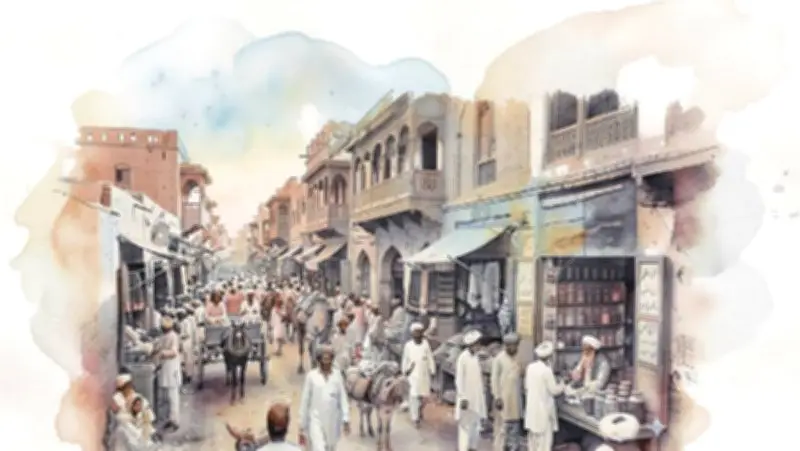
Shikarpur's rich literary, medical, and religious heritage continues to keep alive the memory of its remarkable past. The city produced many eminent religious scholars, spiritual figures, and renowned hakims whose contributions once shaped the intellectual and cultural life of Sindh. Although many of these distinguished personalities are little known to younger generations today, their legacy still survives in old manuscripts, memories, shrines, and historic neighbourhoods of Shikarpur.
One such figure is Maulana Hakim Illahi Bakhsh Awan. Born in Shikarpur city, his father, Ghaus Bakhsh Awan, was a landlord whose ancestors came from Punjab during the reign of the Talpurs. Like the Kalhora period (1700–1783), the Talpur period (1783–1843) also witnessed migration from Punjab and Balochistan. Many tribes from Punjab settled in Sindh after some of their nobles were appointed to important positions at the Talpur court.
Early Education and Religious Inclination
Maulana Hakim Illahi Bakhsh Awan received his early education in Shikarpur. Recognising the importance of modern education, his father later sent him to Sukkur, where he pursued studies in English. He used to stay at Salawatan Wari Masjid in Sukkur, where he also received religious education. However, his heart was drawn to religious learning. According to the Sawaneh Hayyat number of the monthly Shariat (1981, Vol 9, No 1–4), edited by Abdul Wahab Chachar, Maulana Hakim Illahi Bakhsh Awan changed his mind and went to Amrot Sharif. There was a madrasa of Maulana Taj Mahmood Amroti, an eminent religious scholar, freedom fighter, poet, and social reformer.

His father, Wadero Ghaus Bakhsh, was unaware that his son had developed a deep interest in religious learning. When the young boy could no longer be found in Sukkur, where he had been sent for further education, his father began searching for him and eventually learned that he was studying at Amrot Sharif. Determined to bring his son back, Wadero Ghaus Bakhsh travelled to Amrot Sharif. Upon meeting Maulana Taj Mahmood Amroti (d 1929), he expressed his desire to take his son home. The Maulana gently explained to him that the boy showed a much stronger inclination towards religious education, so it would not be wise to force him into learning English if his heart was elsewhere. Recognising the boy's sincerity and deep love for religious learning, the Maulana advised Wadero Ghaus Bakhsh to allow his son to pursue the path he had chosen. Touched by the Maulana’s wisdom, Wadero Ghaus Bakhsh agreed. However, he requested that his son return home for some time.
Further Studies and Mentorship
After returning from Amrot Sharif, Maulana Hakim Illahi Bakhsh spent some time studying under the guidance of Maulana Khalifo Yar Muhammad Qureshi, an eminent religious leader, scholar, and sufi of Shikarpur. His thirst for knowledge, however, remained undiminished. In due course, he returned to Amrot Sharif to continue his advanced studies. It is believed that, on the instructions of Maulana Taj Mahmood Amroti, Maulana Hakim Illahi Bakhsh Awan went to Darul Uloom Deoband for further studies. He also greatly benefited from Maulana Ashraf Ali Thanvi (d 1943) and remained under his guidance for some time.
Maulana Hakim Illahi Bakhsh continued to learn from different scholars. His interest also developed in Unani medicine when he studied under Maulana Khalifo Yar Muhammad, who was also a hakim. Maulana Hakim Illahi Bakhsh Awan was admitted to Delhi's famous Tibbia College to pursue his education in traditional medicine. This college was founded in 1882 by Hakim Ajmal Khan (d 1927). Maulana Hakim Illahi Bakhsh studied for five years at Tibbia College and remained under the supervision of Hakim Ajmal Khan. During his stay in Delhi, he also greatly benefited from Hakim Abdul Wahab. Hakim Abdul Wahab was a renowned Unani physician who became widely known as Hakim Nabina or Nabina Sahib because he was blind. Despite his visual impairment, he distinguished himself through his exceptional intellect, dedication, and mastery of medicine. His reputation as a skilled and compassionate healer spread far and wide, leading him to practise in several prominent cities, including Hyderabad, Poona, Bombay, and Delhi, where he earned the respect of both patients and fellow practitioners.

Return to Shikarpur and Medical Practice
After learning from great scholars and hakims, Maulana Illahi Bakhsh Awan returned to Shikarpur. With Maulana Taj Mahmood Amroti's advice, Maulana Hakim Illahi Bakhsh Awan opened the Dawakhano, known as Dawakhano Ashrafia in Shikarpur. According to Abdul Wahab Chachar (1981), the editor of the monthly Shariat, Maulana Taj Mahmood Amroti inaugurated this Dawakhana (clinic). On this occasion, Qari Sher Muhammad Shah of Ghotki and Maulana Ghulam Muhammad Dinpuri were also present. Maulana Hakim Illahi Bakhsh Awan continued to teach, lead prayers at the mosque in his mohalla, and practise Unani medicine at his clinic. His Dawakhano was known far and wide. Several other dawakhanas were also operating in Shikarpur.
Family and Legacy
Maulana Hakim Illahi Bakhsh Awan had two brothers, Wadero Hussain Bakhsh and Bashir Ahmad. Maulana Illahi Bakhsh had one son, Khurshid, and one daughter. However, according to Maulana Naeemullah Qureshi, whom I interviewed, Maulana Hakim Illahi Bakhsh had two daughters. One was married to Maqbool Ahmed Awan and the other to Nazeer Ahmad Awan, both of Awan Mohalla in Hathidar, Shikarpur. Maulana Illahi Bakhsh Awan also had three sisters. Maulana Hakim Illahi Bakhsh died in 1964 and was buried in a graveyard on Mukhtiarkari Road in Shikarpur. There are five graves on a common platform. On his left is buried his son Khurshid Ahmad alias Mama Ishan (d 2023). On his right are buried Nazir Ahmad Awan, son of Pir Muhammad Awan; Noor Jehan, wife of Molvi Illahi Bakhsh Awan; and Abdul Karim, son of Wadero Abdul Ghafoor.
It is important to write more about his life and contributions. One of the articles he wrote about his spiritual mentor, Maulana Khalifo Yar Muhammad, was published in the Sawaneh Hayyat number (1957) of the Quarterly Mehran. However, there may be additional writings that I am not aware of. He likely had valuable insights on traditional medicine that have yet to be published. His contributions deserve recognition and sharing. His work on religion, medicine, and literature should be highlighted and published. Further research into his life and contributions is certainly needed.