Washington - Talks with mediators are underway to reorganize the first round of technical negotiations between Washington and Tehran, an Iranian Foreign Ministry spokesperson said Friday. Tehran pulled out of the talks, which were originally expected to get underway in Switzerland this weekend, following renewed fighting between Israel and the Iran-backed militant group Hezbollah, which threatened to derail the diplomatic efforts.
Spokesperson Esmaeil Baghaei told reporters the next round of talks was no longer as urgent because a memorandum of understanding with the US has already been digitally signed, according to a statement posted on the Iranian Foreign Ministry’s Telegram channel. The statement said further negotiations can only begin once some of the key components from the 14-point US-Iran agreement are met.
These include ending the conflict in Lebanon, lifting the US blockade on Iranian ports, allowing vessels to safely pass through the Strait of Hormuz without any charges, terminating Iran’s sanctions and unfreezing its assets, according to Baghaei.

The Foreign Ministry also denied reports that Iran had invited the United Nations’ nuclear watchdog, the International Atomic Energy Agency (IAEA), to inspect all of its nuclear facilities. The ministry said the IAEA will not be invited to nuclear sites that were attacked by the US and Israel but can continue to monitor other sites, like Bushehr in south Iran.
Pakistan's Mediation Role
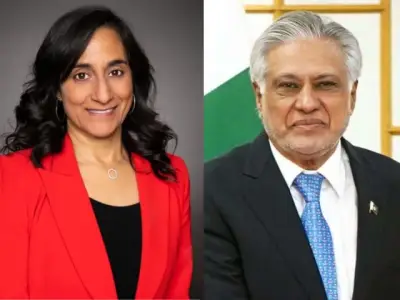
Pakistan’s Foreign Minister Ishaq Dar Friday spoke with Foreign Minister of Iran, Seyed Abbas Araghchi and the two leaders exchanged views on regional developments and highlighted the ceasefire violations conducted by Israel in Lebanon, expressing serious concern over the situation. Dar felicitated the leadership, government, and people of the Islamic Republic of Iran on the signing of the historic “Islamabad Memorandum of Understanding” with the United States. He also conveyed his best wishes for the commencement of the next phase of negotiations, expressing hope that the process would move smoothly and yield positive outcomes.
FM Araghchi expressed gratitude for Pakistan’s constructive and sustained mediation efforts. FM Araghchi also thanked Dar for Pakistan’s facilitation in the repatriation of thirty (30) Iranian nationals, including 8 fishermen rescued at sea by the United Kingdom and 22 crew members recently interdicted by the United States. The transit arrangements of whom are currently being coordinated by Pakistan. Both sides agreed on the importance of continued engagement and agreed to remain in close contact.
Trump's Stance and Ceasefire Efforts
In Washington, President Donald Trump lashed out once again in the midst of the intensified fighting in Lebanon and the stalled nuclear talks. “We didn’t meet out of desperation, Iran did,” Trump wrote in a social media post Friday. “They are FINISHED! We’ll play out the 60 days. They get no money, not ten cents!” US President Trump tells NBC News in a phone interview that he spoke with Israel and asked it to agree to a ceasefire with the Iranian-backed terrorist group Hezbollah. “You just gotta calm down sometimes and use your head,” Trump is quoted as saying on X by an NBC reporter, who adds that Trump declined to specify whether he spoke with Prime Minister Benjamin Netanyahu directly.
Israeli airstrikes and bombardments killed at least 47 people and wounded 97 others in Lebanon on Friday, according to the latest updated toll from the Lebanese health ministry. The dead included at least seven women and two children and the figures — which do not differentiate between civilians and combatants — are released amid a new ceasefire between Israel and Hezbollah. Israel and the Iranian-backed Hezbollah militant group agreed Friday to halt the heavy fighting in southern Lebanon that had threatened to unravel an interim agreement between the United States and Iran to end their war, officials said. Neither Israel nor Hezbollah immediately confirmed the truce.
It came after a heavy exchange of fire killed 47 people in Lebanon and four Israeli soldiers. Hezbollah and Israel went to war shortly after the outbreak of the wider conflict, with Hezbollah firing rockets and drones at civilian communities in northern Israel and Israel seizing large swaths of southern Lebanon.

Interim Deal and Nuclear Talks
The interim agreement to end the Iran war has already reopened the Strait of Hormuz, which Iran effectively closed, cutting the global economy off from significant supplies of oil and natural gas. The deal would also relaunch talks on Iran’s nuclear program, the core issue over which Israel and the U.S. began the war on Feb. 28. But the accord already faces threats, chiefly from Lebanon, with the fighting there leading to a delay in the start of talks planned for Friday in Switzerland. The agreement calls for a halt to military operations in Lebanon and for its sovereignty to be respected. Neither Israel nor Hezbollah is a party to the deal.
Israeli Prime Minister Benjamin Netanyahu has vowed to keep Israeli forces in southern Lebanon until the threat is eliminated. Hezbollah has refused to halt its attacks unless Israel commits to withdrawing from Lebanon, which Iran says is also a condition of the deal. Iranian officials did not travel as planned to Switzerland, insisting that the fighting in Lebanon must stop before the talks can take place, according to the two regional officials, an Iranian official and a fourth person familiar with the matter who spoke on condition of anonymity to discuss sensitive conversations behind the scenes. U.S. Vice President JD Vance also postponed his trip.
The future talks are supposed to bring about a permanent end to the conflict. On Friday, Iranian Foreign Ministry spokesperson Esmaeil Baghaei said consultations through mediators were ongoing regarding the next phase of negotiations to draft a final agreement. Because the initial deal was signed digitally earlier this week, the talks in Switzerland were not urgent, and plans were underway to hold a meeting in the coming days, he said.
The discussions in Switzerland were expected to focus on Iran’s nuclear program. Tehran maintains it is peaceful, though it has highly enriched uranium that could be used to build multiple atomic bombs, should it choose to do so, according to the International Atomic Energy Agency. Those talks are expected to be difficult. The 2015 nuclear deal, which Trump scrapped during his first term, took more than 18 months to negotiate.
The interim deal gives negotiators 60 days to come up with a nuclear agreement, but that can be extended. It outlines lucrative incentives if Iran does reach a new agreement, including the eventual lifting of all international sanctions and a $300 billion fund for postwar reconstruction. Already Iran has won some concessions. Following the signing of the interim deal, the U.S. lifted its blockade of Iran’s ports and is allowing it to sell its oil freely. The deal also calls for Iran’s assets to be unfrozen — though it’s not clear how quickly.