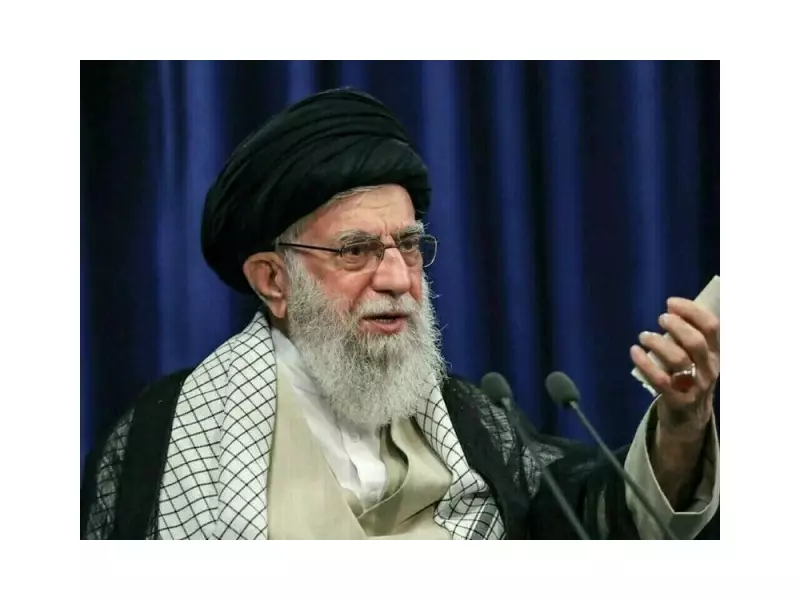
Iran's Supreme Leader, Ayatollah Ali Khamenei, has publicly recognized the economic frustrations driving widespread protests across the country, even as he issued a stern warning against those he labeled as "rioters." The demonstrations, which began over economic hardships, have now expanded to include political demands and have resulted in several deaths.
Economic Grievances and a Stern Warning
In a speech marking a Shiite holiday on Saturday, Ayatollah Khamenei stated that the economic demands of the protesters were "completely fair." He acknowledged the struggles of shopkeepers and citizens in a nation battered by international sanctions. The Supreme Leader confirmed that President Ebrahim Raisi and other high-ranking officials are actively working to resolve the country's economic difficulties.
However, Khamenei drew a sharp line between peaceful protesters and those he accused of causing chaos. He emphasized that while dialogue with protesters is necessary, it is "useless to have dialogue with rioters." He declared that such individuals must be "put in their place," signaling a firm stance against any actions perceived as destabilizing.

Escalation and Casualties
The protests, which ignited on Sunday primarily over soaring prices and economic stagnation, have rapidly spread. According to an AFP tally based on local media reports, demonstrations have been recorded in at least 25 cities, with significant activity in mid-sized urban centers in Iran's west and southwest.
The situation has turned violent, leading to casualties. Official figures confirm that at least eight people have been killed since the protests began. The first deaths were reported on Thursday following clashes between demonstrators and authorities.
On Saturday, the Mehr news agency reported that a member of the Basij, a volunteer paramilitary force overseen by the Islamic Revolutionary Guard Corps (IRGC), was killed. Ali Azizi was "martyred after being stabbed and shot" in the city of Harsin in western Iran during what authorities described as a gathering of "armed rioters."
In a separate incident, the Tasnim news agency reported a man was killed in the holy city of Qom on Friday when a grenade he was allegedly attempting to use exploded in his hands.
Protests Take a Political Turn
What started as an economic movement has increasingly adopted political overtones. In Karaj, near the capital Tehran, protesters were reported to have burned the Iranian flag while chanting slogans such as "Death to the dictator!" and referencing the return of the exiled Pahlavi monarchy, which was overthrown in the 1979 Islamic Revolution.
Despite reports of gatherings in several working-class neighborhoods of Tehran on Friday, the capital appeared calm on Saturday, a public holiday, with streets largely empty due to rainy and snowy weather.
Authorities have maintained a dual-track response: expressing sympathy for economic complaints while promising a harsh crackdown on any actions deemed seditious or violent. This approach mirrors strategies used during previous waves of nationwide protests in 2019 and 2022, though the current demonstrations are assessed to be smaller in scale than the massive unrest triggered by the death of Mahsa Amini last year.
State media continues to downplay the coverage of the protests, while a flood of videos on social media remains difficult to independently verify, creating a fragmented picture of the ongoing situation across Iran.