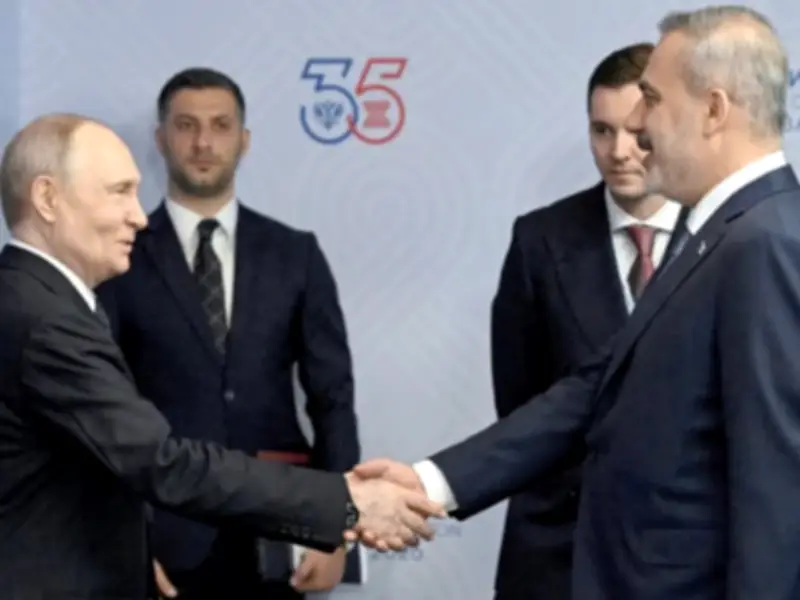
KAZAN: Russian President Vladimir Putin began welcoming Southeast Asian leaders to a summit in the central Russian city of Kazan on Wednesday, as the West pressures Moscow to end its Ukraine offensive. Putin has sought to deepen political and economic ties with Asia during Moscow's more than four-year full-scale offensive against Ukraine.
Summit Details
The summit in the capital of Tatarstan, around 700 kilometres (435 miles) east of Moscow, comes as the G7 meets in France with its focus on ending the Ukraine and Middle East wars. Representatives of 11 countries in the Association of Southeast Asian Nations arrived in Kazan ahead of Thursday's main business summit. It commemorates 35 years of collaboration between Russia and the ASEAN countries, the Kremlin said.
Delegations
Thailand, Vietnam, Cambodia, Laos, Malaysia and Singapore are sending their prime ministers, while the Philippines will be represented by President Ferdinand Marcos. Myanmar -- which held a coup in 2021 and has close ties to Moscow -- will also send a delegation.

Moscow said the leaders will exchange views on global and regional problems while strengthening Russia-ASEAN ties in security, trade, investment and humanitarian cooperation. Facing giant Western sanctions over its Ukraine offensive, Moscow has reoriented its economy -- especially oil exports -- towards Asia.
Bilateral Meetings
Wednesday saw Putin meet with Marcos, who invited his host to Manila in November and told him he wished to deepen energy links with Moscow. Putin also met with the Sultan of Brunei, Hassanal Bolkiah, who was accompanied by his son Abdul Mateen, foreign minister as well as enjoying a sizable following on Instagram. During those talks Putin said the strategic partnership between Russia and the ASEAN is a key stabilising factor in the Asia-Pacific region.
Energy and Sanctions
The Russian leader's economic and international affairs advisor Kirill Dmitriev told reporters that only Russia is in a position to resolve the energy problems of Asian states. All the ASEAN states have realised that sanctions do not work -- and they particularly realised that when they were confronted by the serious energy provision problems which arose in the wake of the US-Israel war on Iran, Dmitriev said.
Russia's economy -- on a war footing for four years -- is struggling with high inflation, a labour shortage and high borrowing costs. The advance of forces on the Ukrainian battlefield has slowed this year while Kyiv has multiplied attacks on Russian soil, including Tatarstan.
G7 Developments
At the G7 in France, US President Donald Trump said Moscow should make a deal to end the Ukraine war, as he met Ukrainian leader Volodymyr Zelensky. Trump also said Washington will soon be able to reimpose sanctions against Russian oil. Soon we will be able to do that as the oil is now flowing through the Strait of Hormuz after the deal with Iran to end the Middle East war, Trump said. Washington had imposed and then extended a sanctions waiver for Russian oil cargoes already at sea, troubling European allies.
Putin has repeatedly refused offers for face-to-face talks with Zelensky, insisting that Moscow intends to capture Ukraine's eastern Donbas region by force. The Russian leader, 73, ordered a full-scale military attack on Ukraine in February 2022, which has since turned into Europe's worst conflict since WWII.