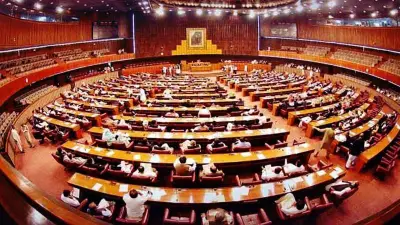
ISLAMABAD: As tax exemptions for the merged tribal districts are set to expire at the end of the month, the government on Friday moved to reassure the opposition that it would seek an extension from the International Monetary Fund (IMF), while both sides also used a rare face-to-face meeting to discuss broader political dialogue and democratic engagement.
The breakthrough came after senior government and PTI leaders met at Parliament House following concerns raised by the opposition in the National Assembly over the impending expiry of tax waivers for the erstwhile Fata and Pata regions. The government said it would take up the matter with the IMF, while PTI signalled its willingness to engage in dialogue and even consider a broader democratic charter.
Speaking to reporters after the meeting, Prime Minister's Adviser on Political Affairs Rana Sanaullah said Finance Minister Muhammad Aurangzeb had assured the opposition that efforts would be made to secure an extension of the tax exemptions. "The finance minister has promised [the opposition] that he will seek to extend these exemptions after speaking with the IMF, and God-willing, will make efforts for it," Sanaullah said.

The meeting took place in Aurangzeb's chamber and was attended by Minister for Kashmir Affairs and Gilgit-Baltistan Amir Muqam from the government side, while PTI leaders Asad Qaiser, Junaid Akbar and party MNAs from the erstwhile tribal districts represented the opposition.
Sanaullah said PTI lawmakers had raised the issue of the tax exemptions before Prime Minister Shehbaz Sharif during proceedings of the National Assembly earlier in the day, prompting the premier to direct him, Aurangzeb and Amir Muqam to immediately engage with the opposition. According to Sanaullah, Muqam had already been actively pursuing the matter and the government remained hopeful that the exemptions could be extended after taking the IMF into confidence.
Apart from the tax issue, the meeting also touched on the broader political environment, with Sanaullah stressing that dialogue remained essential to democratic politics. "This is the foundation of democracy," he said. Referring to Prime Minister Shehbaz Sharif's standing offer for negotiations and a proposed "Charter of Pakistan", Sanaullah urged the opposition to engage. "That offer should be accepted. You should hold a dialogue with the prime minister. You can discuss any issue you want to. He is willing to listen and discuss any subject," the adviser said.
Describing the opposition's response as encouraging, Sanaullah said PTI representatives informed the government that consultations were underway within the party and that a decision would be reached soon. He also appreciated the opposition's support for a unanimously adopted National Assembly resolution earlier in the day, which praised Pakistan's leadership for its role in facilitating the recent US-Iran peace agreement.
Commenting on PTI founder Imran Khan's health, Sanaullah said the former prime minister, who is undergoing treatment for an eye ailment while incarcerated at Rawalpindi's Adiala Jail, was receiving the "best treatment available in Pakistan". He added that Khan remained in judicial custody and that any release could only come through the courts.
Turning to the situation in Azad Jammu and Kashmir, Sanaullah said the "heinous conspiracy to create agitation and interrupt the freedom movement for a free [occupied] Kashmir has been brought under control". He expressed hope that the "slight interruption in supply [chains]" would be resolved within a week.
PTI's response
Speaking after the meeting, PTI leader Asad Qaiser welcomed the prospect of democratic engagement and said his party was prepared to support a broader political understanding. "We are ready for talks at all times for true democracy," he said.
Qaiser said PTI would be willing to sign a "Charter of Democracy", provided it guaranteed equal political rights and institutional independence. "There should be no [political] vendetta against anyone, the judiciary should be independent and the parliament should be strengthened," he said.

He confirmed that both sides had also discussed the proposed federal budget and conveyed their concerns directly to the finance minister. Among those concerns, he highlighted a proposed tax on tobacco and warned that certain fiscal measures could further damage economic activity at a time when trade with Afghanistan remained suspended. He said some of the proposed steps would "ruin whatever economy is left".
Responding to a question, Qaiser noted that the engagement had not been initiated by one side alone. The meeting, he said, was held at the desire of both the government and the opposition.