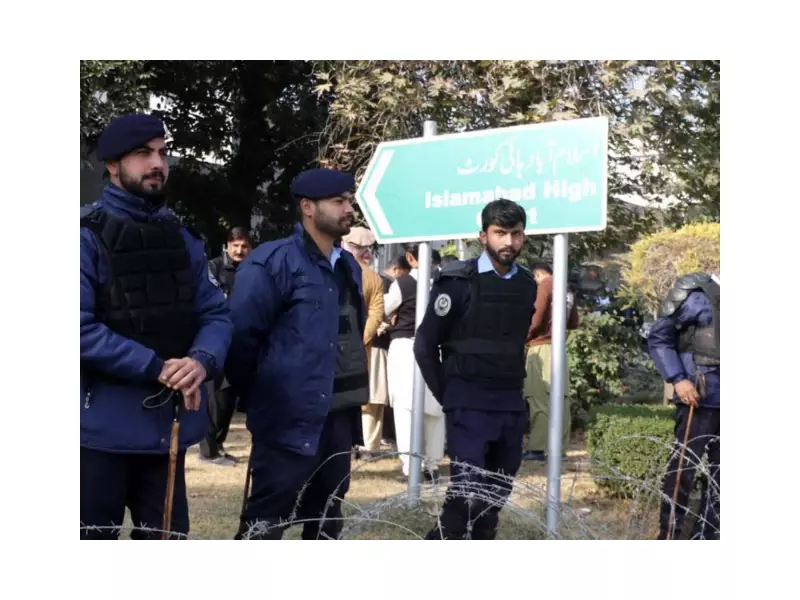
The Islamabad High Court (IHC) has issued a significant order, temporarily halting the government's ongoing drive to deport Afghan refugees and other undocumented foreigners. The court has directed the relevant federal ministry to present a clear, reasoned policy decision on the matter within one month.
Court Demands Clarity from Federal Government
Justice Babar Sattar of the IHC presided over the hearing of multiple petitions challenging the deportation campaign. The court expressed serious concerns about the process, questioning the legal basis and the mechanisms used to classify individuals as "illegal." A central demand from the bench was for the Ministry of States and Frontier Regions (SAFRON) to formally articulate and present its policy regarding the status and treatment of Afghan nationals residing in Pakistan.
The court has granted SAFRON a period of one month to deliberate and finalize its official stance. This order effectively puts a pause on the large-scale expulsion of Afghan refugees until the government can provide a transparent and legally sound framework for its actions. The bench emphasized that any state action, especially one impacting the lives of hundreds of thousands, must be grounded in established law and procedure.

Legal Scrutiny of the Deportation Process
During the proceedings, the petitioners' lawyers argued that the government's campaign was being executed in a haphazard and arbitrary manner. They contended that it failed to distinguish between various categories of Afghan nationals, including those with legitimate claims to asylum, registered refugees, and individuals with pending legal applications. The court scrutinized the government's authority to declare entire groups as "illegal immigrants" without individual assessment.
The IHC also sought details on the implementation mechanism of the deportation plan and the specific legal provisions under which the federal cabinet had approved the action. This line of questioning underscores the judiciary's intent to ensure that executive authority is exercised within constitutional bounds and with due regard for fundamental rights.
Implications and Next Steps
The court's intervention provides a critical respite for the Afghan refugee community in Pakistan, which has been living under a cloud of fear and uncertainty since the deportation deadline was announced. The one-month window allows for more structured legal arguments to be presented and for the government to potentially refine its approach.
This ruling places the ball firmly in the government's court. SAFRON now faces the task of formulating a comprehensive policy that can withstand judicial scrutiny. The outcome of this process will have profound implications for Pakistan's domestic policy, its international humanitarian obligations, and its diplomatic relations with Afghanistan and global watchdogs. The next hearing is expected after the expiry of the one-month deadline, where the government's submitted policy will be examined.