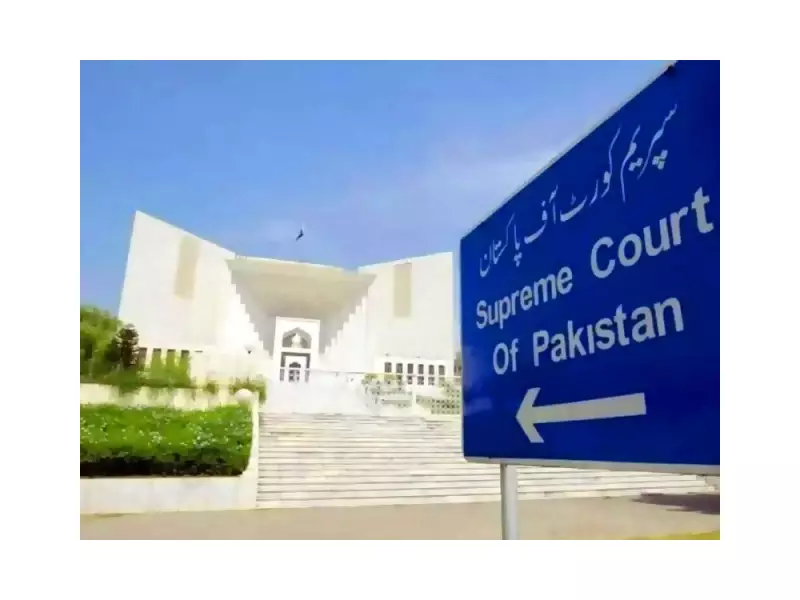
In a significant ruling that clarifies procedural law in Pakistan, the Supreme Court has provided crucial guidance on handling duplicate lawsuits filed on the same legal grounds.
Court's Clear Stance on Duplicate Litigation
The apex court has authoritatively stated that when legal proceedings are already active in an earlier case, any subsequent lawsuit based on the same cause of action can be dismissed under Order II Rule 2 of the Civil Procedure Code (CPC). This clarification comes as a landmark decision that streamlines civil litigation processes across the country.
Evidence Recording Not Mandatory
In what legal experts are calling a progressive interpretation, the two-member bench comprising Chief Justice Aamir Farooq and Justice Ali Baqar Najafi established that courts don't need to wait for evidence recording to determine whether two suits share the same cause of action.

The court emphasized that the pleadings from both lawsuits provide sufficient material for judges to ascertain whether the cases originate from identical legal grounds or represent distinct matters. This approach prevents unnecessary delays in the judicial process while maintaining fairness.
Case Details and Broader Implications
The verdict was delivered in case CPLA 3055/2023, where the bench examined the application of Order II Rule 2 of CPC. This ruling is expected to have far-reaching consequences for how civil courts across Pakistan handle multiple lawsuits stemming from similar circumstances.
Legal practitioners welcome this clarification as it provides clearer guidelines for determining when subsequent lawsuits should be dismissed as duplicative. The decision reinforces the principle that the judicial system should not entertain multiple cases on the same subject matter, thereby conserving court resources and preventing conflicting judgments.
This ruling particularly benefits defendants who might otherwise face prolonged litigation from repeated lawsuits on identical issues. It establishes that once the pleadings demonstrate overlapping causes of action, courts can promptly dispose of subsequent cases without going through the entire evidence recording process.