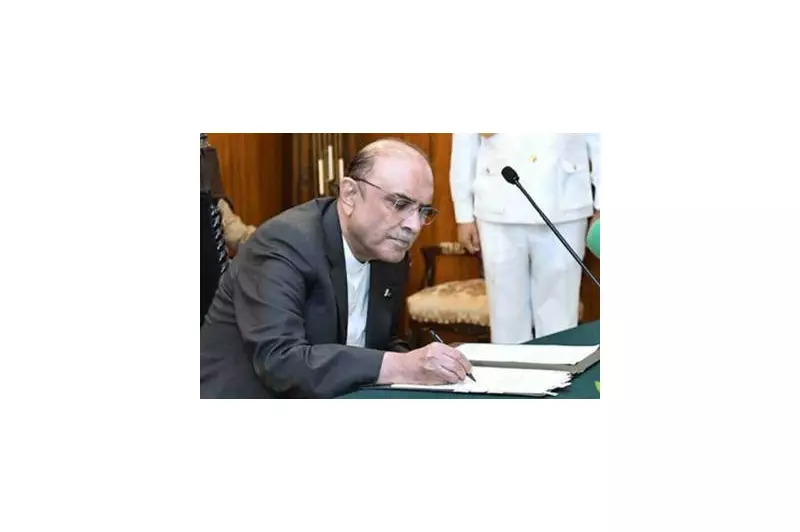
President Asif Ali Zardari has formally approved several crucial pieces of legislation, enacting them into law following their passage through Parliament. The presidential assent was given on Wednesday on the advice of Prime Minister Shehbaz Sharif.
Three Key Bills Receive Presidential Assent
The head of state signed the Qanun-e-Shahadat (Law of Evidence) (Amendment) Bill, 2025 into law. This legislation updates the longstanding rules governing evidence in Pakistani courts, a move legal experts anticipate will modernize judicial proceedings.
Furthermore, President Zardari approved the King Hamad University of Nursing and Associated Medical Sciences Bill, 2025. This law paves the way for the establishment of a specialized institution aimed at enhancing the country's healthcare education and addressing critical shortages in the nursing and medical fields.

In a significant step for religious communities, the President also assented to the National Commission for Minorities Rights Bill, 2025. The core objective of this bill is to protect, empower, and develop religious minority communities across Pakistan through a structured framework and various nationwide measures.
One Bill Returned for Reconsideration
However, not all proposed legislation received immediate approval. President Zardari opted to return the Daanish Schools Authority Bill, 2025 to Prime Minister Shehbaz Sharif for reconsideration. This decision was made in light of the need for broader consultation with provincial governments.
In his observations accompanying the returned bill, the President emphasized that prior consultation with the relevant provincial governments was inevitable for any plan to establish Daanish Schools within the provinces. This move underscores the importance of federal-provincial harmony and constitutional process in educational initiatives.
Implications and Next Steps
The enactment of the three bills marks a concrete step in the government's legislative agenda for the year. The evidence law amendment is expected to impact the judicial system, while the nursing university bill addresses vital human resource needs in healthcare. The minorities' rights commission establishes a permanent body to safeguard the interests of minority communities, a long-standing demand.
The return of the Daanish Schools bill indicates that the federal government will need to engage further with provincial stakeholders before the proposed authority can be established. This process highlights the collaborative nature of governance required for projects with inter-provincial dimensions.
All these actions took place on Wednesday, following the standard constitutional procedure where the President acts on the advice of the Prime Minister after bills have been passed by both the National Assembly and the Senate.