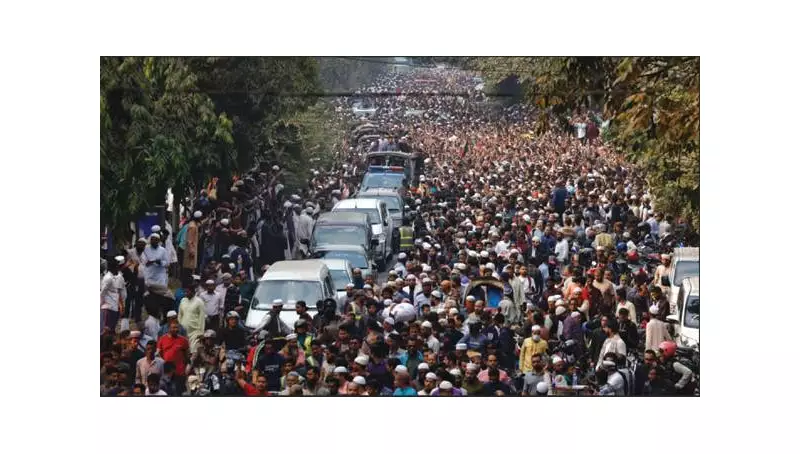
Tens of thousands of mourners flooded the streets of Dhaka on Saturday for the emotionally charged funeral of a prominent student leader, Sharif Osman Hadi. The massive gathering occurred under a heavy security blanket following two days of intense protests and violent incidents that have shaken the nation.
A Nation in Mourning
The funeral procession for Sharif Osman Hadi, a central figure in last year's pro-democracy movement, drew massive crowds who came to pay their final respects. Hadi, 32, was shot by masked assailants last week as he left a mosque in Dhaka. He was later transferred to a hospital in Singapore, where he succumbed to his injuries on Thursday.
Interim leader Muhammad Yunus addressed the solemn crowd in front of the parliament building, where funeral prayers were held. "You are in our hearts and you will remain in the heart of all Bangladeshis as long as the country exists," Yunus stated in a heartfelt speech. The government declared a day of state mourning, with flags flying at half-mast. Police officers equipped with body cameras were deployed extensively in the area. Hadi was finally laid to rest at the central mosque of Dhaka University.

Political Tensions and Violence Erupt
Hadi was known as a vocal critic of India, where Bangladesh's ousted Prime Minister, Sheikh Hasina, sought refuge after fleeing Dhaka during the 2024 uprising. His death has acted as a catalyst for widespread unrest, with protesters across the South Asian country demanding the immediate arrest of his killers. Bangladeshi police confirmed they have launched a manhunt but have reported no significant progress yet.
Iqbal Hossain Saikot, a 34-year-old government employee who traveled to Dhaka for the funeral, told AFP he believed Hadi was targeted due to his staunch opposition to India. "The millions of Bangladeshi people who love the land and its sovereign territory will carry on Hadi's legacy," Saikot said.
The violence escalated following news of Hadi's death on Thursday. Enraged mobs set fire to several buildings in the capital, including the offices of leading newspapers Prothom Alo and the Daily Star, which critics accuse of favoring India. Cultural institutions and a former minister's residence were also attacked.
Broader Implications and Condemnation
The unrest, fueled partly by rising anti-India sentiment in the majority-Muslim nation, turned deadly in other instances. A Hindu garment worker, Dipu Chandra Das, was killed in the central district of Mymensingh on Thursday following blasphemy allegations. Interim leader Yunus stated that seven suspects had been arrested in connection with Das's killing.
Rights group Amnesty International expressed alarm over what it termed Das's "lynching" and urged Bangladesh's interim government to conduct prompt and impartial investigations into both Hadi's assassination and the subsequent violence.
Political parties across the spectrum have condemned the violence, expressing deep concern over public order and security ahead of the February general elections—the first since Sheikh Hasina's autocratic government was ousted. The Bangladesh Nationalist Party accused a "long-identified group," an apparent reference to Hasina's now-banned Awami League, of trying to push the country into anarchy. Nahid Islam, convener of the National Citizen Party, criticized the government for failing to control rogue elements.
The tragic events have cast a long shadow over Bangladesh's fragile political landscape, highlighting the severe challenges facing the interim administration as it prepares for pivotal elections.