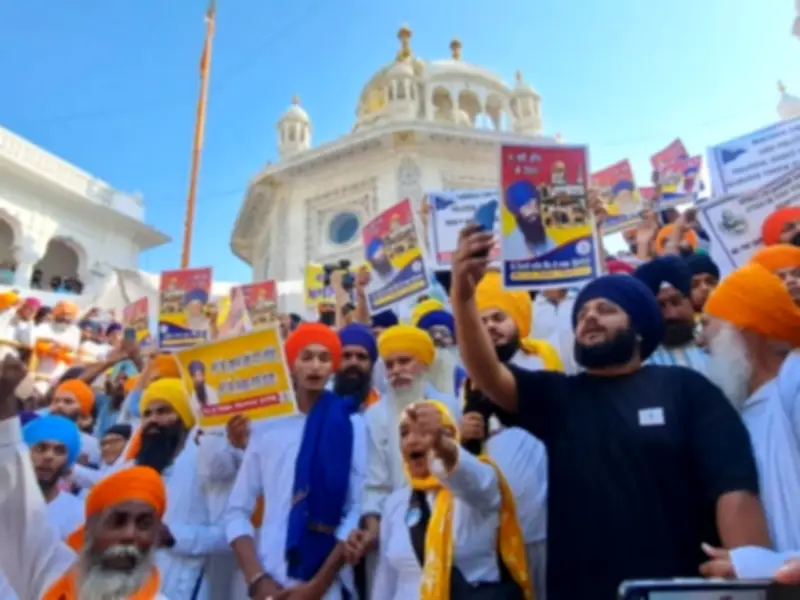
Forty-two years after Operation Blue Star, the memory of the assault on the Golden Temple remains vivid in the Sikh consciousness. The trauma has traveled from Amritsar to Sikh diaspora centers in London, Toronto, California, Melbourne, and beyond. Although Indian military fire damaged the Akal Takht, Sikh political consciousness emerged stronger from the ruins.
The Assault on the Akal Takht
Ordered by then Prime Minister Indira Gandhi, Operation Blue Star was not a routine military action but a full-scale armed assault on the spiritual and political heart of the Sikh nation. Led by Major General Kuldip Singh Brar, the operation involved tanks, artillery, and multiple battalions, representing a brutal overkill against armed Sikh separatists inside the complex. In June 1984, the Indian state sent tanks into the Akal Takht and simultaneously attacked 41 other gurdwaras across Punjab.
Casualties and Massacre
While official figures claim 493 deaths, independent accounts and groups like Ensaaf reveal that between 3,000 and 8,000 or more civilians, including women and children pilgrims, were killed through summary executions, artillery barrages, and point-blank shootings. Sikhs remember the event as a desecration, betrayal, and state violence against their sacred identity.

Martyrs and Resistance
The killing of Sant Jarnail Singh Bhindranwale, Bhai Amrik Singh, and Major General Shabeg Singh turned the operation into a permanent chapter of Sikh resistance. India awarded soldiers for the assault, which Sikhs see as a deep wound on their faith and a moral indictment of the Indian state. The operation triggered a crisis of conscience, sparking spontaneous mutinies among thousands of Sikh soldiers, including 1,461 at Ramgarh, exposing deep alienation within the Indian Army.
The Demand for Khalistan
Khalistan is the political response to repeated betrayal, denied justice, and state hostility. India urges Sikhs to move on, but Sikhs ask: move on from what, when the state has never answered for June 1984? The anniversary highlights how the Brahmin-dominated Indian polity and armed forces have disrespected the religious sites of minorities. This intolerance led to Indira Gandhi's assassination by her Sikh bodyguards.
Continued Oppression and Referendums
India's tactic of using Sikhs against Sikhs — arming pro-regime elements, police, and informants — began during Blue Star and continues today, with every dissenting Sikh voice labeled a terrorist. Massive Khalistan referendums in 2025-2026, recording over 53,000 votes in Ottawa (November 2025), over 35,000 in Los Angeles, 27,000 in Seattle (March 2026), and thousands more in Washington DC and elsewhere, reflect a strong rejection of Indian oppression. Sikhs for Justice's campaign is advancing toward the United Nations in 2026.
International Community's Role
The international community can no longer remain silent. The demand for a separate Khalistan, where Sikhs can live free from Indian oppression, has grown stronger. As a fighter nation, Sikhs are pursuing Khalistan democratically through worldwide referendums organized by Sikhs for Justice, despite sharp Indian reactions. The international community has a moral obligation to support them, as it did for East Timor and South Sudan.
Leaders of the Movement
Jarnail Singh Bhindranwale, fiery Jathedar of Damdami Taksal, emerged as a defender of the Sikh faith and rights. He advocated strict orthodoxy, backed the Anandpur Sahib Resolution for autonomy, and led the Dharam Yudh Morcha, stating he was 'neither for nor against' Khalistan. Major General Shabeg Singh, a decorated hero with PVSM and AVSM, symbolized betrayal. A veteran of World War II and the 1947, 1962, and 1965 wars, and architect of the Mukti Bahini's 1971 success, he was dismissed on false charges before retirement.
Operation Blue Star was not counter-terrorism but a calculated desecration and massacre that martyred Bhindranwale and Shabeg Singh. It radicalized Sikhs and stained India's soul with innocent blood. The wounds remain raw, and the hypocrisy unforgivable.