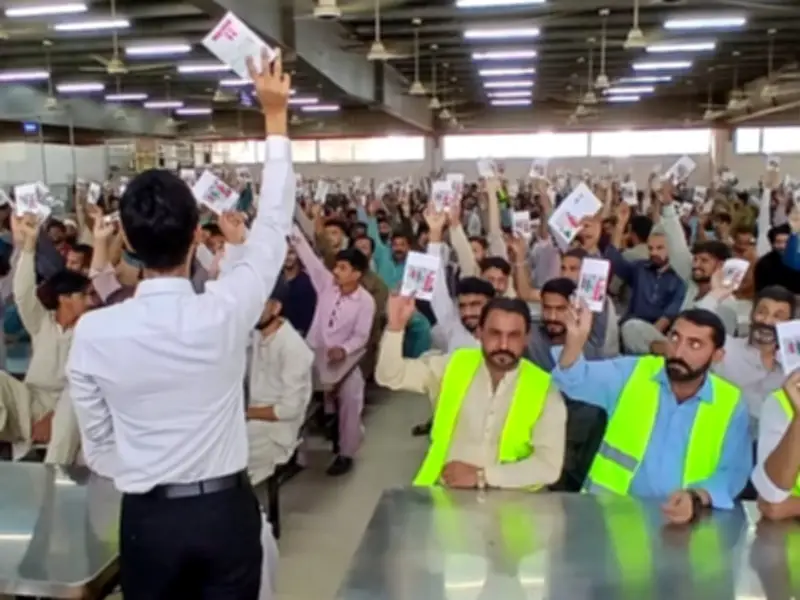
Pakistan has joined the global drive towards sustainable manufacturing by becoming only the third country to establish a national chapter of the Apparel and Textile Transformation Initiative (ATTI). Industry leaders say the move could strengthen export competitiveness, attract climate finance and improve access to international markets. However, manufacturers warn that international recognition must be matched with domestic policy reforms, noting that outdated industrial estate regulations continue to discourage investment and limit the sector's export potential.
PRGMEA commits to ATTI national chapter
The Pakistan Readymade Garments Manufacturers and Exporters Association (PRGMEA) has formally committed to establishing the Pakistan National Chapter of ATTI, a global manufacturer-led platform jointly launched by the International Apparel Federation (IAF) and the International Textile Manufacturers Federation (ITMF). Under the collaboration, the association will develop a Pakistan Transformation Plan focusing on decarbonisation, energy efficiency, water stewardship, climate finance, resource efficiency and sustainable manufacturing. The initiative is expected to provide technical support, particularly to small and medium-sized enterprises (SMEs), while helping exporters meet increasingly stringent environmental and compliance requirements of international buyers. Pakistan is the third country to join the initiative after Bangladesh and Turkiye.
Announcement during London Climate Action Week 2026
The announcement was made during London Climate Action Week 2026, where manufacturers, global brands, investors and development partners discussed climate finance and sustainable transformation of the apparel sector. Dr Muhammad Ayyaz Uddin, convener of PRGMEA's Decarbonisation Committee, said joining ATTI marks an important milestone that will accelerate sustainability efforts and strengthen collaboration across the industry. PRGMEA North Zone Chairman Imran Salahuddin said the partnership would improve the competitiveness of Pakistani manufacturers by promoting innovation and practical decarbonisation solutions, enhancing the country's standing as a preferred global sourcing destination. PRGMEA has maintained close ties with the IAF over the years, having hosted the federation's World Fashion Convention in Lahore in 2019.

Industry calls for policy reforms
While welcoming Pakistan's inclusion in the global initiative, the Pakistan Hosiery Manufacturers and Exporters Association (PHMA) has urged the Punjab government to revise its industrial estate policy, arguing that existing regulations are slowing industrial relocation and reducing export competitiveness. Zonal Chairman Abdul Hameed said the requirement for manufacturers to install entirely new machinery before relocating to industrial estates is impractical, particularly when many factories already possess underutilised production capacity. He called for a relocation policy allowing existing factories to shift operations with installed machinery instead of making fresh investments that increase financial pressure on exporters. Hameed welcomed the Punjab government's proposed Rs13.3 billion plug-and-play garment factory parks, describing the initiative as a positive step towards value-added industrialisation. However, he stressed that the project would only succeed if existing manufacturers are allowed to relocate without replacing operational machinery.

Compliance challenges and labour issues
Hameed also highlighted growing compliance challenges, noting that export markets, particularly the European Union, now require manufacturers to meet strict environmental, labour and supply-chain standards. Dyeing and processing units, he said, face increasing scrutiny under evolving regulations. Representatives of PRGMEA supported PHMA's recommendations and called for greater industry participation in policymaking. They proposed that both associations be included in decisions relating to industrial park development and export facilitation, while recommending integration of the commerce ministry's National Compliance Centre with Punjab's garment industrial parks to improve technical support and regulatory compliance. PHMA representatives said weak implementation and poor coordination have historically undermined industrial estates. They also highlighted labour shortages in remote industrial zones and suggested transport facilities and workers' housing to ensure a stable workforce.
Concerns over speculative land use
PRGMEA representatives also expressed concern that some plots in Quaid-e-Azam Business Park were reportedly being used for speculative real estate activity instead of manufacturing, undermining the objective of industrial development. Industry leaders warned that unless issues relating to machinery relocation, compliance infrastructure, labour availability and land-use enforcement are addressed, industrial estates may continue to underperform despite significant public investment.