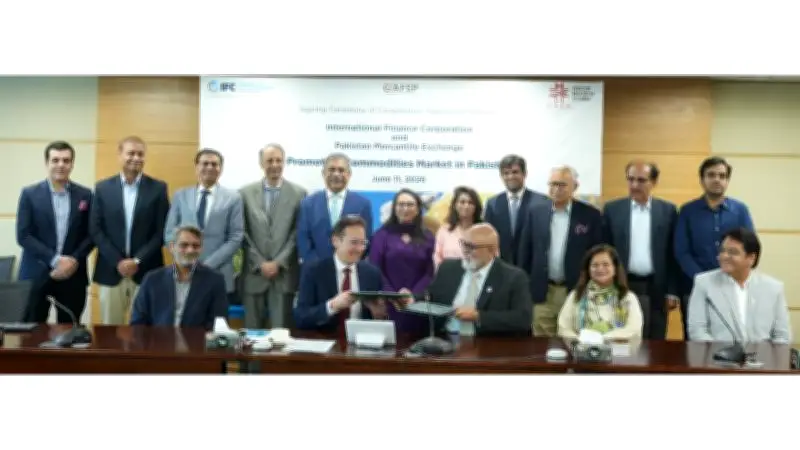
The Pakistan Mercantile Exchange Limited (PMEX) and the International Finance Corporation (IFC) have signed a Cooperation Agreement aimed at strengthening Pakistan's agricultural commodities futures market and supporting the implementation of the Electronic Warehouse Receipt (EWR) regime.
Enhancing Transparency and Efficiency
The partnership is designed to improve transparency, efficiency, and private sector participation in commodity markets. By strengthening price discovery and risk management tools, the initiative will help farmers, traders, processors, and investors make informed business decisions. It is also expected to support investment in warehousing infrastructure, reduce post-harvest losses, and contribute to food security in Pakistan.
Priority Commodities Identified
Maize, rice, cotton, and wheat have been identified as priority commodities for futures trading on the PMEX platform. Under the agreement, the IFC will support a review of the existing regulatory framework governing the storage, transportation, and trading of agricultural commodities and recommend reforms to strengthen the enabling environment.

The IFC will also facilitate stakeholder engagement, support the development of futures contracts, and lead awareness and capacity-building initiatives to promote futures trading and the wider adoption of electronic warehouse receipts.
Official Statements
“This partnership with IFC marks an important step towards modernizing Pakistan's agricultural markets. Efficient commodity futures markets and electronic warehouse receipts can improve price transparency, strengthen risk management, encourage investment in storage infrastructure, and provide farmers, traders, processors, and investors with better market access. Together, we aim to create a stronger and more resilient agricultural marketing ecosystem for Pakistan,” said Mr. Khurram Zafar, Chief Executive Officer of PMEX.
The partnership aligns with the World Bank Group’s Agri Connect Global initiative, which supports governments and other key public and private sector stakeholders to strengthen agricultural value chains, promote climate-smart production, and improve market access for farmers. In Pakistan, the program focuses on promoting modern storage systems, enhancing price transparency, and connecting farmers to competitive markets.
“A modern, efficient commodities market is essential for unlocking Pakistan’s agricultural potential. By strengthening price discovery, expanding private sector warehousing, and promoting electronic warehouse receipts, we can help farmers secure better returns, reduce losses, and access finance. This is a critical step towards building a more resilient and market-driven agri-food sector,” said Mr. Simon Andrews, IFC Director for Pakistan.
“The government has launched the Agriculture Innovation and Growth Program (AIGP) for the capacity building of farmers. The federal government is also working on reforms to modernize the agriculture sector regulatory framework and is in the process of finalizing the national Wheat Policy, which will be a giant leap for the agriculture sector as a whole,” said Mr. Ahmed Umair, Coordinator to the Prime Minister on Agriculture and Food Security.
Signing Ceremony Attendees
The signing ceremony was attended by members of the Board of Directors of PMEX, Additional Secretary of the Ministry of National Food Security and Research, Director of the Commodities Regulation & Development Department of the Securities and Exchange Commission of Pakistan, as well as World Bank Group representatives.