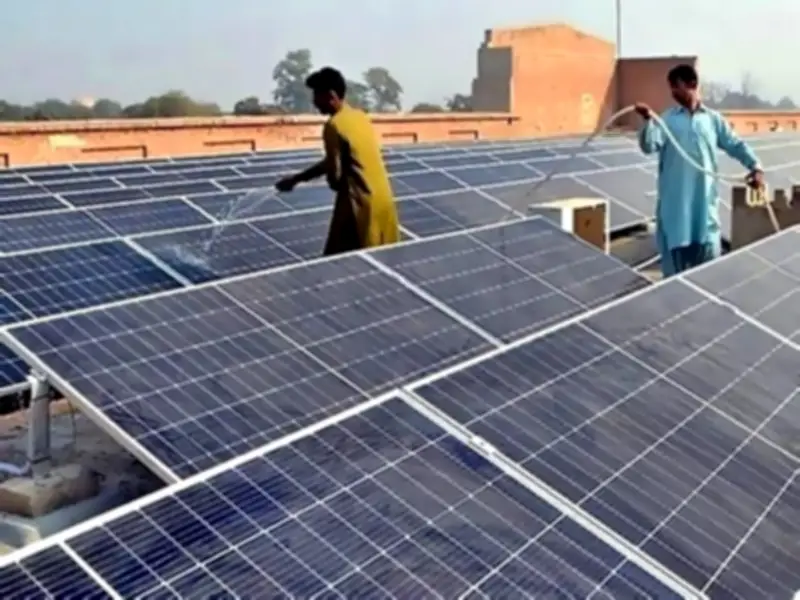
The government of Pakistan has presented a new plan to the International Monetary Fund (IMF) to substantially increase fixed charges on electricity bills. This move is designed to penalize industrialists who consume less than their sanctioned load or have shifted to solar and other off-grid power sources. The policy, officially termed the "two-part industrial tariff policy," primarily aims to generate revenue from industrial consumers to cover idle capacity payments. These payments have arisen due to a faster migration of consumers away from the expensive national grid, coupled with lower economic growth and productivity.
Implementation Timeline and Objectives
According to a Power Division spokesman, the new policy may be implemented within two months. Under the proposed framework, higher consumption from the national grid will be rewarded with reduced unit costs, while lower utilization will attract heavy fixed charges. Sources indicate that Power Minister Sardar Awais Laghari recently shared this two-part industrial tariff policy plan with the IMF. The policy is based on the assumption that increasing fixed costs and reducing per-unit prices will compel industrialists to remain connected to the national grid for longer periods.
Scope and Expansion
Initially, the policy will target industrial connections, but it may later be extended to commercial and residential users. The government has been trying various measures to discourage consumers from leaving the national grid but has failed to address the root causes, such as high electricity costs. The proposal suggests that fixed costs will be spread over higher sales, thereby reducing the per-unit cost of electricity. The government anticipates that preliminary assessments could lead to an increase in demand of approximately 1,000 MW within six to twelve months of implementation, though actual outcomes will depend on market response.

Current Cost Structure
At present, the energy cost for all consumers is significantly higher than the fixed charges being levied. The government has been steadily increasing fixed prices over time. The Power Division believes there is no incentive for industrial consumers to boost their consumption to keep bills low. Under the new policy, monetary penalties will be higher if consumption from the national grid is lower relative to the sanctioned load. For instance, an industrial user in Karachi received a bill of Rs8,158 for just four units, translating to Rs2,040 per unit due to a fixed charge of Rs6,750. This cost will increase further under the new policy.
IMF Concerns
During recent budget discussions, the IMF expressed concerns over the rapid decline in industrial electricity demand from the national grid. Demand has fallen due to high power costs, prompting consumers to adopt cheaper alternatives like solar panels and gas-fed generators. There are fears that if all high-paying consumers leave the grid, the already financially strained power sector could collapse, leaving no buyers for power distribution companies. Sources say the IMF has requested periodic data on industrial consumption and the number of consumers who have left the grid before approving the plan.
Minister's Statement
Speaking on a show, the power minister stated that the fixed cost of power generation constitutes 75%, while the variable cost is only 25%. During months of high consumption, fixed costs are lower, but they spike abnormally when consumption drops. A Power Division spokesman confirmed that the government is working on the policy, which could be implemented within two months. He described the proposed two-part industrial tariff as "optional rather than mandatory," with the primary goal of encouraging growth in industrial electricity consumption and improving utilization of the existing power system.

Rationale and Incentives
The spokesman explained that many industrial consumers maintain a high sanctioned load but consume relatively low energy. The power sector must still maintain generation, transmission, and distribution infrastructure to ensure standby availability, incurring fixed costs regardless of actual consumption. Under the proposed tariff, industries would be incentivized to increase electricity usage in line with their sanctioned demand. If an industrial consumer utilizes more than 50% of its sanctioned load, it could benefit from a reduction in energy tariff of approximately one to two US cents per kWh, bringing the effective tariff down to around seven to eight US cents per kWh. With higher utilization, tariffs could potentially decline further to nearly six US cents per kWh, making Pakistan's industrial electricity prices more competitive internationally.
Consultation and Implementation
The Power Division stated that aligning tariffs with the underlying cost structure can benefit both the government and industrial consumers. Industries with higher utilization of their sanctioned load stand to gain the most. The proposed tariff is currently under consultation and finalization. Once approved by relevant authorities and regulators, implementation is expected without significant delay. Based on current progress, finalization is anticipated within the next two months. In the initial phase, the tariff will primarily target industrial consumers, with continuous-process industries and energy-intensive sectors expected to be the first adopters. The policy may also influence industrial investment decisions regarding captive generation and solar installations, particularly as daytime grid tariffs could become comparable to the levelized cost of solar energy.
IMF Stance
When asked about the IMF's view, the spokesman said the finance ministry would be best placed to comment on any formal IMF position. He noted that the IMF has generally supported measures that promote economic activity, industrial growth, improved energy sector efficiency, and better utilization of existing infrastructure. Any tariff mechanism that increases industrial competitiveness, expands electricity sales, and improves recovery of fixed system costs would broadly align with these objectives.