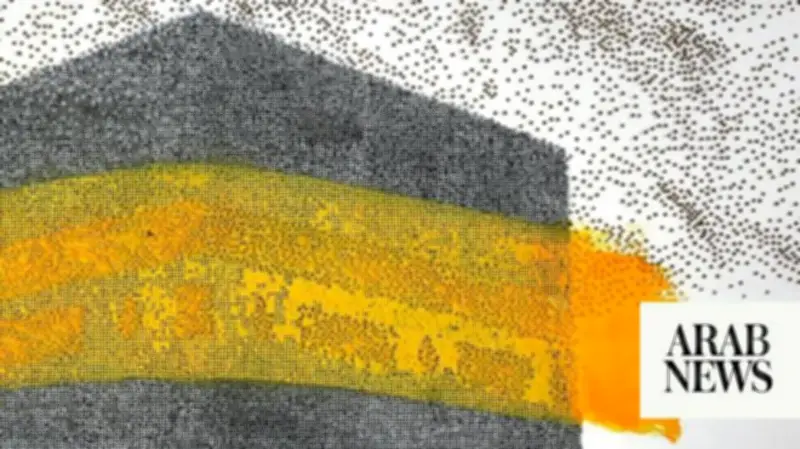
In the Eastern Province of Saudi Arabia, artists Hussain Al-Sadah and Sahar Al-Omair find beauty in the most unexpected places. From their home studio, the husband-and-wife duo transforms thousands of everyday objects—nails, pushpins, screws, coffee beans, and rusted metal sheets—into intricate artworks that explore memory, culture, environmental change, and human connection. Their meticulous processes can take months to complete.
Philosophy of the Ordinary
Al-Omair explains their artistic philosophy: “Each individual pushpin, nail, or bead might seem unremarkable on its own, but when thousands are thoughtfully arranged together, they transform into something magnificent. Through our work, we demonstrate how overlooked or ‘imperfect’ elements can unite to create stunning visual harmonies, much like how individual human actions, when coordinated, can achieve remarkable feats.”
Coffee Bean Portrait
One ambitious project involved creating a portrait using 13,000 discarded coffee beans. To achieve the necessary tones, the artists spent two months roasting the beans themselves, treating the process like mixing paint. “We bought a small roastery and roasted the beans into different shades, with seconds separating one shade from another,” Al-Omair said. “We finally managed to get nine shades, then organized them into categories, almost like a color library.”

Large-Scale Nail Works
Their large-scale nail works require similar meticulousness. Some pieces incorporate over 100,000 nails, requiring Al-Sadah to calculate dimensions, weight distribution, and structural load before production. “It wasn’t easy at the beginning,” Al-Sadah said. “Not knowing where to start or whom to ask, and a lot of research. I feel hardship was a blessing because it led me to experiment and be creative.”
Influences from Qatif Region
The artists’ visual language is shaped by their surroundings in the Qatif region, historically defined by oasis landscapes, palm groves, and agricultural heritage. “The calmness of the oasis, the density of palm trees, the desert surroundings, and the traces of old architecture created a very strong visual memory for us,” Al-Omair said. Witnessing many of those elements gradually disappear over time has left a profound emotional impact on their work.
Upcoming Exhibition Using Rust
Their upcoming exhibition uses rust gathered from corrugated zinc sheets that conceal the remains of the historic Darosh Spring, a 2,000-year-old water source whose decline symbolizes environmental transformation. “The material already carries its own beauty, history, and presence; we’re simply highlighting it,” Al-Sadah said. “What interests us is the honesty of the surface itself, the textures, the stains, the erosion, the evidence of time and neglect.”
Collaborative Journey
The pair met at an art workshop in 2021 and quickly discovered a shared creative language despite different artistic backgrounds. Al-Sadah worked in woodworking and digital art, while Al-Omair focused on sketching and visual composition. “When we first started creating together, the collaboration felt very natural; our way of thinking was surprisingly similar,” Al-Omair said. Neither has formally studied art, which they believe shaped their willingness to experiment.
Since marrying in 2022, the couple has produced 20 to 30 collaborative works, many requiring months of research, material testing, and fabrication. They have built a loyal community of collectors who often encounter the work directly in their home studio. “People don’t just arrive to purchase a finished object; they often witness fragments of the process, the experiments, the failures, the materials, and the stories behind the work,” Al-Sadah said.
Although open to larger international platforms, they remain committed to drawing inspiration from Saudi Arabia’s landscapes, histories, and ongoing transformations. “Even if the work travels internationally, we don’t see that as separate from preserving or reflecting local Saudi narratives,” Al-Sadah said. “In many ways, the more deeply rooted the work is in our own environment and experiences, the more universally people seem to connect with it.”