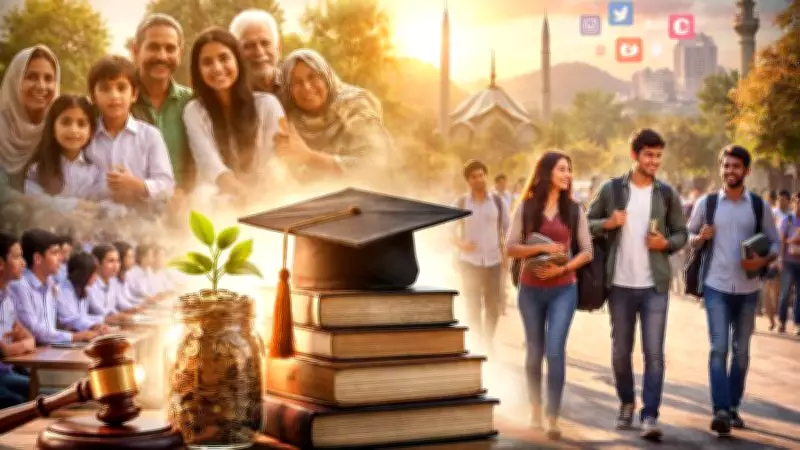
In a welcome initiative, universities across Pakistan are taking steps to inculcate moral character building among students. This move comes in response to serious concerns over moral degradation fueled by the unabashed use of social media, a decline in socio-cultural values, and the challenges posed by a growing youth population. The efforts by universities reflect a correct understanding of the youth's pivotal role in shaping Pakistan's future, aiming to address these issues head-on.
The Role of Universities in Moral Development
With good intentions, universities are introducing specialized courses, energizing moral character societies, and enhancing the overall campus environment. This includes teaching ethics, improving the behavior of faculty and staff, and organizing regular sessions with scholars and motivational speakers to instill virtues and strong character traits in students. However, while these initiatives are commendable, it is crucial to recognize that universities represent only one stage in a lifelong journey of moral development.
The Sequence of Character Building
Students arrive at universities after passing through five critical stages of character development: family, school, college, societal changes, and finally, universities. This sequence is well-defined by theorists from both Western and Eastern schools of thought in psychology, sociology, and religion. For instance, psychologist Lawrence Kohlberg suggests that core moral reasoning patterns are established before adulthood. Sociologist Emile Durkheim emphasizes that morality is sustained through collective life, while Albert Bandura highlights that individuals learn ethics by observing behaviors. From an Islamic perspective, concepts like Ikhlaq, hidayat, and tarbiyat underscore the importance of early and continuous moral guidance.

Pakistan's Context: A Weakening Foundation
In Pakistan, the sequence of moral character building faces significant challenges. At the family level, institutions are weakening, with nuclear families giving way to individualism and diminishing traditions of respect for elders and wisdom-sharing. Social interactions, such as mohalla sittings and collective activities in masjids, are decreasing, replaced by self-interest-based engagements and superficial religiosity.
Educational System Gaps
At the school level, Pakistan's four-tiered education system—comprising government schools, private schools, elite private schools, and madaris—creates disparities in moral education. While elite private schools may adopt models like the Finnish system to foster moral character and civic sense, other systems struggle due to administrative incapacity, lack of political will, bureaucratic inertia, or religious considerations. Colleges face similar issues, with outdated textbooks, fatigued teachers, and inadequate sports facilities contributing to rebellious dispositions and hopelessness among youth.
Socio-Political and Media Influences
The phase of societal changes has been deeply impacted by historical events, such as the military regime of Zia-ul-Haq, which turned seminaries into war-making factories, banned student unions, introduced Islamisation policies, controlled media, and created sectarian fault lines. This era, awash in heroin and arms, led to cognitive dissonance among youth, splitting their energy between superficial religiosity and moral confusion.
Subsequent governments, including those of Nawaz Sharif, Benazir Bhutto, and General Pervez Musharraf, opened the economy to market dynamics, fostering consumerism and further weakening family structures. Capitalism thrives on individualism, which is amplified by social media operating under corporate logic to sell products for profit. In this landscape, serious and reflective content is overshadowed by fake information, unethical claims, and sensational material, pushing morality to the back seat.

Building an Integrated Moral Ecosystem
In a socio-political and media environment where content often focuses on character assassination rather than ethical development, deviation from morality becomes almost natural. Revisiting the sequence—family, school, college, socio-economic society, media, and universities—it is clear that an integrated moral ecosystem is needed. Corrections must begin at the earliest stages, not merely at the final station of universities.
Universities' resolve to address moral character building is praiseworthy, but the issue is far more complex, especially given Pakistan's youth bulge. Moral character building must start at the earliest stages of life; universities can at best serve as ethical refiners, not the sole creators of strong character. This lifelong journey requires collective efforts across all societal levels to foster a robust moral foundation for future generations.