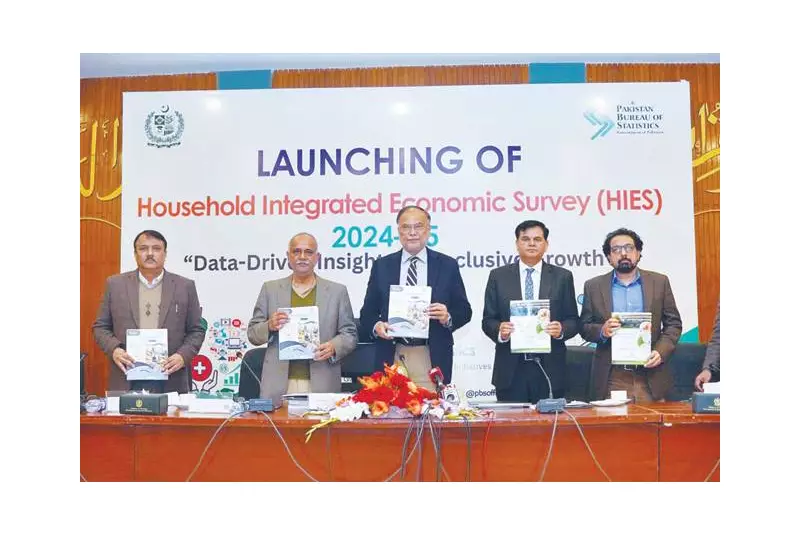
In a significant development for data-driven policy, the Government of Pakistan has officially launched the first-ever digital Household Integrated Economic Survey (HIES) 2024–25. Federal Minister for Planning, Development & Special Initiatives, Ahsan Iqbal, inaugurated the survey, which paints a picture of gradual socio-economic improvement alongside persistent challenges.
Education and Health: Progress and Persistent Gaps
The survey, conducted by the Pakistan Bureau of Statistics, shows a national literacy rate increase to 63% from 60% recorded in the last survey of 2018-19. However, progress is uneven across provinces. Punjab leads with a 68% literacy rate, while Balochistan lags significantly at 49%.
A critical concern remains the number of children not attending school. While the proportion has dropped from 30% to 28%, this still translates to approximately 25 million children. Minister Ahsan Iqbal emphasized treating this as an "education emergency," stressing the goal of raising the education participation rate to 90% for true national development.

On a positive health note, the survey records improvements in child mortality. The Infant Mortality Rate has decreased from 60 to 47 per thousand live births, and the Neo-Natal Mortality Rate has fallen from 41 to 35.
Digital Revolution and Living Standards
One of the most striking findings is Pakistan's rapid digital adoption. Household internet access has skyrocketed from 34% to 70% since 2018-19. Khyber Pakhtunkhwa (KP) shows the highest penetration at 77%. At an individual level, internet usage has more than tripled, jumping from 17% to 57% nationwide.
Ownership of communication devices is nearly ubiquitous at the household level, with mobile or smartphone ownership at 96%. Interestingly, Balochistan leads this metric with 98% ownership.
The survey also indicates improvements in housing, water, and sanitation:
- Access to tap water increased from 18% to 22%.
- Use of flush toilets improved significantly from 80% to 89%.
- Households with no toilet facility reduced from 12% to 7%.
- Use of clean fuels for cooking and heating rose from 35% to 38%.
Economic Patterns and Population Welfare
On income and consumption, the HIES 2024-25 reports a nominal household income increase of 97.81%, from Rs 41,545 to Rs 82,179. Household consumption expenditure saw an even larger nominal jump of 113%. The largest share of household spending goes to food (37%), followed by housing and fuel (26%).
In population welfare, positive trends include a decrease in the total fertility rate to 3.6 children per woman and an increase in the proportion of women making informed decisions about their reproductive health to 56%.
Launching the survey, Minister Ahsan Iqbal linked these indicators to broader economic goals, terming the recent 3.71% GDP growth in Q1 of FY 2025-26 as "encouraging." He expressed optimism that Pakistan is on track to achieve around 4% growth for the full fiscal year, underpinned by a cautious and responsible economic policy focused on sustainability.
The HIES, a key tool for monitoring socio-economic indicators since 1963, provides vital data for planning and underscores both the progress made and the substantial work ahead in education and equitable development.