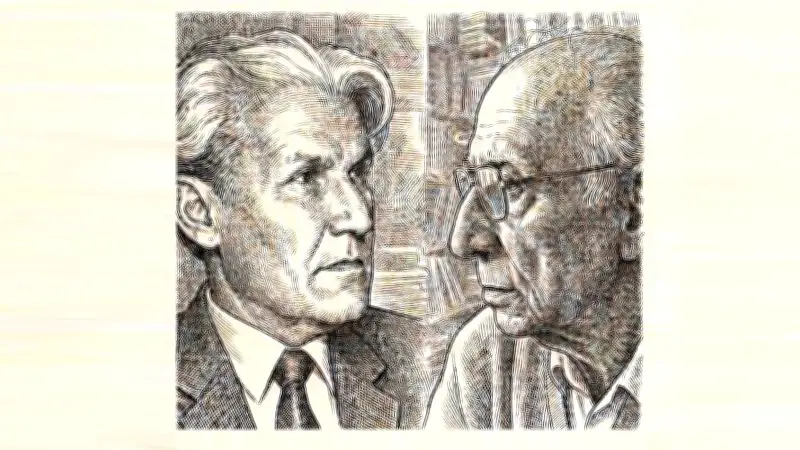
Among the many stories that illuminate the formative years of Rasool Bakhsh Palijo, one singular episode from his school days at Sindh Madressatul Islam stands out with a quiet, luminous brilliance. It was a moment of early triumph, yet it remains draped in the soft, melancholic hues of a world long past.
A Record-Breaking Student
As a young boy in Class V, Palijo had set an unprecedented academic record at the historic institution. Though assigned to Section A, his intellectual reach spanned far beyond his classroom walls, securing the absolute highest position across all four sections—A, B, C, and D. His mastery was not merely a matter of aggregate marks but a sweeping, brilliant conquest of diverse disciplines. He soared through Arabic and Sindhi, mapped the contours of History and Geography, untangled the mysteries of Physics and Chemistry, and conquered the rigid structures of Algebra, Geometry, and Mathematics, alongside the spiritual depths of Fiqh and Islamic History. Yet, it was in Sindhi and Mathematics that his genius shone brightest, marking him indisputably as the foremost student of his entire grade.
The Layout of an English House
One quiet afternoon, during the final period of the day, the rhythmic hum of the classroom was broken. A school peon slipped through the doorway with a brief, summonsing message: “The teachers have called Rasool Bakhsh Palijo to the staff room.” Palijo walked down the echoing corridors, entirely unaware of what awaited him. As he crossed the threshold into the room, a slim instructor of middle height stepped forward, turning to address his assembled colleagues. He held an examination paper in his hand—Palijo’s answer copy of English—and announced that he wished to read a particular answer aloud to the staff.

The teacher cleared his throat and read the examination question: “What is the layout of an English house?” In response, the young student had faithfully detailed the domestic geography of a typical British home—the drawing room, the kitchen, the secluded study. But then, touched by the political currents of an empire in its twilight, the boy’s pen had soared into the realm of radical philosophy. He wrote that English houses were beautiful, spacious, strong, and meticulously maintained because England was a free, independent nation.
Then came the contrast—sharp, sorrowful, and deeply felt. He described South Asian homes as narrow, congested, and unlovely, precisely because South Asia languished under the heavy boot of colonial rule. He argued with fierce maturity that until the people achieved their liberation, their physical and spiritual circumstances would remain forever unchanged. True freedom, the young boy wrote, demanded sacrifice; no nation could break its fetters without a relentless struggle. The teacher's voice dropped to a dramatic cadence as he read the final, arresting line from the answer book: “The tree of liberty is watered by the blood of tyrants.”
A silence blanketed the room as the teachers exchanged long, thoughtful glances. The slim teacher turned to Palijo, his expression softening with formal warmth. “Rasool Bakhsh,” he said, “you have performed exceptionally well among all sections of Class V, and you have written an extraordinary essay. Therefore, we, the teachers of this Madressah, wish to honour you. Today, as a student, you shall sit among us on a chair as our guest.”
Tea was poured, and the young boy sat suspended in that rarefied air, listening to the elders praise his academic gifts and the startling originality of his mind. Overwhelmed by an immense wave of gratitude and humility, Palijo remained frozen. Not a single word escaped his lips. It was only later, when he returned to the solitary sanctuary of his hostel room and bolted the door behind him, that the emotional dam broke. He collapsed into tears—not of sorrow, but a heavy, beautiful torrent of joy, honour, and the deep ache of being truly understood.

A Transformative Teacher
Palijo would soon discover that the slim teacher who had orchestrated that unforgettable afternoon was none other than Muhammad Ibrahim Joyo—the man who would formally teach him English in Class VI, and who would ultimately reshape his universe. Palijo recalls that Joyo practised a natural, deeply moving method of instruction. He did not merely parse sentences; he resurrected the dead. He would introduce the author, paint the historical landscape, and then seamlessly tether the vintage European verses to the burning political realities of Sindh and South Asia.
There was a melancholic magic to the days when Muhammad Ibrahim Joyo introduced William Wordsworth to the class. He explained how Wordsworth stood at the emotional epicentre of the English Romantic movement, spearheading an era that canonised human emotion, the elegance of ordinary life, the sanctity of memory, and the healing spirit of the wild. With a voice that seemed to carry the mist of the Scottish highlands into the heat of Sindh, Joyo recited his favourite lines from The Solitary Reaper:
“No Nightingale did ever chant
More welcome notes to weary bands
Of travellers in some shady haunt,
Among Arabian sands:
A voice so thrilling ne'er was heard
In spring-time from the Cuckoo-bird,
Breaking the silence of the seas
Among the farthest Hebrides.”
Joyo explained to his young charges that Wordsworth had purposefully elevated the humble reaper’s rustic song above the legendary notes of the nightingale. The poet utilised both exotic and local imagery to cloak the entire scene in a mysterious, enchanting atmosphere. Joyo emphasised how this music transcended ordinary human experience, offering an immediate emotional comfort and a profound, haunting thrill. He showed how the Romantic movement elevated a solitary, impoverished rural labourer into a figure of otherworldly beauty, beautifully fusing human grief with the passing landscape.
Then, shifting his cadence to a more solemn, lingering rhythm, Joyo delivered the concluding stanzas:
“Whate'er the theme, the maiden sang
As if her song could have no ending;
I saw her singing at her work,
And o'er the sickle bending;-
I listened, motionless and still;
And, as I mounted up the hill,
The music in my heart I bore,
Long after it was heard no more.”
Muhammad Ibrahim Joyo demonstrated how the romantic elements deepened within these final lines, rendering the maiden’s simple melody eternal and soul-stirring. Through the teacher's brilliant guidance, Palijo realised that Wordsworth sought the extraordinary within the ordinary, capturing a spiritual resonance that lingered long after the physical sound had vanished into the hills. He learned, too, how Wordsworth’s youth as an ardent admirer of the French Revolution had directly forged his lifelong devotion to liberty and nature.
Unpacking the Weight of Verse
In another session of an English class, Muhammad Ibrahim Joyo read Alfred Lord Tennyson’s classic work, Home They Brought Her Warrior Dead. Palijo would later recall how the poem seemed to electrify the very air of the classroom. Joyo read the selected stanzas aloud, slowly dissecting their heavy, emotional anatomy:
Home they brought her warrior dead:
She nor swooned, nor uttered cry:
All her maidens, watching, said,
‘She must weep or she will die.’
With vivid, cinematic language, Joyo painted the scene for the boys. He described the heavy wooden doors of the castle hall creaking open as a terrible, suffocating silence blanketed the room. Muted, battle-weary soldiers marched inside, bearing the lifeless body of their captain toward his young wife. The women of the court held their breath, waiting for the inevitable screams of grief, a desperate embrace, or a sudden collapse onto the cold stone floor.
But the widow did not move. She stood frozen like a marble statue, her wide, unblinking eyes fixed entirely on his pale face. No sound escaped her throat, and no tears filled her eyes because, as Joyo softly explained, the sheer magnitude of the trauma had paralysed her entire being. Her maidens whispered in terror from the shadows, realising that this emotional freeze threatened her very life. They knew she had to release the agony through tears, or her heart would break under the immense, unuttered pressure.
The companions tried desperately to shatter her shock. One maiden unveiled the warrior's face to provoke a reaction, but Joyo showed his students how the widow remained unreachable, an isolated ghost.
“Rose a nurse of ninety years,
Set his child upon her knee—
Like summer tempest came her tears—
‘Sweet my child, I live for thee.’
Joyo elaborated that an old nurse finally stepped forward from the back of the room. She carried ninety years of life experience, recognising both the finality of death and the survival instinct of the living. Joyo detailed how the old woman walked silently to the cradle, lifted the warrior's infant child, and placed the baby directly onto the mother's lap.
The widow slowly lowered her gaze from the dead face of her husband to the breathing face of her infant. Joyo emphasised that she recognised her husband’s eyes in the child, feeling the urgent, fragile weight of a life that still depended on her survival. The internal wall of ice instantly shattered. Her tears erupted like a violent summer storm, loud and completely uncontrollable. Joyo’s voice filled the quiet classroom as he described her collapsing over the infant, weeping intensely into its chest as her paralysing grief converted into a life-saving torrent. Holding the child tightly against her breast, she peered through her blurred vision and spoke with a newfound, fierce determination: “Sweet my child, I live for thee.”
A Legacy of Radical Thought
It was within these historic, echoing corridors of Sindh Madressatul Islam that the young Rasool Bakhsh Palijo first encountered the mind that would fundamentally alter the trajectory of his life. Muhammad Ibrahim Joyo did not merely instruct; he transformed. Decades later, Palijo would reflect that while ordinary teachers drilled language mechanics, Joyo unspooled the magical, transformative power of verse, demonstrating how literature, when unlocked correctly, could elevate human consciousness itself.
In a lifetime of encounters, Palijo maintained he had never seen another teacher like him—a man whose wisdom soared far beyond the rigid, unimaginative curricula of his contemporaries. Joyo was a rare intellectual creature for the era: deeply read, unboundedly idealistic, and possessed of a vast, almost mysterious perspective that challenged his pupils to shed provincial habits of mind. His conversations were a continuous exhortation to think anew, to critically look at what they were doing, and to endure for a more profound maturity.
Under Joyo’s quiet stewardship, Palijo did not just learn the natural cadences of English prose or the art of unpacking a poem. He grasped a far more profound truth: that language was an instrument to expand the very boundaries of understanding. Knowing or expressing oneself in one language was fine, but one had to learn the world languages—be it Latin, Sanskrit, Chinese, Arabic, Persian, French, or English. To feed this hunger, Joyo would introduce his students to contemporary radical thought, frequently passing them copies of MN Roy’s progressive weekly newspaper, selecting choice pieces to ignite their imaginations.
As later recorded by Idrees Laghari in the compiled book, Rasool Bakhsh Palijo Ji Atam Khattha, it was Joyo who systematically initiated the young scholar into the domains of modern literature, the social sciences, and the revolutionary political writing of a new world. Through this early influence, even in his elementary classes, Joyo encouraged him to read the dense novels of Anthony Trollope. Palijo checked out The Three Clerks—a difficult, dizzying text for a student of his grade. Yet through Trollope’s young protagonists, Palijo encountered a powerful critique of institutional authority, the politics of power, the corrupting influence of wealth, and the dangers of ambition without a moral anchor. Joyo's recommendation was never just a lesson in English literature; it was a quiet, masterfully delivered blueprint teaching Rasool Bakhsh Palijo how to think critically, question injustice, and decode the massive, shifting forces of power that shaped their own lives under colonial rule.