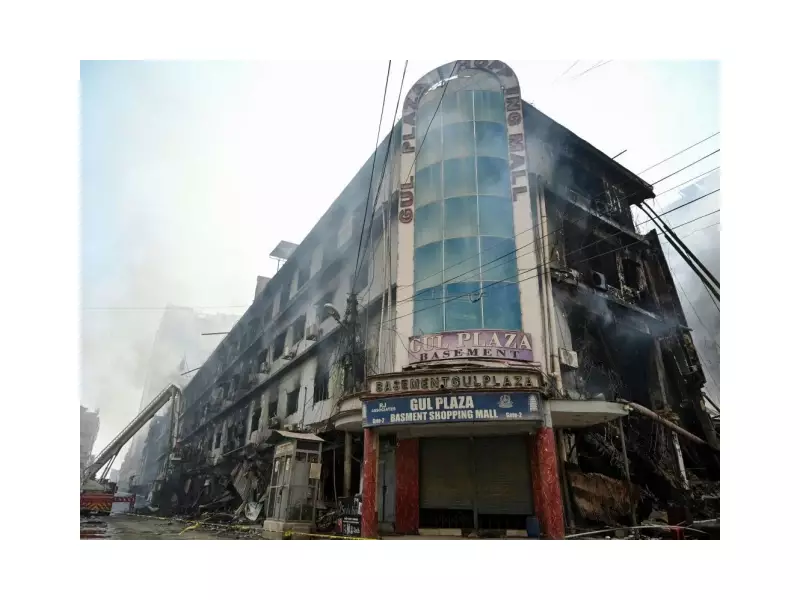
A devastating third-degree fire tore through the multi-storey Gul Plaza on Karachi's MA Jinnah Road on the night of January 17, 2026, transforming a bustling commercial hub into a scene of tragedy. The inferno, which began on the ground floor, rapidly consumed the entire complex, leaving at least 26 people dead, dozens injured, and over 60 missing by Monday evening. The disaster has laid bare a catastrophic failure of safety regulations, emergency preparedness, and a culture of neglect that prioritizes profit over human life.
A Textbook Case of Systemic Failure
While authorities have pointed to a suspected electrical short circuit as the cause, health and safety experts describe the blaze as a predictable outcome of deep-rooted systemic issues. Saad Abdul Wahab, CEO of the HSE organisation Grow Safe, called it a "textbook case" of regulatory failure. He criticized a societal mindset that treats life-saving safety measures as a financial burden with no return, rather than a fundamental necessity.
The conditions at Gul Plaza were a ticking time bomb. Originally approved for 500 shops, the plaza was illegally packed with nearly 1,400 establishments, creating an enormous fire load of flammable imported garments, plastics, and carpets. This overcrowding meant that for a building housing around 7,500 workers and up to 100,000 daily visitors, basic firefighting equipment was grossly inadequate. The entire complex relied on only 200 fire balls and 144 fire extinguishers, averaging roughly one extinguisher for every ten shops.

Three Tiers of Neglect Leading to Disaster
Wahab outlined three critical levels of control that collectively failed at Gul Plaza, ensuring a small flame became an unstoppable inferno.
First, administrative controls by the government collapsed. Regulators allegedly prioritize bribes over rigorous safety audits, allowing hazardous buildings to operate without oversight. The Sindh Occupational Safety and Health (SOSH) Act 2017, designed to prevent such tragedies, remains unenforced due to what Wahab termed "systemic corruption." A critical failure was that 13 out of 16 building gates were locked, trapping people inside.
Second, engineering controls by building owners were non-existent. There was a complete neglect of both active systems like sprinklers and alarms, and passive protections like fire doors. No trained Emergency Response Team (ERT) was present, leaving evacuation in the crucial first 15 minutes entirely to panicked shoppers and workers.
Third, the emergency response was crippled from the start. Karachi, a megacity of roughly 30 million, operates with a fraction of the required firefighting infrastructure. Against an international standard of 300 fire stations and 1,200 trucks, the Karachi Metropolitan Corporation (KMC) has only 28 stations and 15-16 active fire trucks. Response times are measured in hours, not the standard six minutes, due to traffic, bad roads, and logistical delays. Even upon arrival, trucks often carry a fraction of their water capacity. "It's like fighting a forest fire with a garden hose," Wahab explained.
Staggering Human and Economic Cost
The toll of the fire is immense on every level. The human tragedy was underscored by the death of a young firefighter, Furqan Shaukat, whose recovery highlighted the lack of even basic protective gear like self-contained breathing apparatus for first responders.
Economically, the losses are catastrophic. With over 1,000 shops destroyed, individual traders face losses estimated at Rs2 to Rs2.5 billion each, with an overall impact nearing Rs100 billion. Wahab noted the painful irony that shopkeepers stocking Rs300 million in inventory often refuse to spend Rs30,000 on fire blankets or extinguishers. "A major fire can set a business back by 10 years," he warned.

While the Sindh government has declared the fire a "national tragedy" and announced Rs10 million in compensation for victims' families, experts stress that without fundamental reform, such disasters are inevitable. The call is for a shift from individual, shop-level safety to integrated, centralized systems for detection and response. Until the writ of the state is enforced to protect lives over bribes, the grim formula of a "third-degree fire"—one that only stops when nothing is left to burn—will continue to haunt Karachi's commercial heart.