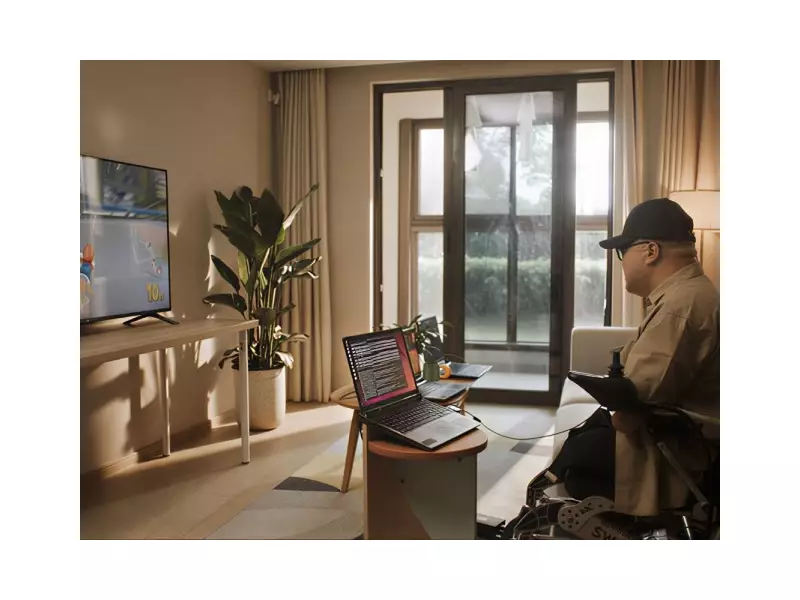
In a stunning leap for neurotechnology, a patient paralyzed from the neck down has successfully navigated a smart wheelchair through a neighborhood and directed a robotic dog to fetch a food delivery using nothing but his thoughts. This remarkable feat was part of a recent clinical trial conducted by researchers from the Chinese Academy of Sciences (CAS), moving brain-controlled devices from the lab into the complexities of the real world.
From Lab to Real-World Mobility
The patient, who suffered a spinal cord injury in 2022 that left him quadriplegic, received a sophisticated brain-computer interface (BCI) system in June 2025. The system was developed by the Center for Excellence in Brain Science and Intelligence Technology under the CAS. Unlike previous demonstrations confined to screens, this trial shattered conventional rehabilitation boundaries by translating the brain's commands into full-bodied, three-dimensional interaction with the physical environment.
Within weeks of training, the patient gained reliable control over a computer cursor and a tablet. The researchers then employed a high-throughput wireless invasive BCI system. This technology allowed the patient to stably control both a smart wheelchair and a robotic dog using pure neural signals, achieving autonomous mobility and completing tasks like object retrieval in everyday settings.

Technical Breakthroughs Behind the Scenes
The success of this trial hinged on several critical technical advancements. The research team creatively fused two distinct decoding strategies to extract clear, meaningful commands from the noisy background activity of the brain. This innovative approach boosted the overall brain-control performance by more than 15 percent.
Furthermore, the engineers managed to drastically reduce system latency. They squeezed the end-to-end delay, from the moment a neural signal is picked up to the execution of a command, to under 100 milliseconds. This is faster than the body's own natural reaction time, providing the patient with control that feels fluid, responsive, and surprisingly natural.
A New Horizon for Neurorehabilitation
This trial signifies a pivotal shift in the goals of BCI research. The focus is moving beyond simply restoring basic communication or cursor control on a screen. The aim is now to actively expand the real-life horizons and independence of paralyzed patients. The ability to command a wheelchair to move through a dynamic outdoor space and instruct a robotic helper to perform a practical task represents a monumental step toward integrating such systems seamlessly into daily life.
While research groups worldwide have demonstrated 'mind typing' and robotic arm control in laboratories, the enduring challenge has been making these systems reliable and robust enough to vanish into a patient's routine. The CAS team's work, achieving stable control in unpredictable real-world settings, marks significant progress toward that ultimate goal of invisible, intuitive assistance.