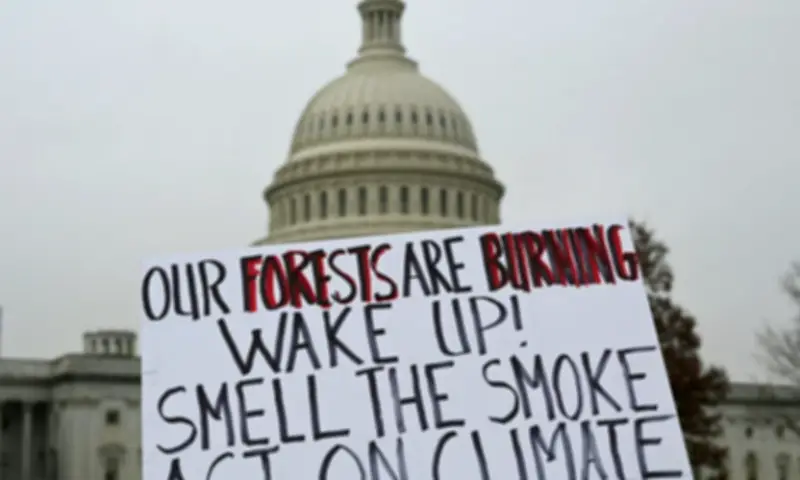
As the midterm elections approach, a notable shift has occurred among Democratic politicians. Those who once framed climate change as the defining crisis of our time now rarely mention it in speeches, social media posts, or podcast appearances. The primary exception is Senator Sheldon Whitehouse of Rhode Island, who has delivered his “Time to Wake Up” speech on climate dangers over 300 times in the past 15 years. He has accused “climate hushers” of pushing the party to avoid the topic.
The turning point appears to be the 2024 presidential election. After President Donald Trump defeated former Vice President Kamala Harris in all seven swing states, Democrats scrambled to understand their loss. One prevailing theory was that they focused too heavily on social justice and planetary issues at the expense of everyday concerns like the rising cost of living. Whitehouse, however, views global warming as integral to that conversation, not a distraction.
“Climate change is right now raising costs for families across the country through higher property insurance premiums, grocery and electric bills, and health care expenses,” Whitehouse stated to Grist.

The idea that discussing climate change is a Democratic liability has become conventional wisdom. Last year, the Democrat-aligned Searchlight Institute advised, “Don’t say climate change.” A New York Times op-ed concluded, “When it comes to climate change, for now, it might be better to say nothing at all.” An early draft of the Democratic National Committee’s autopsy of the 2024 election suggested that climate and green energy messages “created anxiety among workers in traditional industries worried about job losses.”
But experts challenge this narrative. Matto Mildenberger, a political science professor at the University of California, Santa Barbara, noted, “It’s very zeitgeisty to assume right now that it’s really important not to talk about climate, or that Democrats have paid a political cost for talking about climate.” He and other researchers told Grist there is no hard evidence that discussing climate change hurts Democrats electorally. In fact, studies show it may provide a modest boost.
Polling from the Yale Program on Climate Change Communication indicates climate change ranks 24th out of 25 issues when voters are asked about priorities. However, this is largely because other concerns, such as protecting democracy and government corruption, have risen in importance among liberal Democrats. Assuming that talking about climate change is a liability simply because it is not a top issue is a logical leap, experts argue.
Some commentators suggest that climate action can be achieved by electing Democrats regardless of their rhetoric. But deemphasizing climate change could have long-term consequences, including loss of momentum for action and signaling that the issue is unimportant. “You actually need to have conversation and attention to an issue to slowly build the coalition and policy work necessary to address it,” Mildenberger said.
He added that Democrats are ceding rhetorical ground to opponents, even as Trump’s anti-climate agenda—blocking wind farms, scrubbing global warming information from government websites, and withdrawing from the Paris Agreement—remains broadly unpopular. “All of this is, frankly, doing the service of the fossil fuel industry, ultimately, because it’s helping climate delay,” Mildenberger stated.
Whitehouse argues that Democrats are “poll-chasing” with bland, backward-looking messages. “Many Americans don’t believe Democrats are fighters,” he said. “The best way to shed that label is to actually step into the arena and fight. Our climate messaging has long been terrible, but it would be malpractice to shy away from a fight with Central Casting villains (the fossil fuel industry climate denial fraud and dark money corruption operations) with such high stakes for the economic well-being of American families.”

As Americans struggle with rising costs and surging gas prices, oil giants profit from the Iran war—a dissonance Democrats could exploit. Matt Burgess, an economist at the University of Wyoming, agrees that Democrats alienated voters on cultural issues and lost sight of affordability, and that progressive climate messaging was part of that. However, he said it is wrong to assume climate change is a losing issue. “There are lots of different lines of evidence that suggest that climate change as an issue overall helps the Democrats and hurts Republicans,” Burgess said.
A 2024 study he co-authored found that in a hypothetical world without climate change as an issue in the 2020 election, Republicans could have gained a 3 percent swing in the popular vote, enough to hand Trump the White House. “If you have any issue that moves the needle a little bit in your favor in a super-close election, it can make the difference between winning and losing,” Burgess said.
Exit polling from Navigator Research shows that swing voters considered “US efforts to fight climate change” a reason to support Harris over Trump by 21 points. Trump won on inflation, the economy, and immigration. Bryan Bennett, who directed the post-election survey, said, “The very simple version is, Trump winning those voters won the election.” Harris did not lose because she mentioned climate change, nor because Democrats passed climate policies under Biden. If anything, voters were unaware of federal investments.
The fragmented media ecosystem makes it harder for politicians to control their narrative, Bennett noted. The Democratic Party has increasingly emphasized “message discipline” to cut through noise. “So much of the oxygen in the room is taken up by, ‘How do Democrats deal with, and how do progressives deal with, talking about the economy in a way that really meets voters where they are?’” Bennett said. “And I think that inherently detracts from basically every other issue, regardless of whether it’s a good thing to talk about or not.”
Democratic politicians who still mention climate change often do so indirectly, linking clean energy to cheaper energy and rising electricity bills. Polling from the Yale Program on Climate Change Communication last fall found that 41 percent of respondents wanted candidates to discuss reducing global warming more often, nearly double the number who wanted less discussion.
The trend of climate-hushing may stem from a misperception. Studies show that politicians and the public vastly underestimate Americans’ appetite for climate action, from carbon taxes to renewable energy expansion. “We have this tension where, I think, empirically, talking about climate change provides a net benefit. It’s a very small net benefit, but it is a net benefit,” Mildenberger said. “But we have a discourse that somehow says that it’s this massive cost.”