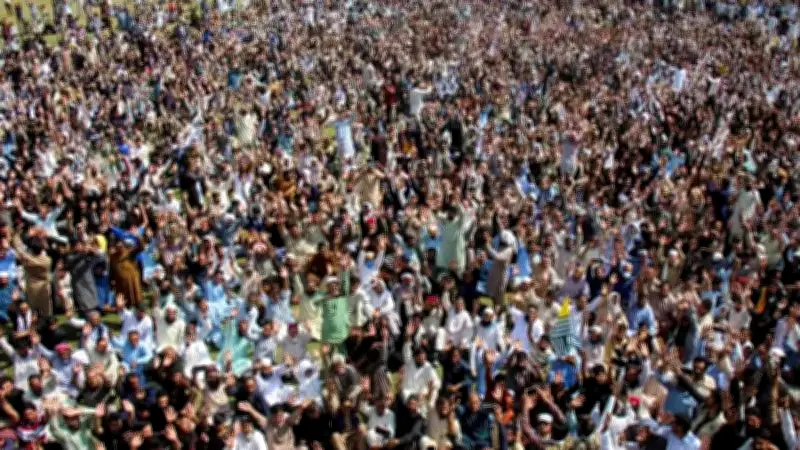
The ongoing crisis surrounding the Joint Awami Action Committee (JAAC) in Azad Jammu and Kashmir (AJK) has escalated far beyond a simple protest movement. With continuous sit-ins, shuttered markets, communication disruptions, and clashes that have reportedly claimed at least twenty lives, the situation has become one of the most significant political challenges the region has faced in recent years. The unrest, initially sparked by public anger over electricity tariffs, inflation, and economic hardship, has forced critical questions about governance, political representation, institutional legitimacy, and the sustainability of AJK's political model into the open.
Beyond Law and Order: The Political Significance
Reducing the JAAC crisis to a mere law-and-order problem would miss the larger story. While economic grievances triggered the movement, they do not fully explain its political resonance. The importance of JAAC lies less in the specific demands it raised than in the debate it has ignited. As the movement expanded, public discussion shifted from electricity bills and inflation to broader questions: How responsive are local institutions? To what extent do elected bodies exercise meaningful authority? Why do many citizens believe that key decisions affecting AJK are shaped outside the formally responsible institutions? These questions strike at the heart of governance itself.
Governance Deficit Exposed
Supporters of JAAC argue that the movement exposed a governance deficit that had long remained hidden beneath the surface of political stability. They contend that the crisis revealed the limitations of local institutions and reinforced a perception that meaningful decision-making remains heavily influenced by Islamabad. Whether one agrees with this assessment is secondary, as political realities are often shaped as much by perception as by formal constitutional arrangements.

Strained Political Framework
More importantly, the crisis has exposed the growing exhaustion of a political framework that once appeared durable. For decades, stability in AJK rested on a familiar arrangement involving mainstream political parties, influential electables, patronage networks, and institutional intermediaries capable of absorbing public grievances before they became politically disruptive. This framework relied on the assumption that established political actors retained sufficient legitimacy to mediate between society and the state. JAAC has challenged that assumption by emerging largely outside conventional party structures, mobilizing support through issue-based politics rather than partisan loyalties. This has revealed a widening disconnect between established political mechanisms and the public they are intended to represent.
Managed Democracy Under Strain
The conventional model of managed democracy in AJK—where political competition existed but remained largely channeled through established parties, electables, and carefully regulated institutional structures—appears increasingly strained. Citizens are no longer relying exclusively on traditional political intermediaries to articulate their grievances; they are seeking alternative avenues for political expression. This suggests not merely dissatisfaction with policy outcomes but growing skepticism towards the mechanisms through which those outcomes are produced.
Debate Over Refugee Seats
Nowhere is this more evident than in the renewed debate surrounding the twelve refugee seats allocated to refugees from Indian-administered Jammu and Kashmir but contested from constituencies located in Pakistan. Historically justified as an extension of Pakistan's principled position on Kashmir, critics argue these seats have evolved beyond their original representative purpose and become instruments of political bargaining, capable of influencing electoral outcomes and shaping governments within AJK. The issue has become symbolic of broader concerns about political legitimacy and representation, contributing to debates concerning accountability, autonomy, and the balance between local and national political interests.

Economic Dependence and Legitimacy
The crisis has also challenged the argument that Kashmir's economic dependence on Pakistan weakens the legitimacy of political protest. Economic support does not eliminate demands for accountability, nor does financial assistance negate expectations of responsive governance. Citizens do not surrender political rights because they benefit from public spending. Reducing political grievances to economic dependence risks confusing financial support with political legitimacy. The persistence of public mobilization despite this argument demonstrates that the current crisis cannot be understood through economics alone.
Battle Over Narrative
Equally important has been the battle over narrative. One major challenge confronting JAAC has been the visible gap between its stated objectives and public perceptions. Supporters framed the movement around economic relief, governance reform, and institutional accountability, yet many citizens encountered it through a very different lens. Social media, electronic media, and sections of the print press became arenas for competing narratives, with selective reporting, misinformation, emotionally charged commentary, and unverified claims overshadowing substantive discussion. As a result, public understanding became shaped by perceptions of the movement rather than its actual demands. Critics viewed JAAC as destabilizing and irresponsible, while supporters interpreted criticism as deliberate misrepresentation. Public discourse became polarized, narrowing the space for meaningful dialogue.
Governance Challenges and Polarization
This polarization itself represents a governance challenge. A widening perception gap between citizens and institutions rarely remains confined to a single movement; over time, it risks creating a deeper trust deficit between sections of Kashmiri society and the Pakistani state. The implications of the crisis extend far beyond the immediate confrontation between JAAC and the authorities.
Five Key Implications
First, it has exposed the diminishing effectiveness of the governance model that has underpinned political stability in AJK for decades. Traditional mechanisms of political management appear increasingly incapable of absorbing public grievances before they become wider political challenges. Second, it has raised difficult questions regarding the sustainability of AJK's long-standing model of managed democracy. The emergence of a movement capable of mobilizing support outside traditional party structures suggests that conventional political arrangements may be losing their ability to command public confidence. Third, it has revived unresolved debates regarding representation and legitimacy, particularly concerning the twelve refugee seats and the broader relationship between local autonomy and federal influence. Fourth, it has highlighted the limitations of coercive approaches to fundamentally political challenges. The proscription of JAAC may have strengthened administrative control, but it has done little to resolve the grievances that produced the movement. Political order and political legitimacy remain distinct concepts; states can impose compliance through authority, but durable stability ultimately depends upon public confidence. Fifth, the crisis has exposed the growing importance of information and narrative management. In an era dominated by digital communication, governance failures increasingly become narrative vulnerabilities.
Strategic Implications for Pakistan
For Pakistan, these implications are not merely political; they are strategic. Pakistan's position on Kashmir has long rested upon principles of political representation, democratic rights, and the aspirations of the Kashmiri people. Consequently, governance crises within AJK inevitably generate external consequences. Indian media and policy commentators have already incorporated the unrest into broader critiques of Pakistan's administration of Kashmir, demonstrating how domestic governance challenges increasingly become instruments of international narrative competition. The response of the Kashmiri diaspora further illustrates this reality: through demonstrations, advocacy campaigns, and digital activism, overseas Kashmiris transformed a regional governance dispute into an international discussion. Domestic political crises no longer remain confined within territorial boundaries.
Longer-Term Implications
The longer-term implications may prove even more significant. Political vacuums rarely remain empty. Where trust in institutions weakens and dissatisfaction deepens, alternative political narratives inevitably emerge. In the context of Kashmir, prolonged frustration risks creating greater space for stronger nationalist sentiments operating outside traditional political alignments. Such developments are rarely sudden; they emerge gradually through accumulated grievances, perceived exclusion, and declining confidence in existing structures.
Conclusion: A Warning Signal
Ultimately, the significance of the JAAC crisis lies not in the future of a single organization. Movements emerge and disappear. What endures are the conditions that make them possible. The real question facing Pakistan is whether this episode will be treated as an isolated disturbance or recognized as a warning signal. The crisis has exposed weaknesses in governance, revived unresolved debates over representation, highlighted the limits of traditional political management, and revealed the strategic costs of allowing perception gaps to widen into trust deficits. Whether JAAC ultimately succeeds or fails may prove less important than whether policymakers understand what the movement has revealed. The future of governance in AJK will depend not on how effectively dissent is contained, but on how effectively its causes are understood. That is the real lesson of this crisis—and it is one that Pakistan cannot afford to ignore.