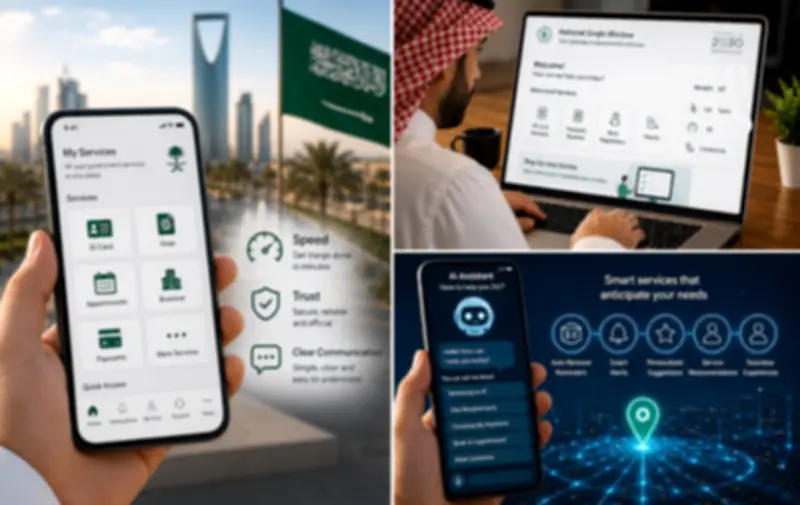
A new study from King Saud University has found that trust, speed, and clear communication are the most valued factors among users of Saudi Arabia’s government digital platforms. The research, conducted by Rayan Mal as part of his master’s degree in the department of media, surveyed 450 Saudi citizens and residents. Nearly three-quarters of respondents (73%) said they have a high level of trust in government digital platforms, citing reliable information, efficient services, and straightforward procedures as the main reasons they continue to use them.
Digital Transformation Reshaping Daily Life
For many residents, these findings reflect daily experience. Saeed Ahmed, an Arab expatriate living in the Kingdom, said Saudi Arabia’s digital transformation has fundamentally changed the way he interacts with government institutions. “I have lived in other countries, but Saudi Arabia’s digital transformation surpasses many of them,” he told Arab News. “Complex services that once required taking time off work and visiting government offices can now be completed with just a few clicks from home.”
However, Ahmed noted occasional challenges, particularly when information takes time to synchronize between different government platforms after services such as passport renewals or sponsorship transfers. To improve the experience, he suggested stronger real-time integration between government systems and a manual “refresh data” option that would allow users to immediately update their information when delays occur.

Visual Guidance and Multilingual Support
Ahmed also believes visual guidance could make digital services even easier to use. “Providing visual guides and short tutorial videos that explain services step by step would save users a great deal of time and reduce errors,” he said. He added that expanding multilingual communication beyond Arabic and English would make essential government services even more accessible, as Saudi Arabia is home to millions of expatriates.
The King Saud University study suggests that these changing expectations reflect the Kingdom’s growing digital maturity. Government platforms are no longer viewed as alternatives to traditional services but as the primary way people interact with public institutions.
Study Focuses on User Experience
“The inspiration came from witnessing one of the most rapid and profound digital transformations in modern governance, driven by Saudi Vision 2030,” Mal told Arab News. He said he wanted to focus on how people experience digital government rather than the technology itself. “What surprised me most was the exceptionally high level of digital maturity and expectation among the respondents. Users no longer view digital platforms as mere alternatives to traditional paperwork, but as the primary, authoritative source of truth.”
According to Mal, fast service is no longer enough on its own. “Reliability builds institutional trust. Clear, jargon-free communication ensures inclusivity, making these platforms accessible to all segments of society.” Respondents also highlighted the importance of consistent information across government platforms, multilingual content, and multiple official communication channels.
Communication Key to Trust
Dr. Haitham Younis, a media professor at King Saud University, said communication has become just as important as technology in shaping public confidence. “Technology is merely the infrastructure — the pipeline. Media and communication represent the human experience.” He said even the most advanced digital platform can fall short if users struggle to understand the information being presented.
Younis believes Saudi Arabia has distinguished itself by combining digital innovation with a user-focused approach to communication. “Under Saudi Vision 2030, the Kingdom has achieved a rare synthesis where user-centric technology meets strategic communication. The transition from a bureaucratic transactional relationship to a fully conversational, transparent and immediate civic interaction is a global benchmark in nation-branding and state-to-citizen communication.”

Future: Predictive and Cognitive Governance
Looking ahead, both the study and its researchers see the next phase of digital government moving beyond simply delivering services online. Mal expects artificial intelligence to play a much larger role in the future. “Five years from now, I expect we will see the shift from reactive digital services to fully predictive and cognitive governance. Users won’t just go to a platform to request a service; the platform will anticipate their needs.”
As expectations continue to rise, the focus is shifting toward creating government platforms that are intuitive, trustworthy, and designed around the people who use them.