French President Emmanuel Macron has become the first European head of state to visit Damascus since the fall of President Bashar Assad in late 2024, marking another pivotal step in Syria’s emergence from years of diplomatic isolation. With Syria’s political transition still fragile, observers are asking what France hopes to gain.
Strategic Calculations Behind Macron’s Visit
Samy Akil, a senior adviser at The Syria Report, said the visit reflects a long-term strategic calculation. “Paris is trying to plan more strategically in the long term,” Akil told Arab News. “France has long seen itself as a leading power in the Mediterranean, especially in Lebanon and, to a lesser extent, Syria.” In that context, Macron’s landmark visit may be “part of an effort by the French government to position itself as the key interlocutor between the EU and Syria — or at the very least to ensure that any future EU policy on Syria aligns with French priorities,” Akil said.
To achieve that, France appears to be backing Syria’s institutional and financial recovery, including, Akil said, “support for reconstruction, the restoration of banking services, and efforts to help Syrian businesses resume operations and revive the labor market.”

Economic Interests and Investment Opportunities
Macron arrived in Damascus on July 6 for talks with interim President Ahmad Al-Sharaa, focusing in part on regional security ahead of the NATO summit in Ankara. The French president was accompanied by a business delegation exploring investment opportunities, Syria’s state news agency SANA reported. France has taken a leading role in Europe’s outreach to Syria since Assad’s departure on Dec. 8, 2024. Paris has pushed to ease sanctions, hosted an economic conference in February 2025 to support Syria, and invited Al-Sharaa to Paris in May.
Economic interests are central to France’s approach in the war-weary country. Benjamin Feve, a senior consultant at Karam Shaar Advisory, said: “France can theoretically help in almost every sector — energy, ports, logistics, health, education, banking and public administration, especially institutional reform.” But, he added, the key word is “theoretically.” “French companies remain very risk-averse,” he explained. “Like most firms, they are still concerned about lingering US sanctions, unclear investment rules, weak arbitration mechanisms and the disconnect in banking services.” He added that high input costs and weak purchasing power inside Syria remain additional obstacles.
Indeed, nearly 15.6 million people in Syria, or two thirds of the population, require humanitarian assistance, and 90 percent are living below the poverty line, according to UN figures. The country’s GDP has shrunk by more than half since the outbreak of the civil war in March 2011.
Laying the Groundwork for Investment
As a result, France’s most immediate role may be less about large-scale investment and more about laying the groundwork for it, according to Feve. That could include “supporting the frameworks that would make investment possible: better laws, clearer procedures, technical assistance, and institutions that are reliable and predictable,” he suggested.
Beyond reconstruction, France also sees Syria as a potential hub for regional trade routes linking the Gulf to Europe, Akil said. Early examples include commercial agreements involving shipping giant CMA CGM, aviation partnerships and plans for dry ports. Those ambitions were reflected in a series of agreements signed on July 7 covering transport, aviation, health, banking, trade, infrastructure and higher education. Among them was a strategic partnership between Syria’s ports authority and CMA CGM spanning maritime, air and logistics operations, according to Syrian media. In addition, Syrian Foreign Minister Asaad Al-Shaibani and his French counterpart, Jean-Noel Barrot, signed a framework declaration on comprehensive cooperation to strengthen political, economic and institutional ties across multiple sectors.
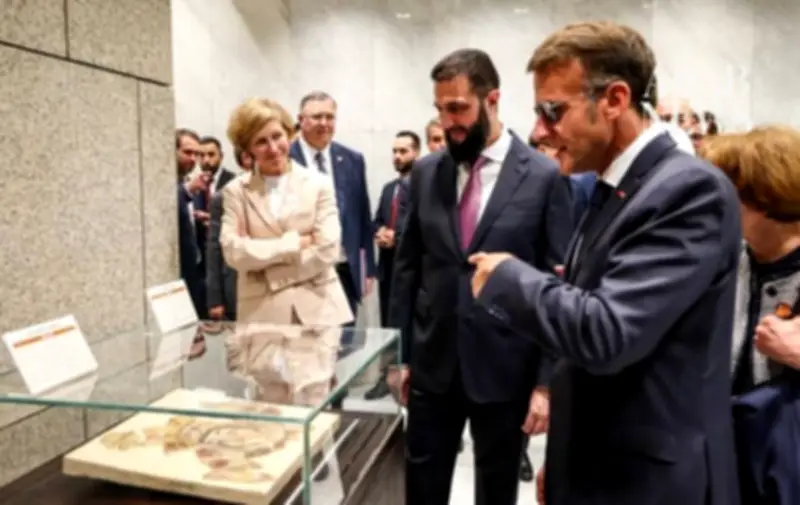
Macron also used the visit to return 23 Syrian archaeological artifacts that had been in Paris for about 15 years after being loaned for an exhibition. The items were flown to Damascus aboard his presidential aircraft and placed in the National Museum.

Limits of French Influence
Despite France’s early engagement, Nanar Hawach, senior Syria analyst at the International Crisis Group, said its influence “may only go so far, given that Washington, the Gulf capitals and Turkiye hold the levers that matter most to Damascus.” The US controls sanctions policy and access to international financial systems, shaping whether foreign firms can invest or operate in Syria. Meanwhile, Gulf countries, including Saudi Arabia, Qatar and the UAE, have the political willingness and the financial capacity to fund large-scale reconstruction.
Security Concerns and Counterterrorism Cooperation
Security concerns also complicate France’s approach, as Joshua Landis, director of the Center for Middle East Studies at the University of Oklahoma, pointed out. “As French businesses make more investments in Syria, France will be even more concerned about terrorist activity in Syria and the possibility that it will undermine regional stability and French investments in Syria,” Landis told Arab News.
That risk was underscored during Macron’s recent visit. “President Macron’s trip to Syria was clearly impacted by the bombs that exploded not far from his hotel,” Landis said, referring to two explosions near the Four Seasons hotel in central Damascus, where Macron was staying, that injured 18 people, according to Syrian media. “Both he and President Al-Sharaa put their best face forward and ignored the explosions, but the visit narrowly escaped disaster.” Macron wrote on X after the twin blast: “Nothing can smother the aspiration of Syrian women and men to live in a fully sovereign, safe, pluralistic, and united Syria.” Later that day, Al-Sharaa reportedly praised Macron’s courage for continuing his visit. On July 9, Syrian authorities said they had arrested suspects linked to the bombings, which officials, citing preliminary investigations, attributed to Daesh, though the militant group did not claim responsibility.
Counterterrorism cooperation is a central pillar of France’s engagement, analysts say. “France has been developing improved cooperation from Damascus on identifying and neutralizing (Daesh) cells, disrupting terrorist financing, and dismantling extremist propaganda,” Landis said. “This counterterrorism and security collaboration involves strategic intelligence-sharing and institutional support. In exchange, France — acting alongside the US — has moved to support institutional security and stability.” Macron said during his visit that France was exploring expanded security cooperation, including potential support from special forces in the fight against Daesh.
Tracking French Foreign Fighters
Another priority is tracking French nationals who have joined extremist groups in Syria. “France is, naturally, focused on tracking and resolving their status,” Landis said. “Al-Sharaa has promised that they will not be allowed to plot foreign operations from Syrian soil, but that may not entirely reassure French authorities.” He added that AFP quoted a French security source describing cooperation between Damascus and Western countries in combating extremists as “generally good.” However, the continued presence of these fighters “poses a problem for Al-Sharaa because some reject integration into the Syrian military and adopt more extremist positions,” Landis said. “For this reason, France wants actionable field intelligence on French nationals who traveled to the region to join extremist groups. Paris needs Damascus to help track, locate, or verify the status of these individuals to prevent their return to Europe.”
Providing more detail, analyst Akil said: “There are a few dozen French nationals or foreign fighters operating in or still present in Syria. The most notable of them is Firqat Al-Ghuraba, which operates in Harem in Idlib and is under the command of Omar Omsen.” The latter is the adopted name of the Franco-Senegalese criminal-turned-preacher Oumar Diaby. French security sources previously told AFP that “around 50” people are believed to be part of Omsen’s group, based in a displacement camp known as the French Migrants Camp in Idlib.
As a result, France appears focused on containment rather than repatriation, analysts say. “France’s priority here is to ensure that the remaining foreign fighters are either absorbed into the state apparatus or kept under tight surveillance by Syrian intelligence and security services, in coordination with French counterparts,” Akil said, adding that there seems to be “little appetite in France to bring these fighters home.” He continued: “In many Western countries, repatriating battle‑hardened fighters generates intense domestic backlash and negative publicity, and France is no exception. The aim instead is to keep these individuals on a very short leash so they cannot remobilize or form new groups that might conduct operations outside Syrian territory. From what we understand, coordination between Syrian intelligence authorities and French intelligence services on this issue has so far been relatively effective.”
Similarly, analyst Hawach said France “may want Damascus to become the partner that keeps (Daesh) suppressed and prevents Syrian territory from again serving as a base for attacks abroad, as the (Kurdish-led) Syrian Democratic Forces can no longer carry that role on its own.” He added that “cooperation would likely center on tighter state control over the foreign fighters integrated into Syria’s armed forces and on workable custody and prosecution arrangements for the European detainees still held in the northeast.”
Migration Policy and Refugee Return
Beyond security, migration policy may be another driver of engagement. Since the toppling of Assad, the EU has pushed to repatriate Syrian refugees. Within days of his fall in December 2024, Germany, Denmark, Sweden and Austria suspended asylum processing for Syrians and announced plans for “orderly repatriation and deportation.” Multiple member states have since reviewed Syrian protection status and begun revocation proceedings.
“Refugee return is a major structural driver behind France’s push to improve relations and normalize diplomatic ties with Syria’s government,” Landis said. “Facilitating the ‘safe, dignified, and voluntary return’ of Syrian refugees is a core pillar of the EU’s and France’s renewed diplomatic approach toward post-Assad Damascus.” However, he noted that “France and Europe have been explicit that they do not want to force refugee return before Syria is stable and has jobs.” Macron, Landis said, “explicitly tied refugee returns to Syria’s internal recovery,” adding: “European leadership acknowledges that refugees will not return home unless basic living conditions exist.”
Still, Hawach argued France’s position is more limited. “France’s shift is shaped more by security and investment than by a mass return agenda,” he said, noting the country hosts a comparatively small Syrian population and has kept its policies voluntary. “The migration pressure shaping European policy on Syria comes mainly from Berlin and The Hague, rather than Paris,” he stated.
While Macron’s trip is a bet that France can lock in influence over Syria’s reconstruction and security architecture, whether Paris can turn early moves into lasting leverage remains uncertain.