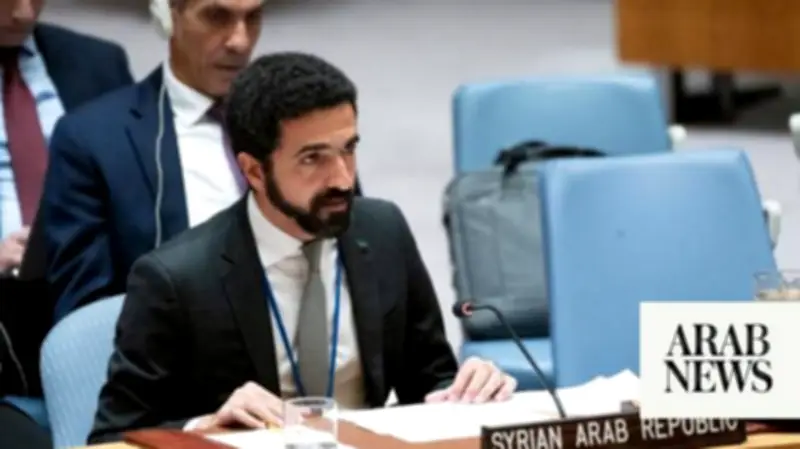
Syria's ambassador to the United Nations, Ibrahim Olabi, declared that Israel is the primary impediment to stability in Syria during a Security Council meeting on Sunday. He accused Israeli Prime Minister Benjamin Netanyahu of undermining a US-brokered memorandum of understanding between Washington and Tehran aimed at de-escalating regional tensions. Olabi noted that on the same day the deal was announced, Netanyahu stated that Israeli forces would not withdraw from seized Syrian territory.
Envoy Accuses Israel of Violating International Law
“This statement confirms that Israel is the main obstacle to stability in Syria,” Olabi said. He accused Israel of violating international law and Security Council resolutions while Syria “is choosing wisdom and diplomacy.” The envoy welcomed the US-Iran agreement but highlighted Israel's refusal to comply with the 1974 Disengagement of Forces Agreement, under which Israeli forces have conducted near-daily incursions and detained civilians in southern Syria.
Transitional Justice and Missing Persons
Olabi highlighted the case of Rania Al-Abbasi, a dentist and former Syrian national chess champion who went missing 13 years ago with her husband and six children. It was confirmed this month that all were killed during the civil war by gunmen loyal to the former Assad regime. “The ambiguity has ended but the responsibility to uncover the truth and achieve justice has not,” Olabi said. He renewed the commitment of new Syrian authorities to uncover the fate of all forcibly disappeared persons and advance transitional justice “without compromising.”

Progress in Five Areas
Olabi outlined five areas of progress: about 6,000 former regime members in detention, including senior officers, will face transitional justice; implementation of Presidential Decree No. 13 granting citizenship to eligible Kurds; economic initiatives including energy partnerships with ConocoPhillips; return of over 3.5 million refugees and displaced persons; and ongoing operations against Daesh and cross-border arms smugglers. “These battles are not Syria’s alone; they are global battles, even if Syria is fighting them on your behalf on the ground,” Olabi said.
UN Officials Describe Fragile Transition
UN deputy special envoy Claudio Cordone said the post-Assad transition is “at a critical phase, with opportunity and fragility existing side-by-side.” He noted that Israeli forces maintain a near-daily presence in southern Syria, violating the 1974 agreement. Damascus has “exercised restraint while signaling openness to a security arrangement with Israel,” Cordone said, reiterating UN calls for Israel to respect the agreement and Syria’s sovereignty. Indirect elections for the transitional parliament took place peacefully in Hasakeh and Ain Al-Arab, but the People’s Assembly has not been constituted due to delays in presidential appointments. “The delay is generating anxiety,” Cordone said, stressing the need for meaningful representation of all Syrians, particularly women.
Demonstrations and Transitional Justice Law
Demonstrations in Idlib, Aleppo, Hama, Deir Ez-Zor, and Damascus called for accountability for civil war-era crimes, some accompanied by violence. Syria’s mufti issued a fatwa criminalizing revenge, and authorities reported 5,989 people linked to the former regime are in detention awaiting prosecution. Cordone called for a draft transitional justice law covering “all perpetrators of atrocity crimes, not just those associated with the Assad regime.” He highlighted the sentencing by a Dutch court on June 15 of a former paramilitary member to 26 years for crimes against humanity.
Humanitarian Situation and Funding Gap
Indrika Ratwatte, acting assistant secretary-general for humanitarian affairs, said about 1.6 million refugees and nearly 2 million displaced people have returned since December 2024. However, the $2.92 billion humanitarian appeal is only 20 percent funded at midyear. He called for more predictable funding alongside investment under the government’s “No Camps, No Tents” vision. Cordone also referenced a UN report documenting sexual violence by former regime members, Daesh, and the Syrian National Army against Alawite, Murshid, Bedouin, and Druze communities.

Kurdish Integration and Sweida Stalemate
Regarding northeastern Syria, Cordone said implementation of the Jan. 29 agreement between the government and the Syrian Democratic Forces is progressing, with four SDF brigades integrated and 1,300 SDF-affiliated detainees released. In contrast, no progress has been made on the September 2025 Sweida roadmap agreement between Syria, Jordan, and the US. Distrust persists, calls for secession threaten national unity, and UN mediation failed to allow over 13,500 students in Sweida to sit exams.