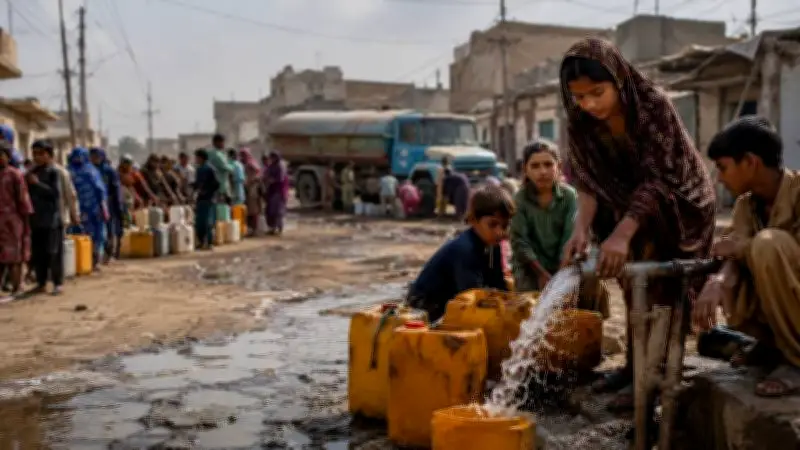
In the middle of June, with temperatures pushing past 40 degrees Celsius, residents of Lyari, Orangi, and Korangi are doing what they have done every summer for thirty years: rationing. Not electricity this time, water. Tanker mafia rates spike. Taps run dry for days. Children miss school because collecting water from distant hand pumps is a morning job that belongs to them. And yet, forty kilometres away, in DHA and Clifton, sprinkler systems maintain emerald lawns with water drawn from the same depleted Indus basin, the same crumbling K-Electric-adjacent infrastructure, the same Karachi Water and Sewerage Board that has not been properly reformed since the late 1980s.
This is not a scarcity problem. It is a distribution problem. And distribution problems in Pakistan are, ultimately, political problems. Karachi receives its water primarily from the Indus River through the Keenjhar and Haleji lakes, supplemented by the Hub Dam and a patchwork of groundwater extraction points. The city is entitled to roughly 1,100 million gallons per day under inter-provincial allocations. It receives, on most days, somewhere between 550 and 650. The gap of some 600 million gallons has never been adequately explained by any administration, federal or provincial.
The KWSB loses roughly 35 to 40 per cent of what it does receive to what engineers diplomatically call "unaccounted-for water": broken mains, illegal connections, and the informal economy of theft that has grown up around every crack in the system. The KWSB has, over the decades, become something of a museum piece — a 1990s institutional design preserved in aspic, staffed beyond capacity, revenue-starved, and politically managed to serve patronage rather than pipes. Successive Sindh governments have treated it as an employment scheme and a source of leverage. The federal government has used Karachi's water as a bargaining chip in centre-province negotiations. The result is a city of 25 million people that plans infrastructure in the past tense.

Karachi Is Not Dying from Heat — It Is Suffering From Policy Failure
The water tanker business in Karachi is estimated to be worth several billion rupees annually. It is not a black market in any meaningful sense — it operates openly, it is politically connected, and it relies entirely on the KWSB's failure to function. When the board works, the tanker mafia suffers. The tanker mafia, therefore, has every incentive to ensure the board does not work and the political and administrative tools to act on that incentive. This is the ecosystem that has persisted through MQM governments, PPP governments, PTI interventions, and military operations. It is more durable than any political party because it is not ideological. It is a business model.
When Karachi runs dry, the blame flows immediately upstream to Punjab, to the federal government, to the Indus River System Authority, to Indus water politics. These are not wrong targets. But they are incomplete ones. Poorer communities, which is to say, most of Karachi, pay a tanker premium that can consume ten to twenty per cent of a household's monthly income. This is a poverty tax, extracted not by the state but by the vacuum the state has deliberately left. The wealthiest neighbourhoods, meanwhile, have largely privatised their water supply through underground storage tanks, private boring, and filtration units. They have, in effect, seceded from the crisis. Their electoral weight goes elsewhere. Their voices in the national conversation are about the stock exchange, the rupee, and the International Monetary Fund. Lyari's taps are not their problem.
This week, the Sindh Irrigation Department Authority chairman demanded the removal of the Indus River System Authority chief over Sindh's water allocations, the latest in an unbroken chain of centre-province disputes that have defined Pakistan's water politics since the 1991 Accord. These disputes are real and consequential. Sindh's farmers are genuinely receiving less water than they are owed; the upstream diversions are genuinely illegal; the federal regulatory body is genuinely captured. None of this is invented. But the Indus River System Authority argument, necessary and legitimate as it is, has also served, for thirty years, as a remarkably convenient alibi for the Sindh government's failure to manage the water it does receive.

Why The 2026 Harvest Is A Federal Failure, Not Four Provincial Ones
When Karachi runs dry, the blame flows immediately upstream to Punjab, to the federal government, to the Indus River System Authority, to Indus water politics. These are not wrong targets. But they are incomplete ones. The K-IV project to bring additional Indus water to Karachi has been under construction, in various stages of incompleteness, since 2014. It has survived four changes of federal government and two complete turnovers of Sindh's provincial cabinet. Every administration has cited the previous one's mismanagement. Meanwhile, K-IV delivers nothing.
The technical solutions to Karachi's water crisis are not mysterious. Urban water economists have produced, over the past two decades, a near-consensus on what functional reform requires: autonomous utility governance with professional management and insulated boards; cost-reflective tariffs with robust pro-poor subsidies for the lowest consumption tiers; metering at scale; aggressive reduction of non-revenue water through network rehabilitation; and investment in decentralised treatment capacity. Singapore did this in the 1970s. Amman did it in the 1990s. Metro Manila did it imperfectly but consequentially through a controversial privatisation that, whatever its flaws, delivered piped water to neighbourhoods that had never had it.
What Karachi has never had is not a reform blueprint. It has the blueprints. What it lacks is the political will to implement one, because implementation requires dismantling the patronage networks, firing the ghost employees, cutting off the tanker operators, and asking the middle class to pay for water at a rate that reflects its actual cost. Each of these steps offends a constituency that the Sindh government, like all governments, depends on for political survival. Karachi produces roughly a third of Pakistan's GDP and pays a disproportionate share of the country's taxes. It cannot, reliably, fill a glass of water.
There is, however, a constituency that has never been properly mobilised: the working-class Karachiite who spends three hours a day managing water logistics and a fifth of her income buying it. She does not appear in think-tank reports as a political actor. She is a number in a United Nations Development Programme briefing. But she is also a voter, and she is angry in ways that the current political settlement does not adequately absorb.
Pakistan’s Power Crisis Is Not New — But It Is Becoming Unmanageable
What makes this moment particularly urgent is that Pakistan's water stress is no longer a function of governance alone. Climate change is accelerating the depletion of the Indus basin. Glacial retreat in the upper reaches will, within decades, shift the seasonal availability of meltwater in ways that will fundamentally alter the downstream calculus. The 2022 floods were not simply a disaster; they were a harbinger of a system under stress, of aquifers over-pumped, of river courses choked with sedimentation that irrigation departments have not dredged in years.
In this context, the KWSB's dysfunction is not merely a local embarrassment. It is a systemic vulnerability. A city that cannot distribute the water it has today will not be able to manage the volatility of what it will have in 2040. Karachi needs not just better pipes. It needs a fundamentally different governance architecture, one that treats water not as a political resource to be allocated according to patronage, but as infrastructure that the city's economy and its poorest residents cannot survive without.
After every Karachi heatwave, after every summer of tanker queues and dried-up hand pumps, a familiar ritual unfolds. KWSB issues a statement. A minister promises an inquiry. A television anchor broadcasts standing in front of an empty pipe. Nothing changes. The question that is rarely asked, not in the National Assembly, not in the Sindh Assembly, not with any real seriousness in the press, is a simple one: who benefits from the current arrangement? Not rhetorically, but specifically. Which contracts are awarded to which companies for which incomplete projects? Which tanker operators hold which political connections? Which KWSB directors have been appointed by which ministers, and what were their qualifications?
This is investigative journalism that Pakistani media has not yet done at scale. It is also the political accountability that no party has yet found it in its electoral interest to pursue. The water crisis is legible as a development failure, as a climate story, as a centre-province dispute. It is less comfortable to read as corruption — not petty, opportunistic corruption, but the institutional, systemic, normalised variety that does not require any individual to be villainous. It only requires that no one with power has a reason to stop it.
Between Virtuous City And Bare Life: Al-Farabi, Agamben And The Crisis of Human Becoming In The Slum
Karachi produces roughly a third of Pakistan's GDP and pays a disproportionate share of the country's taxes. It cannot, reliably, fill a glass of water. That is not a resource problem. It is a political choice, and it is one that Karachiites, and the governments that claim to represent them, are going to have to confront before the climate makes the choice irreversible.