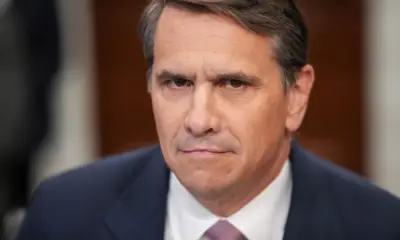
Marc Saxer is a political analyst, strategist, and writer who has worked in Asia for over a decade. He currently serves as Regional Coordinator at the Friedrich-Ebert-Stiftung Asia-Pacific (FES) Geopolitics and International Order Program, focusing on geopolitics and world order. I had the opportunity to ask him several questions about his new book, Geopolitical Conflict in the Wolf World. Below are my questions and his responses.
Relevance of Hobbes in Today's World
Ahmad Faruqui (AF): You state that we live in an increasingly predatory world where Thomas Hobbes's description still applies: “The law of the jungle rules and man is a wolf to man.” Is this 17th-century view still relevant?
Marc Saxer (MS): Hobbes described the English Civil War, when order collapsed and violence spread under anarchy. Today, we see the breakdown of the international order and the highest number of violent conflicts since World War II. The question of how to bring order to a world marked by violent disorder is more relevant than ever.

Non-Western Powers and the New World Order
AF: You claim that after a long time, non-Western powers that once dominated the globe will have a decisive say in shaping the next world order. What evidence supports this?
MS: In an asymmetrical multipolar world, no single victor is likely to impose order on all others. For the first time in history, a truly global order must be negotiated among powers from both Western and non-Western civilizations. Drawing on historical experiences and philosophies of non-Western civilizations, I explore how a non-hegemonic, multipolar rules-based order could stabilize the Wolf World.
Key Powers in the Emerging Order
AF: Which powers are likely to shape the new world order?
MS: In the emerging asymmetrical multipolar order, there are three categories of powers with differing rule-making capacity. The United States and China are in a class of their own, though not fully dominant. Regional powers like Brazil, Mexico, Nigeria, South Africa, Turkey, Israel, Saudi Arabia, Iran, Pakistan, and Indonesia are decisive within their theatres but lack global projection. In between stand three continental-scale question marks: Russia, India, and the European Union. Each has potential to become a pole but faces internal contradictions.
US Adaptation to Diminished Role
AF: How will the US reconcile with a reduced role as the world's only superpower?
MS: The United States is militarily, financially, and politically overstretched. Future administrations will likely shift hegemony burdens onto allies while extracting resources from partners and adversaries. The US will remain the strongest power for some time but must increasingly operate within a multipolar system.
Reasons for Changing World Order
AF: Why is the world order changing? Is Pax Americana ending?
MS: The global distribution of power is shifting, with US hegemony challenged simultaneously by Russia in Europe, Iran in the Middle East, and China in Asia. Trade-offs between these theatres forced the US to abandon its doctrine of fighting and winning two major wars simultaneously, marking the end of the unipolar moment.
Decline of American Civilization?
AF: What drives the decline of American civilization?
MS: American civilization is not declining; rather, American power is declining relative to other powers. Yet, it would be a dangerous mistake to count the United States out.
Future of US Influence
AF: Will the diminution of America's influence worsen or taper off?
MS: That depends on major powers' ability to adapt to shifting global opportunities and address internal challenges. Remarkably, all major powers face significant internal problems, so linear conclusions about the future are unwise.
Historical Precedents
AF: Has the world undergone such a transition before?
MS: The rise and fall of powers is as old as the dynamics described by Thucydides.

Europe's Opportunity
AF: You state that in the multipolar Wolf World, Europe has a unique opportunity to maintain peace and stability. How likely is Europe to seize this, given internal divisions?
MS: Europe, as a fragile political entity held together by treaties, has a fundamental interest in safeguarding a rules-based international order. It shares common ground with most states that recognize the need for rules to protect against great power abuse.
Asia's Role
AF: What role will Asia play in the new world order?
MS: Asia is emerging as the geoeconomic center of gravity and a major geopolitical power center. Major Asian powers, especially China, will be important rule-makers in the multipolar world. Considerable statesmanship is needed to manage regional tensions and prevent major confrontations.
Pakistan's Potential Role
AF: What role will Pakistan play?
MS: Pakistan sits at the fault lines of virtually every major conflict in its region. If it resists the temptation to seek rent for its security and intelligence capabilities, it has potential as a stabilizer and mediator. Its recent role in facilitating dialogue between Iran and the United States is a case in point.
Postscript
I learned much from interviewing Saxer. I was intrigued by his quotation from Thomas Hobbes: “The law of the jungle rules and man is a wolf to man.” I discovered that Hobbes used it in the dedicatory epistle of his 1642 treatise De Cive to describe human brutishness in the state of nature. Further research revealed that Hobbes borrowed the expression from the ancient Roman playwright Plautus, who wrote “Lupus est homo homini” in his comedy Asinaria. The concept has been observed for thousands of years.
Another intriguing point was Saxer’s reference to Thucydides, an Athenian general and historian from the fifth century BC. His work History of the Peloponnesian War chronicled the 27-year conflict between Athens and Sparta. He is regarded as the “father of scientific history” for his rigorous use of eyewitness testimony and critical analysis, viewing history as a timeless cycle driven by human psychology. This brought to mind the French proverb: “Plus ça change, plus c'est la même chose” – the more things change, the more they stay the same.