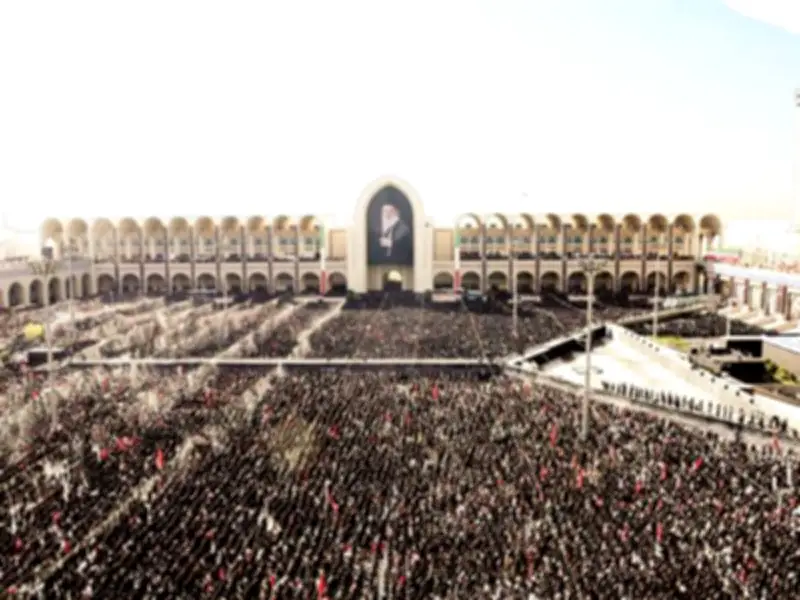
Hundreds of thousands of mourners flooded Tehran on Sunday for a mass funeral prayer honoring Iran's late Supreme Leader Ali Khamenei, who was killed in US-Israeli airstrikes that began on February 28. The ceremony at Imam Khomeini Mosalla Mosque was led by Ayatollah Jafar Sobhani and attended by Iranian President Masoud Pezeshkian, senior military and political officials, and religious figures.
Funeral Procession Draws Massive Crowds
Mourners, many carrying Iranian flags, arrived at the venue in the early hours, filling the vast courtyard of the prayer complex. Dressed in black and draped in the red, white, and green flags of the Islamic Republic, they held up portraits of Khamenei and his son and successor, Mojtaba. Chants of "Death to America" echoed through the hall as a compere encouraged the crowds through a loudspeaker.
Khamenei's coffin, along with those of his daughter, son-in-law, daughter-in-law, and 14-month-old granddaughter, was displayed outdoors under glass after a day of lying in state for senior leaders and foreign officials. Three of Khamenei's sons—Mostafa, Meysam, and Masoud—prayed beside the coffins, but Mojtaba, who has succeeded him as supreme leader, did not appear and has not been publicly sighted since the attack, reportedly due to injuries.

Week-Long Funeral Ceremonies Across Iran and Iraq
The official funeral schedule includes public farewell ceremonies in Tehran, a main funeral procession on Monday, and rites in Qom on July 7. On July 8, ceremonies are planned in Iraq, including Baghdad, Najaf, and Karbala, where the body will be received by religious and political figures before being transferred to major Shia shrines. The final burial is scheduled for July 9 at the Imam Ali Reza Shrine in Mashhad, one of Shia Islam's holiest sites.
Foreign leaders and official delegations from across the region and beyond paid tribute during the ceremonies, which began Friday. The Islamic Republic is staging a week of mass funeral processions to demonstrate public devotion to the theocratic state and revolutionary zeal.
Mourners Express Grief and Defiance
Arash Rahimi, 40, told a news wire in the crowd: "Everyone here has come to avenge the blood of their supreme leader. As our leader has said, we have a blood feud with the United States. Our relations with the United States will never be good." Women in black chadors wore white visors or held umbrellas to shield from the hot sun.
The funeral occurs at a critical moment for Iran, with its clerical rulers backed by the military buoyed by surviving the onslaught with their ruling system intact. The war has been paused for a ceasefire under an agreement with Washington that Iran's authorities say will bring huge economic benefits, framing it as a victory over a superpower.
Political Reactions and Context
US President Donald Trump, quoted by Axios, said peace talks had been paused for the funeral events and remarked that with Iran's leaders all attending, Washington could take them out with "one shot," but added, "we are not going to do that because then we would have nobody to negotiate with." Trump expressed surprise at Iranians crying, suggesting it might be "fake tears." Iran's embassy in Armenia responded on X: "You don't understand these things because you have neither civilization, nor history, nor honor."
Within Iran, beyond displays of solidarity, public loyalty remains difficult to assess. Weeks before the war, hundreds of thousands protested against the government, resulting in a violent crackdown with thousands killed. However, little public dissent has been visible since the US and Israeli attacks began. The war caused over 3,000 deaths, including many senior politicians and military commanders, and destroyed military bases and infrastructure, causing billions in damage.