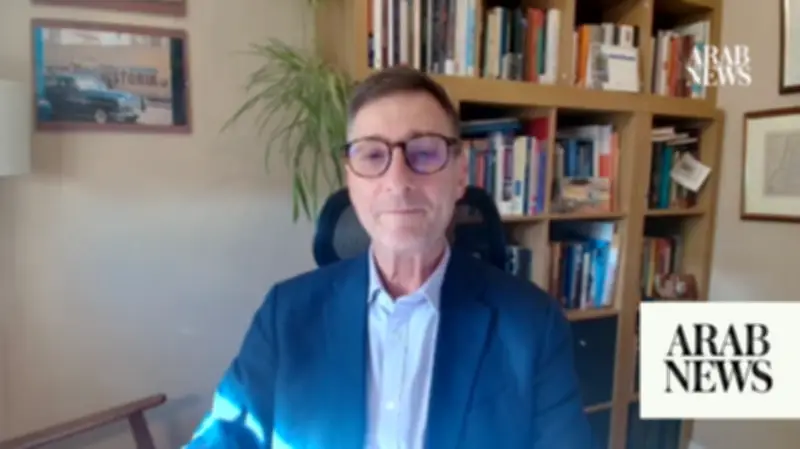
A professor of international relations has stated that diplomacy remains the only viable route to lasting peace in the Middle East, following the US announcement on Friday that Israel and Hezbollah had agreed to a ceasefire in Lebanon. This development came hours after planned US-Iran talks in Switzerland were postponed. Yossi Mekelberg, a senior consulting fellow with the Middle East and North Africa program at London's Chatham House, appeared on the Arab News current affairs program “Frankly Speaking” to share his analysis.
Diplomacy Over Military Force
Mekelberg argued that war alone cannot deliver sustainable results. “If logic and rational thinking prevail, we see that wars don’t achieve their objectives,” he told host Katie Jensen. He emphasized that diplomacy must take precedence, with military force reserved as a last resort. “So, what’s the alternative? Diplomacy. That’s what we haven’t seen for quite a while — while only diplomacy can resolve this very difficult issue … The tensions are real, but diplomacy is what can actually achieve a long-lasting and sustainable solution,” he said.
Regional Ownership of Peace Efforts
According to Mekelberg, any durable diplomatic initiative must originate from within the Middle East, driven by regional actors who have learned from recent conflicts that the situation could worsen unless root causes are addressed. “It’s not only about expecting the US or any external forces to solve it. Can (there) be a discourse within the Middle East?” He noted that diplomacy would be most effective if it emerged organically from within the region.

US-Iran Memorandum of Understanding
Mekelberg described the recent memorandum of understanding (MoU) between the US and Iran as a potential opening to end the war, despite major unresolved questions. “This is definitely a watershed in the Middle East,” he said. “One of the problems right now (is) that all we have seen is the signing of an MoU. The details — and always in agreements, the devil is in the details — too many fronts, too many issues are still open.” He pointed to unresolved issues surrounding Gaza, the West Bank, Israeli-Palestinian relations, and Lebanon, including the timeline for a possible Israeli withdrawal. “Do we know what’s the future of Gaza? Definitely not. The West Bank, the future of relations between Israel and Palestine in general, are we any closer to a peace between the Israelis and the Palestinians? Lebanon, even with the MOU, what is the timeline of Israel withdrawing from Lebanon?”
Impact on Gulf States
The conflict and its regional spillover have also unsettled Gulf states. After the US and Israel launched joint attacks on Iran on Feb. 28, Tehran retaliated by launching missile and drone attacks at Gulf neighbors and other Arab countries hosting US bases. “When we know that the Gulf states suffered, it was a big shock to think that the Gulf would be attacked by a neighbor and be involved in a war (in which) it has no interest,” Mekelberg said. “So, you take all these factors and the relations with the international community, especially with the US, and this can be one of the most momentous moments in the region’s history.”
Details of the US-Iran MoU
The 14-point MoU, signed on June 17 through Pakistani mediation, includes a commitment by the US and Iran to hold further talks within 60 days on a final agreement. It also calls for reopening the Strait of Hormuz and for the US to lift sanctions on Iran. On Friday morning, a new round of direct US-Iran talks in Switzerland was postponed. The White House cited logistical issues, while other reports indicated Iran suspended the talks because of continued violence in Lebanon. Later on Friday, Israel and Hezbollah reached their own ceasefire agreement. However, shortly after the announcement, Reuters, citing sources in northern Israel, reported that strikes could still be seen across the border in Lebanon.

Israeli-Palestinian Conflict and Alternatives
As diplomacy faces challenges in Lebanon, Mekelberg argued that a similar lesson applies to the Israeli-Palestinian conflict. If a two-state solution remains politically out of reach, what is the alternative? “It’s not an easy question to answer, but it’s the right one,” he said. “The alternative is continuing this bloodshed. The Israelis feel isolated more than ever. Ministers are boycotted, can’t even travel outside Israel. Israel, as a result of the occupation, (has) lost its moral high ground. It has compromised its democracy. It doesn’t live in more security. The Palestinians (are) living in horrific conditions … This is not a sustainable situation. We need to start to imagine the alternative.” One possible framework, he said, is an Israeli-Palestinian confederation. “I more and more believe that an Israeli-Palestinian confederation is the way forward in which you basically acknowledge the one-state reality that was created there, but in a two-state solution.” He invoked the Oslo era as an example of political imagination, even if it did not ultimately achieve peace.
Critique of Netanyahu's Strategy
Mekelberg argued that while Israel under Prime Minister Benjamin Netanyahu has demonstrated military power, it lacks a long-term strategy and therefore has not delivered what Israelis want. Still, he said he believes upcoming elections could bring change. “I don’t think Netanyahu, after all these years as prime minister, the longest-serving prime minister in Israel, knows any better,” he said. “But at least in the case of Israel, the voters, the electorate, are going to have a chance very soon, not later than the end of October, for all the voters to say, ‘Hey, we want change because we are embroiled in all these fronts with no resolution. We were promised absolute and total victory, and instead of that … all these fronts are open.’” For Mekelberg, Israel’s battlefield gains amount to tactical achievements rather than a coherent political strategy. “It was a show of military force, but this is tactical. This is not a long-term strategy. No exit plan, no idea how to translate the use of military powers, military superiority, into political achievement. It doesn’t resolve the Palestinian issue. Hamas hasn’t gone anywhere. The situation in the West Bank is deteriorating by the day, if not by the minute.”
Lessons from 1982 Lebanon Invasion
He pointed to Israel’s 1982 invasion of Lebanon as a warning against relying on force without a political endgame. “In 1982, Israel went into Lebanon with the same idea of some sort of regime change. It took 18 years and hundreds and hundreds of Israeli soldiers killed, let alone thousands and thousands of Lebanese killed. Did it make Israel more secure? The opposite. When military power is needed as a last resort, yes, it needs to be used, but it became the only tool in the toolbox under Netanyahu and his more extreme right wing. I think Israel is not more secure.”
Normalization and Arab Peace Initiative
That critique extends to broader regional diplomacy, including the debate over normalization between Israel and Arab states. Saudi Arabia has consistently argued that regional stability and progress toward Palestinian statehood must go hand in hand. Mekelberg said that the Saudi position “proved to be the right one” because while the Abraham Accords improved relations between Israel and Arab signatories, they also helped allow Israel to sideline the Palestinian issue. He said normalization should be offered after reaching a two-state solution, serving as an “incentive” rather than an upfront concession. He also argued for a return to the Saudi-proposed Arab Peace Initiative. The initiative, endorsed by the Arab League in 2002, calls for full Israeli withdrawal from Arab territories occupied since June 1967 and acceptance of an independent Palestinian state with East Jerusalem as its capital, in return for normal relations with Israel. “The Abraham Accords, they definitely improved relations between the UAE and Israel,” Mekelberg said. “But if you look at how it helped Israel to override the Palestinian issue — without justifying ever anything that Hamas did — but at the end of the day contributed to destabilizing the region in the longer term, I think going back to the Saudi initiative, to the Beirut Declaration, we are all supporting normalization. The minute that Israel will agree to a two-state solution and normalize relations with the Palestinians first, then the rest of the region — or at least most of the region, definitely Saudi Arabia — will follow suit.” He said the problem lies not with the Abraham Accords themselves but with how Netanyahu interpreted them, enabling Israel “to avoid dealing with the Palestinian issue.”
Concerns for Israeli Democracy
Mekelberg also said he was concerned about the health of Israeli democracy after nearly two years of sustained conflict. “I’m constantly worried about Israel’s state of democracy,” Mekelberg said, emphasizing the need to “imagine Israel beyond Netanyahu.” “This is the time to look beyond Netanyahu. And luckily the Israeli people will have an opportunity soon to have a say in this.”
Implications of US-Iran MoU for Israel
Asked what the Iran-US MoU meant for Israeli leaders, Mekelberg pointed to the inability of Netanyahu’s far-right government to offer voters a clear resolution. “Two, three months before the election, what is Netanyahu going to show the voters? Oct. 7, 2023, happened under his premiership. Israel’s isolation in the world is more than ever. A prime minister with an ICC (International Criminal Court) warrant against him. They’re again in the quagmire of Lebanon while the north of Israel is not secure. This is not to absolve Hamas. This is not about absolving Hezbollah. This is not the case. It is how to make the alternative to a two-state solution more attractive to the majority of Palestinians. How to work with the Lebanese government and other forces within the region and internationally to ensure that the Lebanese government is capable of reaching an agreement with Israel, so that it has full control of the border on the Lebanese side, and Israel on the Israeli side without occupation. Otherwise, it will continue: low intensity war, then a more intense war.”