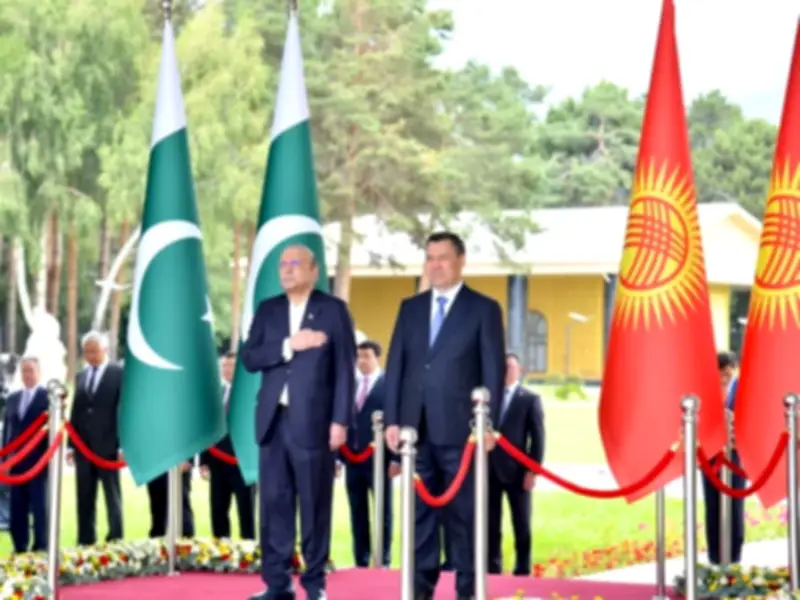
President Asif Ali Zardari and Kyrgyz President Sadyr Japarov on Tuesday reaffirmed their commitment to further strengthening bilateral ties, expanding economic cooperation, and enhancing regional connectivity. The commitment came during delegation-level talks held in Cholpon-Ata, Kyrgyzstan, where Zardari arrived on Monday for a four-day official visit at Japarov's invitation.
Deep-Rooted Brotherhood and Shared History
Speaking at the talks, President Zardari said Pakistan and Kyrgyzstan shared "deep-rooted brotherly relations based on common faith, shared history, and cultural links." He stressed the need to further deepen cooperation by increasing trade, improving connectivity through more direct flights, and exploring new avenues of collaboration. The president said both countries should work together to achieve shared progress, noting that neighbours must strengthen cooperation for mutual prosperity.
Zardari also congratulated Kyrgyzstan on its election as a non-permanent member of the United Nations Security Council for the 2027–2028 term, describing it as a reflection of the international community's confidence in the country's constructive role in promoting peace, security, and multilateral cooperation. He said Pakistan looked forward to working closely with Kyrgyzstan on regional and international issues.

Historic Silk Route Links and Economic Potential
Highlighting historic links through the ancient Silk Route, Zardari expressed confidence that the longstanding relationship could be strengthened further. He said Pakistan was keen to expand trade by supplying quality products to Kyrgyzstan at competitive prices and called for enhanced cooperation in industry, research, innovation, and modern technology. The president also emphasised the importance of investing in the younger generation and creating a peaceful and prosperous future through joint efforts.
Japarov, speaking on the occasion, said Kyrgyzstan attached great importance to its brotherly relations with Pakistan and was committed to taking bilateral ties to new heights. He reaffirmed his country's resolve to implement the CASA-1000 project and enhance cooperation in the energy sector. Japarov also said the two countries would expand collaboration in agriculture, textiles, mines and minerals, the halal industry, healthcare, information technology, science, education, and tourism.
Joint Statement Emphasises Trade and Investment
According to state-run Radio Pakistan, a joint statement issued after talks between the presidents stated that the two sides emphasised the importance of expanding trade, economic, and investment cooperation. They reaffirmed their readiness to support direct contacts between business communities, chambers of commerce, investment promotion agencies, banks, and financial institutions. They also agreed to encourage joint projects and the establishment of joint ventures.
The leaders noted considerable potential for cooperation in the energy sector, particularly through the effective implementation of the CASA-1000 Project. They stressed the strategic importance of strengthening transport connectivity between Central and South Asia, reaffirming the need to implement agreements in transport, logistics, and transit. Both sides expressed readiness to continue joint work on using Pakistan's seaports, developing multimodal transport, and promoting international transport corridors linking Central and South Asia.
Transit and Logistics Potential
The two sides also agreed to explore the transit and logistics potential of the Kyrgyz Republic to ensure access to Central Asian markets and the Eurasian Economic Union. They called for additional measures to increase cargo transportation volumes and create favourable conditions for the sustainable operation of transport and logistics routes.
The presidents reaffirmed their interest in expanding cooperation in education, science, culture, tourism, youth exchanges, and medical and public health exchanges, including medical education quality assurance and professional regulatory collaboration. Condemning terrorist attacks in the region and beyond, the leaders said peace and stability were essential for progress and prosperity. They agreed to work together at international forums, including the UN, SCO, and OIC, to combat terrorism in all its forms and manifestations.

Regional Peace and Mediation Efforts
The Kyrgyz Republic commended Pakistan's mediation efforts for peace and stability in the Middle East and welcomed the signing of the Islamabad Memorandum of Understanding. Both sides expressed hope that the Islamabad MoU would lay the foundation for lasting peace and stability in the region and beyond. They emphasised the peaceful settlement of disputes in line with the principles and purposes of the UN Charter, saying a secure environment was necessary to realise the potential of cooperation and connectivity between Central Asia and South Asia.
Japarov visited Pakistan in December 2025, with Islamabad and Bishkek agreeing to deepen cooperation in trade, investment, energy, and regional connectivity while reaffirming their commitment to regional peace and stability. The countries had agreed to increase bilateral trade to $200 million by 2027-28, signing a series of agreements and memorandums of understanding covering commerce, energy, mining, agriculture, tourism, healthcare, culture, customs cooperation, and the use of Pakistani ports to enhance regional connectivity. The nations also reaffirmed their support for the CASA-1000 electricity transmission project and welcomed the operationalisation of the road corridor under the Quadrilateral Traffic in Transit Agreement. Further, Pakistani and Kyrgyz leaders also agreed that Afghanistan's Taliban authorities must honour their commitments to the international community and address Pakistan's security concerns by taking "concrete and verifiable actions" against militant groups operating from Afghan territory.