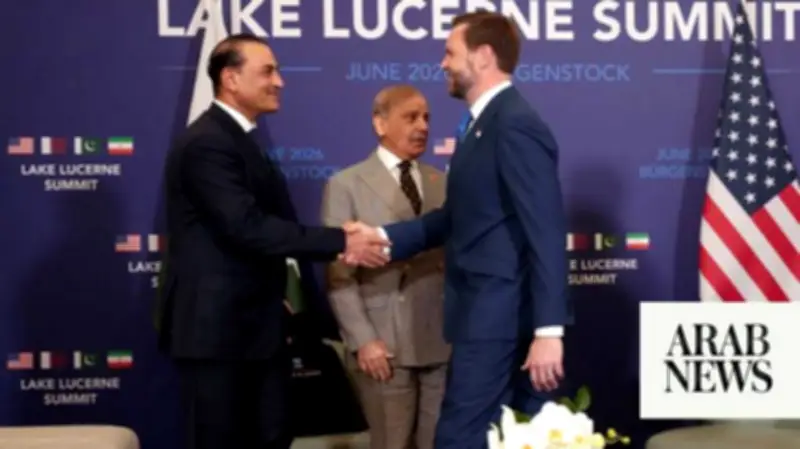
Pakistan Prime Minister Shehbaz Sharif and Chief of Defense Forces Field Marshal Syed Asim Munir met a senior US delegation led by Vice President JD Vance in Bürgenstock, Switzerland, on Sunday, ahead of peace talks involving delegations from Iran and Qatar. The high-level meeting took place at the Swiss resort as part of the implementation of the Islamabad Memorandum of Understanding, a US-Iran peace agreement brokered by Pakistan.
Peace Talks Amidst Regional Tensions
The peace talks, expected to occur on Sunday, come days after US President Donald Trump and Iranian President Masoud Pezeshkian signed a peace agreement ending nearly four months of conflict between Washington and Tehran. The accord provides a 60-day window for further diplomacy. However, tensions rose on Saturday after Iran’s Islamic Revolutionary Guard Corps (IRGC) and military officials announced the closure of the Strait of Hormuz, a key maritime trade route, citing Israeli violations of ceasefire commitments in Lebanon. US Central Command spokesperson Capt. Tim Hawkins rejected Tehran’s claim, stating that Iran does not control the strait.
Pakistan’s Foreign Office confirmed Sharif and Munir’s participation in the high-level talks, stating, “Prime Minister Muhammad Shehbaz Sharif and COAS & CDF Field Marshal Syed Asim Munir will participate in the High-Level Talks on the implementation of the Islamabad Memorandum of Understanding.”

Delegations and Bilateral Interactions
Sharif arrived in Bürgenstock leading a high-level delegation and was photographed meeting Vance, Trump’s son-in-law Jared Kushner, and Trump aide Steve Witkoff. The group exchanged handshakes, hugs, and posed for photographs. The Foreign Office noted that high-level delegations from Iran, Qatar, and the US would also attend the peace talks. Iranian state media reported that a senior delegation led by parliamentary Speaker Mohammad Baqer Qalibaf, including Foreign Minister Seyed Abbas Araqchi and senior security, central bank, and energy officials, had arrived in Switzerland for the negotiations.
According to the Foreign Office, Pakistan will continue to support and advance the implementation of the understandings reached between Iran and the US during the peace talks. Sharif is expected to hold bilateral interactions with delegations from Iran, Qatar, Switzerland, and the US on the sidelines to reaffirm Pakistan’s commitment to dialogue and durable peace in the region. The Foreign Office emphasized, “Pakistan’s facilitative role underscores its principled, balanced, and constructive approach throughout the crisis, including hosting earlier rounds of US–Iran talks and sustained diplomatic contacts that culminated in the Islamabad Memorandum of Understanding.”
Regional Diplomatic Efforts
Pakistan’s Foreign Minister Ishaq Dar arrived in Cairo on Saturday for talks with his counterparts from Egypt, Türkiye, and Saudi Arabia on Middle East security. Meanwhile, Pakistan’s Interior Minister Mohsin Naqvi met Iranian President Pezeshkian, Interior Minister Eskandar Momeni, and Foreign Minister Araqchi in Tehran on Saturday, as reported by Iranian state media.
The Lebanon Challenge
The peace talks in Switzerland occur against the backdrop of ongoing violence in Lebanon, which remains the most immediate challenge for negotiators. Despite ceasefire efforts, violence continued over the weekend. Lebanese authorities reported at least 16 deaths from Israeli strikes on Saturday, with other reports putting the toll at 20. Israel stated it was responding to attacks launched by Hezbollah, which in turn said it would not permit Israel “freedom of movement” in Lebanese territory. Neither Israel nor Hezbollah is a signatory to the US-Iran agreement, complicating efforts to secure a durable regional ceasefire.
Lebanon’s health ministry reports more than 4,000 people have been killed since fighting escalated earlier this year, while Israeli authorities report dozens of soldiers and civilians have also died. The Swiss talks are expected to focus on implementing the ceasefire, preventing further escalation in Lebanon, and negotiating terms for a longer-term agreement on Iran’s nuclear activities. The interim accord also provides for easing some restrictions on Iran’s economy, including allowing Tehran to resume oil exports and regain access to frozen assets.

While both Washington and Tehran have expressed cautious optimism, the dispute over the Strait of Hormuz and continuing violence in Lebanon underscore the challenges negotiators face as they seek to convert the temporary truce into a lasting agreement.