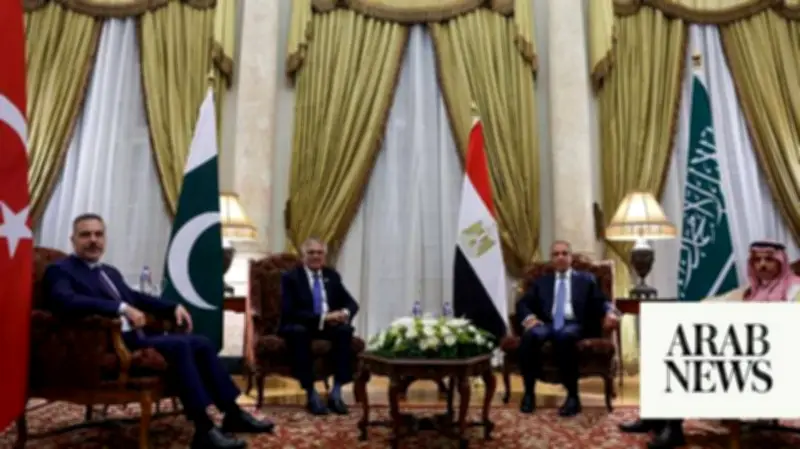
On June 21, 2026, foreign ministers from Saudi Arabia, Pakistan, Egypt, and Türkiye convened in Cairo to express their support for the recent diplomatic progress in US-Iran peace negotiations. The meeting, hosted at Tahrir Palace, aimed to coordinate positions on implementing the interim agreement and ensuring regional stability.
Diplomatic Momentum and Urgent Call for Swift Conclusion
The four nations welcomed the interim deal reached between the United States and Iran earlier that week, emphasizing the need for a rapid and successful conclusion of subsequent negotiations. According to a statement from Pakistan's foreign ministry, the ministers stressed the importance of achieving a lasting, verifiable, and mutually acceptable solution to remaining issues. The talks in Switzerland between US and Iranian negotiators continued on Sunday, with Pakistani and Qatari mediators facilitating technical-level discussions aimed at permanently ending the conflict that began in late February.
The interim agreement includes provisions for stopping hostilities on all fronts, including Lebanon, and unfreezing billions of dollars of Iran's assets. However, on the eve of the talks, Tehran announced it had again closed the Strait of Hormuz in response to Israel's ongoing military campaign in Lebanon.

Regional Security and Energy Market Concerns
The Cairo meeting highlighted the significant risks the conflict posed to regional stability, energy markets, international maritime routes, global supply chains, and international trade. The ministers emphasized that any resolution must consider the security and stability concerns of Gulf Arab states and the Levant region, aiming to strengthen collective security and promote long-term regional stability.
The conflict, which began with US and Israeli strikes on Iran in late February, saw Tehran shut the Strait of Hormuz and attack Israel, US interests, and other infrastructure in the Gulf. The interim US-Iran agreement calls for a permanent end to hostilities and initiates a 60-day negotiating period to reach a final deal on Iran's nuclear program. A major concession from Washington allows Iran to freely sell its oil immediately. The deal also affirms commitment to Lebanon's territorial integrity amid Israel's invasion against Hezbollah.
Launch of Lake Lucerne Summit
Qatar's foreign ministry confirmed the start of talks between the US and Iran in Switzerland, announcing the launch of the Lake Lucerne Summit and the first meeting of the high-level committee. Representatives from the United States, Iran, Qatar, and Pakistan participated. The ministry expressed hope that the meetings would lead to a comprehensive and lasting agreement addressing all aspects covered by the Memorandum of Understanding signed earlier that week.
R-4 Group and Ongoing Coordination
The Cairo gathering was another session of the R-4 group, formed in March to coordinate positions on regional crises and advance de-escalation efforts. The group has met regularly to discuss security, political, and economic developments across the region. The ministers reaffirmed the centrality of the Palestine issue for Middle East peace, stating that the Palestinian cause remains at the heart of efforts to achieve just, comprehensive, and lasting peace.
Support for Palestinian Rights
Particular attention was devoted to the humanitarian and political situation in Gaza, the West Bank, and East Jerusalem. The ministers reiterated support for the legitimate rights of the Palestinian people, including self-determination and the establishment of an independent Palestinian state based on the June 4, 1967 lines, with East Jerusalem as its capital. This aligns with relevant UN Security Council resolutions.
The statement came a day after Israeli strikes in Gaza killed at least six people, including two children and a cameraman with Al Jazeera, according to Palestinian health officials. Despite an October ceasefire between Israel and Hamas, near-daily Israeli attacks have killed over 1,000 Palestinians, according to Gaza's Health Ministry. Since the start of Israel's military offensive in Gaza following the October 2023 Hamas attacks, 73,018 Palestinians have been killed, including those slain after the ceasefire.