Pakistan on Monday urged the United Nations to apply its Responsibility to Protect (R2P) doctrine consistently and without selectivity, arguing that the global commitment to prevent genocide, war crimes, ethnic cleansing and crimes against humanity had failed in situations of prolonged conflict and foreign occupation.
Background of the R2P Doctrine
The R2P doctrine emerged from international efforts to prevent a repeat of the 1994 Rwanda genocide and the 1995 Srebrenica massacre, after the international community failed to stop those mass killings. First articulated in a 2001 report by the International Commission on Intervention and State Sovereignty, the concept was endorsed by world leaders at the 2005 UN World Summit. It holds that every state has the primary responsibility to protect its population from genocide, war crimes, ethnic cleansing and crimes against humanity, and that the international community has a collective responsibility to act through the UN when a state is manifestly failing to do so.
Pakistan's Statement at UN General Assembly
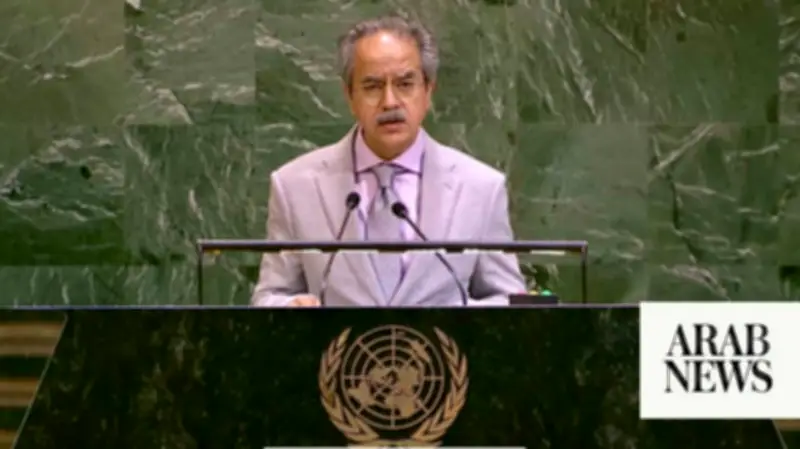
Addressing the UN General Assembly’s annual debate on the doctrine, Pakistan’s Permanent Representative to the UN, Ambassador Asim Iftikhar Ahmad, argued that the principle was being undermined by inconsistent implementation. “With an unprecedentedly high number of conflicts all over the world, the edifice of R2P stands on tenuous grounds,” he said. “Our shared objective to protect fundamental human rights, and to prevent the recurrence of mass atrocities is often obfuscated by inaction, denial, selectivity and paralysis.”

“Nowhere is this void more evident than in situations of prolonged conflict and foreign occupation, where atrocities have been committed with impunity, in full glare of international attention,” he added. “No responsibility, no protection, no accountability. The promise of ‘Never Again’ unfulfilled.”
Criticism of International Inaction
Pakistan has long criticized Israel’s occupation of Palestinian territories and the presence of Indian security forces in Jammu and Kashmir, arguing that the international community has failed to implement UN resolutions in those disputes. Israel has also been facing international accusations of genocide in the Gaza Strip. While Ahmad did not identify any specific territory or conflict by name, he called for renewed commitment to the R2P doctrine, urging UN member states to invest more in prevention rather than responding only after atrocities occur.
Call for Peaceful Resolution and Combating Hate Speech
He also called for the peaceful resolution of long-running conflicts in line with UN Security Council resolutions and international law, while asking the international community to confront “hate speech, xenophobia, Islamophobia and other grotesque ideologies” that fuel discrimination and violence. “This remains the most realistic pathway to honor those who have fallen victim to atrocity crimes, to protect our future generations, and to restore our faith in multilateral action, justice and accountability,” Ahmad added.