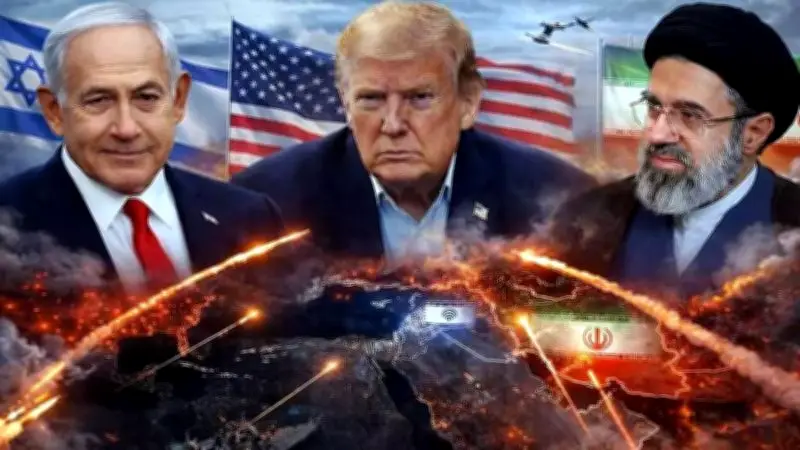
Iran's Rise: From Isolation to Hegemony
Before the war began on 28 February 2026, Iran was isolated in the region. Its relations with neighbouring countries were limited, if not downgraded. It was given little importance in regional affairs, let alone global matters. The region and the world viewed Iran as a dilapidated economy crushed by decades of sanctions, its society primitive and open to criticism, particularly on the treatment of women. Militarily, it was considered weak, with no modern air force or war machinery: a country ruled by the clergy whose ideas were worlds apart from what the world considered a modern society.
Regionally, particularly in the Gulf, Saudi Arabia positioned itself as the leader of the Muslim world — owing to its large economy and landmass, its close ties with the West, and its custodianship of the two Holy Mosques. Just across the strait, the UAE shone in its glory, with Dubai as the centre of the world’s attention. These countries, and their smaller neighbours, lived in the blissful warmth and protection of the US security umbrella — invincible, untouchable, never even open to scrutiny or critical evaluation. This is what the world was accustomed to, as was Pakistan. Global policy, as well as Pakistan’s own, was aligned to this status quo.
Military Dominance and the Old Order
On the military side, the US dominated the seas with its formidable fleet of aircraft carriers, which, once stationed off a country’s shore, could press an outcome of its liking without question or delay. This was the regional geopolitical and security architecture built in the aftermath of the Second World War and further consolidated after the Gulf wars of 1991 and 2003. There was total certainty and confidence in this arrangement, at least in the minds of the United States, Israel, and the Arab nations of the region.

And this is exactly what has fundamentally transformed since the war began on 28 February 2026. The 12-point MoU between the US and Iran, signed electronically on 14 June 2026, mirrors this change clearly. Its fifth point establishes Iran’s permanent control over the Strait of Hormuz, allowing it “… to define the future administration and maritime services in the Strait of Hormuz, in discussions with other Persian Gulf littoral states, in line with applicable international law and the sovereign rights of coastal states of the Strait of Hormuz.” Its sixth point binds the US “with regional partners [Gulf nations], to develop a definitive mutually agreed plan with at least USD 300 billion, for the reconstruction and economic development of the Islamic Republic of Iran.”
New Realities: Iran's Hegemony and Gulf Reactions
These clauses, among others, overwhelmingly favourable to Iran, have fundamentally altered the realities of the region; they establish, to say the least, Iran’s hegemony. The question is whether the Saudis and their Emirati neighbours, with whom they have harboured a border dispute since the Treaty of Jeddah of 1974, will accept this new reality. Will the same Saudis who have long imagined themselves leaders of the Muslim world, the same Emiratis who have extended their reach into Sudan, Yemen and Somalia, and a Pakistan long accustomed to the old arrangement, all accept it too?
It was on that same 14 June that the Israeli newspaper Jerusalem Post published a report analysing Pakistan’s role in the wake of the Iran war. Yoel Guzansky points out that Pakistan entered the peace process out of its own concerns: it shares a 900 km border with Iran, and had signed the Strategic Mutual Defence Agreement (SMDA) in September 2025. As Iran struck US targets on Saudi soil, Saudi pressure mounted on Pakistan to honour its commitments — that, rather than any intent to threaten Israel, was the real driving force.
Pakistan's Dilemma: Alliances and Commitments
Guzansky highlights Pakistan’s commitment to Saudi Arabia under the SMDA, including the stationing of 8,000 troops in the Kingdom, and considers the possibility of Turkey and Egypt joining the SMDA — a development that, in his assessment, could pose a direct threat to Israel. In my understanding, a broader military alliance of this kind is unlikely. It will further diminish Saudi Arabia’s stature, relegating it to a junior partner — a status it may not be happy to accept.

Moreover, a hint from former Secretary of State Hillary Clinton’s recent interview complicates this possibility further: she maintains that Netanyahu has been obsessed with two things — destroying Iran and forging warm relations with the Saudis. Such ambitions were not built on wishful thinking alone — there is scattered evidence that the warming was genuinely reciprocated by the Saudi side, even if conducted quietly and never officially confirmed.
Saudi-Israel Relations: Behind the Scenes
Media reports indicate that Saudi Arabia was close to signing the Abraham Accords before the 7 October attacks. Al Jazeera, NBC, and several other Western media outlets reported on Netanyahu’s clandestine visit to Neom, Saudi Arabia, where he reportedly met Crown Prince Mohammed bin Salman (MbS) — a story leaked by the Israeli press, with no official confirmation or denial, consistent with how discreetly the relationship was being managed on both sides. It must have been regional compulsion, among other things, that pushed the Saudis to mend matters with Israel, after the UAE established close ties with them in 2008.
The prompt was reportedly the Saudi–UAE border dispute over the Shaybah/Zarrarah oil field, which — as the UAE claims — the Saudis placed entirely on their own side of the border, in breach of verbal commitments made under the Treaty. This is why a four- or five-nation military alliance in the region is such a complicated proposition: each nation has its own priorities and ambitions, and the logic used to justify who belongs and who rarely holds up to scrutiny.
Turkey and Egypt: Complicating Factors
Take Guzansky’s own framing above, that Turkey and Egypt joining the SMDA is a plausible scenario. Turkish professor Mehmet Özkan, in an interview with me on Talking Politics, Federal Post, on 4 November 2025, dismissed the idea of Iran joining the SMDA if Turkey were to become part of it, arguing that it would make the alliance “too crowded”. But if Iran’s presence allies crowded, how would Egypt’s presence make it less crowded? Clearly, Turkey is not too inclined to any such ideas.
The war has now introduced new realities, new rivalries, new wounds, and new ambitions. As time moves forward, more new realities will emerge, and more skeletons will fall out of the closet. The question that concerns us most is our own alignment with these emerging realities. The old world has changed for good — and so has the era of maintaining balancing acts.