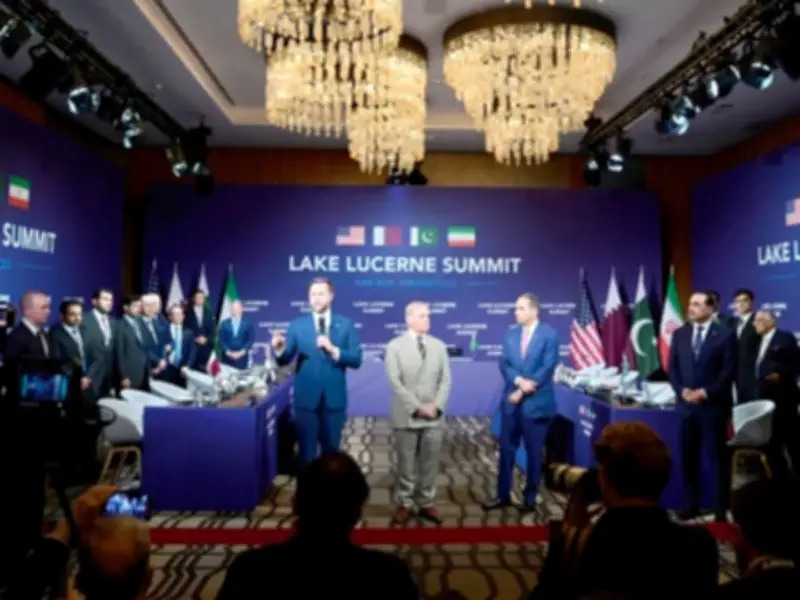
The first round of high-stakes US-Iran negotiations in Switzerland concluded on Sunday without a breakthrough, as back-channel diplomacy persists amid escalating tensions triggered by renewed US threats, Iranian objections, and regional instability linked to Lebanon and the Strait of Hormuz.
The quadrilateral talks, dubbed the 'Lake Lucerne Summit' at the Burgenstock resort, lasted approximately 80 minutes, according to Iranian state media. Separate private meetings were held between US and Iranian teams and Pakistani and Qatari officials.
Stalled but Not Over
CNN, citing diplomatic sources, reported that negotiations between Washington and Tehran have stalled but are not over, with both sides maintaining indirect communication to bring delegations back to the table. An Iranian source in contact with the delegation stated that while differences remain sharp, "talks are ongoing despite hiccups and demands on both sides," adding that delegations remain at the Swiss resort as mediators work through back channels to sustain the process.

A US diplomat told Axios that the talks focused on deconfliction mechanisms in Lebanon and enforcing the ceasefire, and noted good progress on keeping the Strait of Hormuz open.
Delegation Leaders and Threats
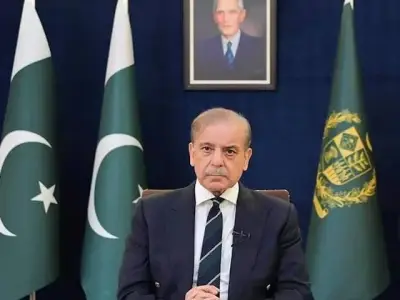
The summit was attended by a US delegation led by Vice President JD Vance, an Iranian delegation comprising Parliament Speaker Bagher Ghalibaf and Foreign Minister Abbas Araghchi, and mediators including Pakistani Prime Minister Shehbaz Sharif, Army Chief Field Marshal Asim Munir, and Qatari Prime Minister Sheikh Mohammed bin Abdulrahman Al Thani.
As Vance called on Tehran to engage, President Trump threatened to restart strikes on Iran for supporting Hezbollah or closing the Strait of Hormuz. "Iran must immediately stop their highly paid PROXIES in Lebanon from causing trouble," Trump posted on social media. "If they don't, we'll hit Iran very hard again, just like we did last week, only harder!!!"
Iran's chief negotiator Ghalibaf rebuked the remarks, accusing Washington of "desperation" and warning that Tehran's armed forces were prepared to respond. "They would do better to be careful about their statements," Ghalibaf posted on X. "Our armed forces are prepared to respond to them in a different manner. They may keep talking, it is we who act."
Draft Framework for Sanctions Relief
Despite tensions, sources indicated that a draft framework for limited sanctions relief on Iranian oil exports has been finalised at technical level discussions. According to Iran's semi-official Fars News Agency, an economy expert on the Iranian delegation said the draft was expected to move towards implementation, focusing on easing restrictions on oil and petroleum derivatives under specific provisions of the emerging understanding.
The framework reportedly links several broader issues to implementation progress, including ending hostilities in Lebanon, reopening critical maritime routes, limited sanctions exemptions, and discussions around frozen Iranian assets. However, Iranian officials have signalled that full implementation remains contingent on de-escalation in Lebanon.
Strait of Hormuz and Lebanon Tensions
A central point of contention remains the Strait of Hormuz, after Tehran announced it had moved to restrict access in response to Israeli strikes in Lebanon—a claim disputed by the US military. Washington has pushed for guarantees on maritime security and uninterrupted energy flows through the strategic waterway, which handles a significant share of global oil trade.
Discussions have also been shaped by the fragile situation in Lebanon, where fighting between Israel and Hezbollah continues to influence the diplomatic track. US officials have indicated that stabilising Lebanon and securing a ceasefire framework remain key priorities alongside any broader agreement with Iran.
Nuclear Issues Not Discussed
Iranian state media reported that nuclear issues were not formally discussed in the opening session. Tehran has reiterated that it will not abandon its uranium enrichment rights, even as it denies any intention of developing nuclear weapons.

Speaking at the start of the summit, Vice President Vance described the opening phase as part of a wider effort to reset relations. However, by the end of the first round, officials confirmed that the talks remained fragile, with no agreement on key sticking points and uncertainty over whether direct negotiations would resume immediately or continue through intermediaries.
Talks Enter 'Difficult Phase'
Iranian state media said the talks had entered a "difficult phase" and recessed after the "publication of an insulting message by the US president," according to the Associated Press. The Iranian delegation then met with Qatari mediators and left the negotiating site. However, an official with knowledge of the talks later told the AP on condition of anonymity that the Iranian delegation remained engaged and had not indicated any intention to leave.
The talks follow an interim agreement signed last week by President Trump, Iranian President Masoud Pazeshkian, and Prime Minister Shehbaz Sharif as mediator, triggering a 60-day sprint to reach a final agreement to end hostilities.