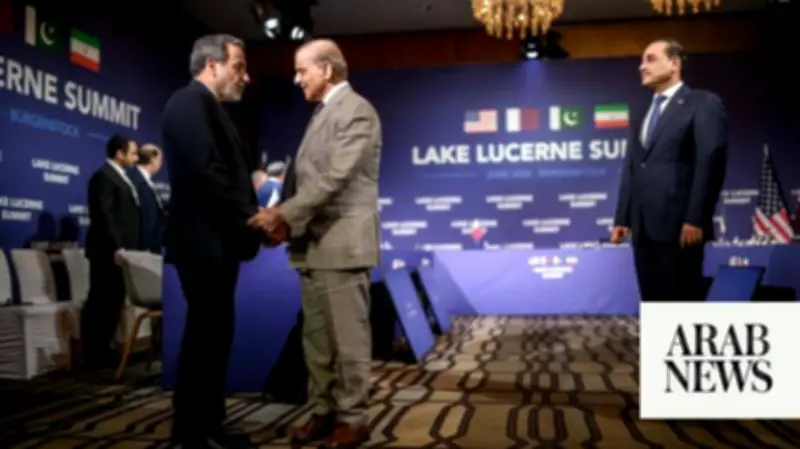
The United States and Iran have agreed on a roadmap to reach a final peace agreement within 60 days and established new mechanisms aimed at preventing clashes in Lebanon and securing commercial shipping through the Strait of Hormuz, mediators Pakistan and Qatar said on Monday.
Quadrilateral Talks in Switzerland
The joint statement by the foreign ministries of Qatar and Pakistan was released after the first session of high-level talks under the framework of the Islamabad Memorandum of Understanding concluded in Bürgenstock, Switzerland. High-level delegations from the US, Iran, Qatar and Pakistan participated in the talks to resolve the months-long conflict in the Middle East that has pushed global prices of oil higher and caused inflationary pressures worldwide.
“The Lake Lucerne Summit was conducted in a positive and constructive atmosphere,” the joint statement said. “Encouraging progress has been made including the creation of a mechanism for further technical talks.”

Key Agreements Reached
All parties have agreed to the formation of a “High Level Committee” that would provide political oversight on mediation. Chief negotiators will report regularly to the committee and lead working groups focused on nuclear, sanctions and a monitoring and dispute resolution group to ensure the effective implementation of the MoU, and on other matters.
“The High Level Committee has agreed upon a roadmap toward reaching a final deal within 60 days, laying the foundation for the immediate commencement of further technical talks,” the statement said. It added that a communication line between the parties has been formed to avoid “incidents and miscommunication” aimed at securing safe passage for commercial vessels through the Strait of Hormuz route.
Lebanon De-escalation Mechanism
Fighting between the Iranian-backed militia Hezbollah and Israel remains a key sticking point of the peace deal. Iran has said a ceasefire in Lebanon is essential to the diplomatic process. Israeli strikes killed 16 people and wounded 12 in Nabatieh district in southern Lebanon on Saturday, the Lebanese Civil Defense agency said.
The joint statement said all parties have agreed on the creation of a “de-confliction cell” between the parties and Lebanon that will be facilitated by the mediators. This cell would ensure adherence to termination of military operations in Lebanon as per the MoU.
“Technical talks will continue for the remainder of the week at the Bürgenstock resort on all issues,” the statement said. It further said that mediating parties will continue to do their utmost to ensure that negotiations continue to be conducted in a “constructive atmosphere” with the aim of reaching a final deal.
Iranian Foreign Minister Hails Progress
Iran’s Foreign Minister Seyed Abbas Araghchi took to social media platform X on Monday to say that the US-Iran peace talks have made “major progress” to end the war in Lebanon. “Oil and petrochemical exports are waived, blockade lifted, some frozen assets released and major reconstruction & development plan launched for Iran,” Araghchi wrote. “1st real test: Lebanon deconfliction cell.”
US Vice President JD Vance, who led the US delegation at the talks, said on Sunday that there was an opportunity to “turn over a new leaf” with Iran as he met the country’s parliamentary speaker, Mohammad Bagher Qalibaf, and Araghchi to discuss permanent peace with Iran.
Pakistan and Qatar's Mediation Role
Mediators from Pakistan and Qatar were also in the room for the direct engagement that, according to Iranian state media, lasted about 80 minutes. The US and Iranian negotiating teams also held separate private talks with Pakistani and Qatari officials. Pakistan’s Prime Minister Shehbaz Sharif and Chief of Defense Forces Field Marshal Syed Asim Munir were in the Swiss resort to represent Pakistan during the negotiations.
Sharif held a telephone conversation with Saudi Crown Prince Mohammed bin Salman on Sunday to thank him for Saudi Arabia’s steadfast support for Pakistan’s peace efforts. “We agreed that the next phase of negotiations must continue to be guided by a firm commitment to dialogue, diplomacy, and vigilance against any attempt to undermine the peace process,” Sharif wrote on X on Sunday.

Background of the Islamabad MoU
The Islamabad Memorandum of Understanding was signed by the presidents of the US and Iran last week. The MoU calls for the Strait of Hormuz to be reopened and a halt to all hostilities, including in Lebanon, which Israel invaded in March. Tensions flared hours before the talks were to be held, with Iran saying on Saturday that it had again shut the strait due to Israel’s ceasefire violations in Lebanon. US officials disputed that the strait was closed, but commercially available shipping data showed an immediate impact.
As the meetings were happening in Bürgenstock, US President Donald Trump threatened in an online post to strike Iran if it did not “immediately stop their highly paid PROXIES in Lebanon from causing trouble,” making reference to Hezbollah.