Seventh Prime Minister in a Decade
A decade after the historic vote to leave the European Union, the United Kingdom is preparing to swear in its seventh prime minister since June 23, 2016. On that day, 52 percent of Britons voted to leave the EU, while 48 percent chose to remain. The decision fractured the European Union and, according to analysts, broke British politics.
Conservative Prime Minister David Cameron, who called the referendum but campaigned for the UK to stay, resigned the following day. His successors have all struggled, largely unsuccessfully, with the consequences of that rupture. The latest is Labour Prime Minister Keir Starmer, who announced on Monday that he was stepping down after two years marked by a sluggish economy, malfunctioning government, and a divided and jaded electorate—all legacies, at least in part, of Brexit.
The Subterranean Trace of Brexit
Though the decision has faded from headlines, “the subterranean trace of Brexit” still runs through Britain’s increasingly unruly politics, said Chris Grey, an academic who has studied the fallout from Britain’s EU departure. The Brexit campaign channeled deep-seated discontent among voters.

Campaigners for Brexit promised that leaving the then-28 member political and economic bloc would allow the UK to “take back control” of its laws, economy, and borders. While the “remain” campaign focused largely on the economic downsides of exiting, the “leave” side was emotive.
“We can see the sunlit meadows beyond. I believe we would be mad not to take this once-in-a-lifetime chance to walk through that door,” said Boris Johnson, a leading Brexit campaigner who later became prime minister, a few weeks before the referendum.
Nostalgia and Unrealistic Promises
Margaret MacMillan, emeritus professor of history at the University of Toronto, said Brexit was fueled by a bundle of motives including nostalgia “for an imagined past.” “It was against what people saw as unrestricted immigration. It was against what they saw as EU regulations. And then there was this mix of nostalgia—‘We fought alone in the Second World War.’ Which was of course not true. It was never clearly explained what Brexit might entail.”
Hard reality soon collided with Brexiteers’ bold promises of immigration controls, trade deals, more money for public services, and an end to complex regulations emanating from Brussels. Acrimonious divorce talks dragged on for years. The UK formally left the bloc on January 31, 2020, followed by an 11-month transition period until the final split.
A Revolving Door of Prime Ministers
Prime Minister Theresa May, Cameron’s successor, quit in 2019 after failing to find exit terms acceptable to a divided Parliament. Johnson succeeded May and promised to “get Brexit done,” managing to secure a bare-bones trade deal after negotiations that left UK-EU relations in the deep freeze. He was ousted by the Conservative Party in mid-2022 after mounting financial and ethical scandals. His replacement, Liz Truss, lasted just 49 days in office. Her successor, Rishi Sunak, thawed the frosty EU relationship without making major changes.
Starmer promised a “reset” but refused to consider rejoining the bloc’s frictionless single market, which was free of tariffs and other trade barriers. As he hands over power, Brexit remains unfinished business.
Political Parties Fracture
Historian Anthony Seldon said Cameron called the referendum hoping it would end arguments about relations with Europe that had riven the Conservative Party. It didn’t. “The people who obsessed about it still obsess about it. Britain’s problems have continued,” Seldon told Times Radio. During the divorce negotiations, Conservatives who wanted a softer Brexit and closer ties with the EU were pushed out of the party by the triumphant Brexiteer faction.
Labour, though much more pro-EU, also has an internal division between those who want to get closer to the bloc or even rejoin, and senior leaders like Starmer who want to avoid reopening old wounds. A decade on, millions of voters have deserted the two big parties for alternatives including the left-leaning Green Party and the hard-right Reform UK led by Nigel Farage.

Farage has arguably been the biggest political winner from Brexit. He campaigned for the divorce then complained it had been betrayed. His anti-immigration message has shifted from focusing on Polish plumbers to asylum seekers in dinghies. His party consistently leads opinion polls.
Growing Cynicism and Political Violence
The economy has struggled in the past decade, with businesses facing new barriers to trade with Britain’s closest neighbors, though Brexit is not the only cause of low growth. The COVID-19 pandemic, the Russia-Ukraine war, and the Iran war also played a part. Through it all, “we just haven’t had politicians who’ve been upfront with the public about the fact that when they get into power, they won’t be able to have no increases in taxes, no increases in debt, and better public services all in the same breath,” said Hannah White, director of the Institute for Government think tank. “And so people are disappointed.”
Brexit failed to ease debate about immigration, which has only become more heightened, regardless of the numbers. Net migration rose after Brexit to more than 900,000 in 2023 before falling to 171,000 last year. Cynicism has grown and trust in politicians has plunged. In recent years, agitators have fueled anti-immigration street violence following crimes committed by, or falsely reported to have been committed by, immigrants.
In the past, Britain had a firm barrier “between the conventional dominant politics of talk and argument, and what was seen as beyond the pale: violence on the streets,” Grey said. “I think that boundary is being eroded. And I think that did to some large extent begin with Brexit.”
Regrets and the Road Ahead
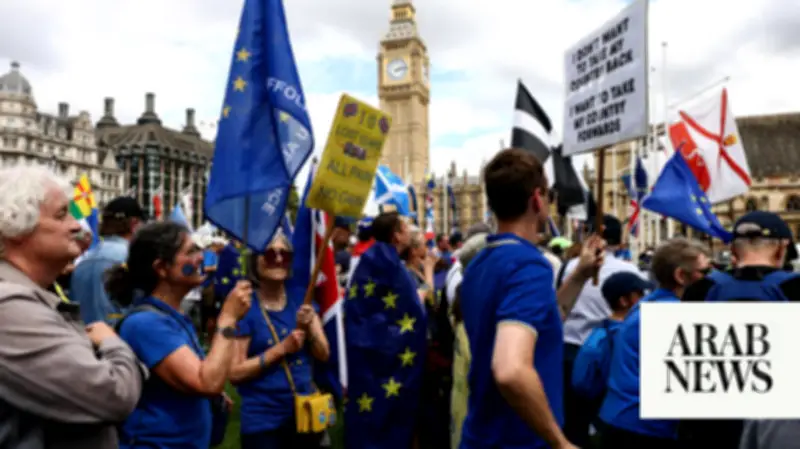
Polls suggest a degree of “Bregret” about Britain’s choice a decade ago, with a recent Ipsos survey finding 52 percent of people in the UK would like to rejoin the EU while 33 percent oppose it. Hundreds of people, many waving blue and yellow EU flags, marched through London on Saturday on a “rejoin” march. It was a much smaller turnout than the mass protests on both sides at the height of the Brexit drama. Many people just want to move on.
But Brexit remains a minefield that politicians fear to enter. Even if Britain wanted to rejoin, it would be a long road back to a wary EU. Grey said that until politicians are willing to face the legacy of Brexit, Britain faces an “undertow of low-grade crisis.” He likened the UK to a person with a nagging illness that saps their energy. “A chronic thing, in this case perhaps not incurable,” he said. “But it’s just that they don’t fancy going to the doctor because they know it’s not going to be very nice.”