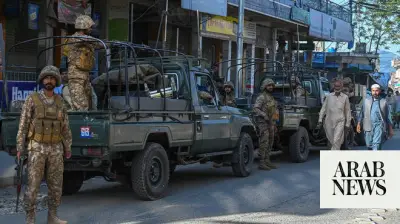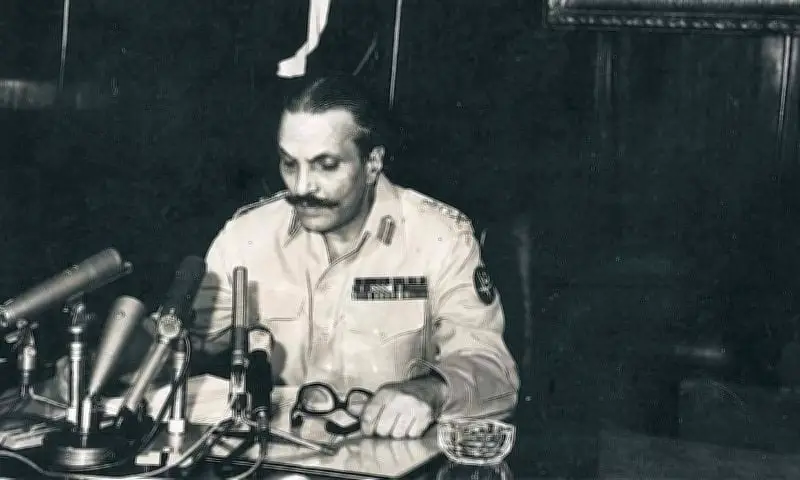
Forty-nine years ago, General Zia-ul-Haq's tanks moved on Zulfikar Ali Bhutto's government. I was twenty. Two months later, I, together with a group of students, sat in a room at 70 Clifton Karachi with Bhutto himself, hours before the regime arrested him a second time. I have spent a lot of time trying to work out where Pakistan's decline actually starts. Not the 1971 war, which was a catastrophe of a different order — a bounded rupture, however bloody, that ended with a new international border. Not any of the crises since. July 5, 1977, is the date that deserves the designation, because it did not just remove a government. It set in motion a political order – a machinery – that has shaped Pakistan's body politic for nearly five decades, entrenching patterns of power that continue to define how the state actually functions. This is an argument for why that date, more than any other in Pakistan's history, marks the start of the darkest chapter — made from the documentary record, not from nostalgia for the man it deposed.
The Appointment Was Not a Routine Seniority Decision
General Zia-ul-Haq was appointed Chief of Army Staff in March 1976 by Prime Minister Zulfikar Ali Bhutto. His selection involved bypassing several lieutenant-generals senior to him in the Pakistan Army hierarchy, as recorded in standard accounts of Pakistan's civil–military history and in Lt Gen Faiz Ali Chishti's memoir of the period. Zia's military career included service in Jordan during the late 1960s and early 1970s, when Pakistani military personnel were present in advisory roles during Jordan's internal conflict involving Palestinian armed groups, an episode widely discussed in historical accounts of the Black September period.
The Betrayal
Mehmood Ali Khan Chaudhary, who served as Secretary of the Interior Ministry through 1977, records (in his book Martial Law Ka Siasi Andaaz) a small but pointed episode from the last days before the coup. Around the time, when the PNA agitation against Bhutto's government was at its peak, American ambassador Henry Byroade was being transferred out of the country, and General Zia-ul-Haq — then Chief of Army Staff — hosted an elaborate farewell reception for him at his own residence. Chaudhary, who received an invitation in his capacity as Interior Secretary, found the gesture strange: a change of ambassador ordinarily called for a routine Foreign Ministry reception, hosted at most in the Foreign Secretary's or Foreign Minister's name; army chiefs did not personally host such farewells except, occasionally, on a country's national day, and even then only as a formality. A serving army chief throwing a lavish, personally hosted party for a departing American ambassador, in the middle of a political crisis actively threatening the government, unsettled him enough that he raised it with the Prime Minister the next day.

This is not merely Chaudhary's word for it. Bhutto himself corroborated the episode independently, in his own written reply to Zia's statement before the Supreme Court, stating that Zia had given "the lavish reception to the departing Ambassador" without the required Foreign Office clearance, that his Interior Secretary had briefed him on it, and that he had told colleagues at the time that the reception, held without proper authorization, was "the signal for the Coup." Two days later, it was.
A Coup and a Judicial Murder
Operation Fair Play was, on its face, bloodless. What followed was not. Bhutto was arrested, released, arrested again, tried on a conspiracy-to-murder charge that most independent legal scholars, then and since, have treated as a pretext, and hanged on 4 April 1979 after a Supreme Court process widely regarded as compromised. The Court had already legitimised Zia's takeover in the first place by invoking the "Doctrine of Necessity" — the same judicial device Pakistan's courts would reach for again in later crises, each time a general needed his coup blessed after the fact. That is the first piece of the machine: a judiciary that learned, in 1977, that it could rubber-stamp the abrogation of the constitution and survive. It has never fully unlearned the lesson.

Washington's Fingerprints
The dismissal of American involvement as pure conspiracy theory does not survive the scrutiny of declassified material. On 6 December 1971, recorded conversations between Richard Nixon and Henry Kissinger referred to Bhutto in explicitly hostile terms — "that son-of-a-bitch" and "a terrible bastard" (Foreign Relations of the United States, 1969–1976, Vol. E-7, Document 171). The record captures not policy disagreement, but personal animus at the highest level of U.S. decision-making. A CIA memorandum titled "Prospects for Pakistan," dated 30 May 1975, assessed scenarios for Pakistan's political future, including Bhutto's sudden removal or assassination, two years before either happened (CIA memorandum, declassified via CREST, released January 2017; Dawn, "Spy files: CIA discussed possibility of Bhutto's downfall in 1975," 31 January 2017).
And there was the nuclear pressure campaign: Bhutto signed a reprocessing deal with France in March 1976; Kissinger visited Lahore that August to press him to cancel it; the declassified memo of that meeting, released by the National Security Archive at George Washington University in 2006, records language about "offensive" assurances and safeguards that "one side could break." Bhutto himself said Kissinger threatened, through Pakistan's ambassador in Washington that September, to make Pakistan "a horrible example" — a claim he made publicly in the National Assembly in June 1977 and repeated in his death-cell testament (Zulfikar Ali Bhutto, If I Am Assassinated, Vikas Publishing House, 1979). Gerald Feuerstein, the U.S. protocol officer present at the 1976 meeting, later confirmed in a Pakistani television interview that a real warning over the nuclear program had been delivered and rejected, without personally vouching for the exact wording (Dawn, "A leaf from history: Kissinger comes to town," 7 July 2013). Whichever version is verbatim-accurate, the substance is not seriously disputed: sustained, high-level American pressure on Bhutto, explicitly framed as a threat, in the two years before he was removed.
Washington then spent essentially no diplomatic capital trying to stop his execution, despite clemency appeals from multiple heads of state. American suspicions extended into Bhutto's premiership, particularly over his nuclear ambitions. A Telegram from the Embassy in Pakistan to the Department of State, dated February 17, 1977 (declassified, FRUS 1977–1980, Volume XIX, South Asia), notes: "There is no evidence to indicate, and indeed some to the contrary, that Bhutto considered as he moved forward [on the nuclear program] that he was risking a major and serious confrontation with the United States." The U.S. ambassador Henry Byroade added that he "nevertheless often talked informally to Bhutto on this subject," warning him he was headed for trouble over the nuclear program. Declassified conversations from May 21, 1978, between Deng Xiaoping and Zbigniew Brzezinski further expose how Bhutto's fate was being discussed in geopolitical corridors. Deng raised the question of Bhutto's death sentence; Brzezinski replied that public pressure would not be helpful, effectively confirming awareness of the situation. A separate declassified telegram from the U.S. Embassy in India to the State Department (February 15, 1979, FRUS Volume XIX) records the U.S. ambassador telling Indian Prime Minister Morarji Desai that Bhutto would likely be hanged — showing that Washington's diplomatic community anticipated the outcome before execution.
The Reward
Eight months after Bhutto was hanged, the Soviets crossed into Afghanistan, and the entire strategic calculus inverted. Carter's initial $400 million aid package was dismissed by Zia as "peanuts" (Christian Science Monitor, "More peanuts for Pakistan?", 26 March 1981). Reagan responded with a six-year $3.2 billion military and economic package, including F-16s (Dennis Kux, The United States and Pakistan, 1947–2000: Disenchanted Allies, Johns Hopkins University Press, 2001). The man who had just hanged an elected prime minister, suspended the constitution, and jailed the political opposition became, within eighteen months, Washington's most valuable regional ally. That is the second piece of the machine: the demonstration that constitutional rupture, if geopolitically useful, is not punished — it is rewarded.
The War Economy Zia Built
This is where the machine becomes structural, not merely political. Pakistan had essentially no heroin addiction problem in 1979. As CIA-funded arms moved to the Afghan mujahideen, heroin refineries opened along the frontier. The number of addicts rose to roughly 5,000 by 1980 and to an estimated 1.3 million by 1985 — an increase the United Nations described as "particularly shocking." Trucks carrying CIA-supplied weapons to the border were reported returning loaded with opium — a claim later examined by The New York Times and The Washington Post in reporting on Gulbuddin Hekmatyar, whom American officials declined to investigate despite evidence of narcotics involvement. Pakistan remains, by a wide margin, one of the most heroin-affected countries on earth. Weapons from the same pipeline produced what became known as "Kalashnikov culture" — automatic weapons embedded into civilian life, changing the nature of crime, politics, and policing. Millions of Afghan refugees entered Pakistan, particularly Peshawar and Quetta, and refugee camps became recruitment infrastructure for the jihad. And sectarianism, which had previously existed in contained form, became organised violence. Sipah-e-Sahaba Pakistan was founded in Jhang in 1985, during Zia's rule, explicitly to counter post-Iranian revolution Shia mobilisation. Its later offshoot Lashkar-e-Jhangvi carried out mass-casualty attacks for decades. Madrassas expanded from roughly 900 in 1971 to over 8,000 officially registered institutions plus tens of thousands unofficially by 1988, funded through zakat reforms and Gulf money. Darul Uloom Haqqania became widely associated with future Taliban leadership.
Madrassas, Militancy, and Institutional Continuity
The radicalisation of this period was engineered, funded, and measured — not incidental. Washington ran the psychological side of the war as a formal program. The USIA partnered with Boston University to train Afghan exiles in Peshawar in journalism and broadcasting. From 1984, USAID's Education Sector Support Project channelled $51 million to the University of Nebraska-Omaha to produce refugee-school textbooks, with ISI advisers fusing religious duty with armed struggle into the content. One 1985 fifth-grade Pashto reader, distributed to over 120 schools across NWFP, taught arithmetic through grenade counts and distances to Soviet convoys. In Buner district, attendance under this curriculum reached 65 percent. The madrassa network grew alongside it, by financing rather than accident. Between 1980 and 1986, Saudi donations of $50,000 to $200,000 per institution funded mosques, dormitories, and Wahhabi and Deobandi clerics across the frontier. Darul Uloom Haqqania hosted a 1986 symposium drawing clerics from Afghanistan, Pakistan, and Saudi Arabia; that year, Saudi Grand Mufti Abd al-Aziz bin Baz visited Pakistan and declared the jihad a religious obligation. By 1987, some 50,000 students were enrolled across hundreds of new or expanded madrassas in what is now Khyber Pakhtunkhwa, many doubling as recruitment pipelines. Bin Laden joined the jihad in 1986 and began funding madrassas and camps directly. Senator Daniel Patrick Moynihan warned at the time that Washington was arming groups that would eventually turn on it. It changed nothing. Zia expanded training camps into Baluchistan and the tribal belt, while Mujahideen factions like Hizb-e Islami and Jamiat-e Islami ran their own media cells, smuggling newsletters and broadcasts across the Durand Line. When the Soviets withdrew in 1989, this machinery didn't shut down. It reoriented — into Kashmir, into the Taliban's founding institutions, and eventually inward, against the state that built it. Pakistan has repeatedly ranked among the countries most affected by terrorism worldwide, including in the most recent assessments. These outcomes are not separate from the Zia period. They are downstream consequences of it.
The Ethnic Card: Karachi and Political Fragmentation
If Afghanistan was the external theatre of Zia's system, urban Sindh became its internal laboratory. Bhutto's Pakistan Peoples Party represented a rare phenomenon in Pakistani politics: a genuinely national mass party with cross-provincial and cross-class appeal. It was not ideologically uniform, but it created a political coalition that extended beyond a single ethnicity or region. For the military establishment, this was structurally dangerous. A national party reduces space for political management. It limits the ability of non-elected institutions to arbitrate outcomes. It creates direct electoral legitimacy that cannot easily be fragmented. Zia's response operated on multiple levels. Religion provided vertical division. Ethnicity provided horizontal division. Together, they fragmented the political field into manageable units. It is within this context that political developments in urban Sindh must be understood. Former Army Chief General Mirza Aslam Beg stated in a televised interview that General Zia-ul-Haq sought the creation of an urban Mohajir political force to counter the PPP in Sindh, and that this process contributed to the emergence of the MQM. The importance of this statement is not that it settles historical debate, but that it places the concept of deliberate political engineering within acknowledged institutional memory. The consequences are visible in Karachi's modern history. A city that once functioned as Pakistan's commercial and cosmopolitan hub became a site of prolonged ethnic conflict, armed political organisation, targeted killings, and repeated military operations. Political identity and coercive power became increasingly intertwined in urban governance. This was not an accidental development. It was the outcome of a broader strategy in which fragmentation replaced consolidation as the dominant logic of political control.
The Persistence of Political Engineering
Zia's system did not end with his death in 1988. What survived was not merely institutional residue but operational logic. Military influence over political outcomes persisted through formal and informal mechanisms. Intelligence agencies became embedded in electoral management. Political alliances were constructed, dismantled, and reassembled with increasing frequency. Civilian governments operated within constraints that limited autonomy regardless of electoral mandate. Different governments, different actors, and different political brands operated within the same structural environment. The underlying principle remained consistent: political power in Pakistan would be mediated, not directly expressed.
The Machine That Survived Its Creator
Zia's legacy is often reduced to Islamisation or Afghanistan. Both are incomplete as explanations. The deeper transformation was institutional. He normalised military supremacy over civilian politics. He embedded judicial accommodation into constitutional practice. He transformed religion into a governing instrument. He institutionalised ethnic fragmentation as a political strategy. And he embedded armed non-state actors into the logic of state policy. By the time of his death in 1988, Pakistan had formally returned to civilian rule. But the architecture constructed between 1977 and 1988 remained intact. That architecture continues to define the limits of political possibility. The judiciary still operates under precedents shaped during military rule. Political parties still navigate a fragmented and managed landscape. Intelligence institutions remain central political actors. Sectarian and militant networks continue to shape internal security dynamics. The system built under Zia has proven more durable than the man who created it.
Conclusion: The Coup That Never Ended
History judges political ruptures not only by their immediate consequences, but by their institutional durability. July 5, 1977, was not simply a change of government. It was the moment Pakistan ceased to evolve primarily through an organic and political process and began to operate through a system of managed politics, external alignment, and internal fragmentation. Nearly half a century later, that system not only remains largely intact but has taken deeper and firmer roots. The tanks that entered Islamabad that night eventually returned to their barracks. The system they created never did.