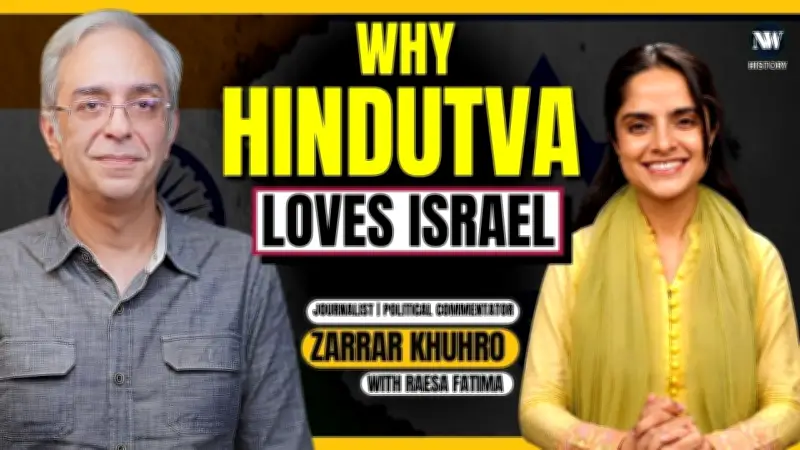
Hindutva Support for Israel: Ideological Links
In a recent conversation, Zarrar Khuhro examined the ideological connections between Hindutva and Zionism, explaining why Hindutva supporters admire Israel. He noted that both ideologies share a vision of ethno-nationalism, where religion and state are intertwined, and both view themselves as civilizational states under threat from neighboring cultures. This admiration is rooted in Israel's military prowess, technological advancement, and its model of a strong, centralized state that prioritizes the majority community. According to Khuhro, Hindutva ideologues see Israel as a successful example of a Hindu nationalist state they aspire to emulate.
Gaza and the Credibility of Western Liberalism
Khuhro argued that the war in Gaza has shattered the credibility of Western liberalism. He pointed out that Western nations, particularly the United States and European powers, have consistently supported Israel's military actions, despite mounting civilian casualties and violations of international law. This double standard, he said, reveals the hypocrisy of liberal values that claim to uphold human rights and democracy. The crisis has led many in the Global South to question the moral authority of the West, as Western governments continue to supply arms and veto resolutions at the United Nations. Khuhro emphasized that this has deepened the divide between the West and the rest of the world, eroding trust in liberal internationalism.
Pakistan's Civilizational Identity and the Indus Valley Debate
The discussion also turned to Pakistan's civilizational identity. Khuhro argued that Pakistan's identity is not solely based on Islam but also on its pre-Islamic heritage, including the Indus Valley civilization. He criticized the tendency to erase this history in favor of a monolithic Islamic narrative, noting that the Indus Valley civilization is a source of pride and a link to the region's ancient past. The debate over the Indus Valley, he said, reflects broader tensions between secular and religious visions of national identity. Khuhro called for a more inclusive understanding of Pakistan's history that acknowledges its diverse cultural roots.

The Role of Liberals in Politics
Khuhro also addressed the role of liberals in Pakistani politics. He argued that liberals have failed to build a strong political movement because they are disconnected from the masses and often impose Western frameworks that do not resonate locally. Instead, he suggested that liberals should engage with indigenous traditions of tolerance and pluralism, such as Sufism, to create a more authentic progressive agenda. He criticized the tendency of liberals to focus on elite issues while ignoring the economic and social concerns of ordinary people.
Decline of American Dominance and Rising Tensions Around Iran
On geopolitics, Khuhro discussed the decline of American dominance. He cited the rise of China, the failure of US wars in the Middle East, and the increasing assertiveness of regional powers like Russia and Iran. He predicted that the US would continue to lose influence, leading to a more multipolar world. Regarding Iran, he noted that tensions are rising due to Iran's nuclear program and its proxy wars in the region. Khuhro warned that any conflict with Iran would have catastrophic consequences for the Middle East and global energy markets.
Media Narratives and the Future of the Global Order
Finally, Khuhro examined media narratives, arguing that Western media often distort events to serve geopolitical interests. He cited the coverage of the Gaza war as an example, where Israeli casualties are highlighted while Palestinian suffering is downplayed. He called for alternative media platforms that challenge these narratives. The future of the global order, he concluded, will depend on whether new powers can create a more just and equitable system that respects sovereignty and human rights.