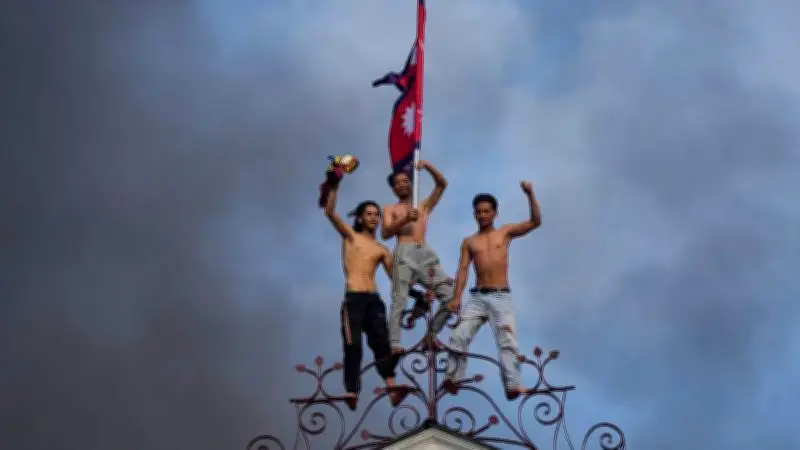
In early September 2025, Nepal experienced an unusual moment in its recent political history. The government imposed a broad restriction on major social media platforms. Within a few days, large numbers of young people across the country took to the streets. Their anger was not directed at a single political figure or party. It was aimed at the decision itself, which they viewed as an attempt to silence their digital presence and restrict their ability to communicate. As protests expanded, clashes with authorities led to casualties and injuries. Yet within roughly a week, the government reversed its decision and restored access to social media platforms.
For many observers, this was more than a routine protest cycle. It represented a new form of youth-driven political pressure, where a digitally connected generation was able to force a rapid policy change without relying on traditional party structures or long-established leadership. This episode has drawn attention in countries with similarly young populations, especially Pakistan.
Pakistan's Demographic Crossroads
With one of the largest youth cohorts in the world, Pakistan stands at a demographic crossroads. Roughly a quarter of its population is between the ages of fifteen and twenty-nine, amounting to tens of millions of young citizens entering adulthood at a time of economic uncertainty and institutional strain. Each year, more young people enter the labour market than the economy can meaningfully absorb, intensifying competition for limited opportunities.

The comparison between Nepal and Pakistan is not about declaring one model superior. It is about understanding how similar generational pressures can produce different political outcomes depending on institutions, digital access, and economic conditions.
Roots of Nepal's Youth Unrest
Nepal's youth unrest in 2025 did not emerge suddenly. It reflected long-standing structural pressures. The country has achieved relatively high youth literacy rates, approaching universal levels in some estimates, yet this educational progress has not translated into domestic job creation. A significant portion of the working-age population is either unemployed or engaged in informal work with limited stability or protection.
As a result, labour migration has become a defining feature of the Nepali economy. Large numbers of young workers leave the country each year to seek employment abroad, sending back remittances that form a substantial share of national income. While these remittances stabilise households and support consumption, they also highlight the economy's inability to generate sufficient opportunities at home.
Against this backdrop, the social media restrictions acted as a trigger rather than the root cause of unrest. For a generation accustomed to digital communication, the platforms were not simply entertainment tools. They were spaces for education, coordination, expression, and livelihood. The sudden disruption of these channels was interpreted as an attack on both personal freedom and economic opportunity.
Organisational Structure of Protests
The protests that followed were notable for their organisational structure. There was no dominant political party directing the movement, nor was there a single charismatic leader shaping its demands. Instead, coordination occurred through decentralised digital networks, group messaging, and peer-to-peer communication. The movement quickly expanded beyond the initial issue of platform restrictions to include broader concerns about corruption, economic stagnation, and lack of accountability.
A defining feature of this mobilisation was its focus on a specific and measurable demand. The central objective was the restoration of digital access and reversal of the government decision. Once that outcome was achieved and key political resignations followed, the intensity of the protests diminished. The movement did not evolve into a prolonged attempt to seize political power. It remained largely issue-centred rather than leadership-centred.

Pakistan's Youth Landscape
Pakistan presents a different but related case. Its youth population is even larger in absolute terms and faces similar structural challenges, including unemployment, underemployment, and limited access to stable formal-sector jobs. Educational attainment has improved in recent years, especially among younger cohorts, yet the economy has struggled to generate sufficient high-quality employment.
A major difference lies in labour absorption and productivity. A large segment of Pakistan's workforce remains in informal employment, often without long-term security or benefits. At the same time, the country has developed a growing digital freelance sector that connects skilled workers to global markets. Hundreds of thousands of young Pakistanis now earn income through remote work in fields such as software development, design, and digital services.
This digital economy, while promising, remains constrained by infrastructure gaps. Internet access is uneven, with a significant portion of the population still lacking reliable connectivity. As a result, the benefits of digital globalisation are unevenly distributed, reinforcing existing social and regional inequalities.
Political Engagement Patterns
Politically, youth engagement in Pakistan has often taken a different form from Nepal's recent experience. Mobilisation has frequently been organised around political personalities rather than narrow policy issues. This tends to produce movements that are highly energised but also deeply polarised. When political identity becomes tied to individuals, protests often evolve into broader conflicts over loyalty rather than specific reforms.
A clear example of this dynamic can be seen in the large-scale protests of May 2023. These events were triggered by the arrest of a prominent political leader and quickly spread across multiple cities. While the demonstrations reflected genuine political frustration for many participants, they also escalated into violent confrontations, including attacks on state institutions. The aftermath was marked by widespread arrests, heightened political tension, and a deepening of institutional mistrust.
Unlike Nepal's 2025 protests, which were largely resolved through a policy reversal, the events in Pakistan did not produce a clear reform outcome. Instead, they contributed to a cycle of confrontation and state response that further polarised the political environment.
Contrasting Approaches to Youth Politics
The contrast between these two cases highlights an important distinction in modern youth politics. In Nepal, digital coordination was used primarily to achieve a specific policy objective. In Pakistan, digital and street mobilisation has often become embedded in broader political struggles over power and leadership. One approach tends to produce short-term policy change, while the other tends to deepen long-term political division.
However, it would be misleading to idealise one model over the other. Nepal continues to face serious structural problems, including economic dependence on remittances, limited industrial growth, and ongoing governance challenges. The success of a single protest movement does not resolve these deeper issues. It only demonstrates that coordinated youth pressure can influence immediate policy decisions.
Pakistan's challenge is more complex because of its scale and institutional conditions. With a much larger population and more fragmented governance structures, translating youth energy into coherent policy outcomes is inherently more difficult. At the same time, the potential for impact is also greater if that energy is channelled effectively.
Opportunities for Human Capital Development
One of the most significant opportunities lies in human capital development. Young Pakistanis increasingly possess digital skills that can be integrated into global markets. The expansion of remote work has created pathways for income generation that are not fully dependent on domestic job creation. This shift has the potential to reduce economic pressure while increasing individual autonomy.
Yet economic independence alone does not automatically translate into political maturity or institutional reform. For that, there is a need for stronger civic understanding and engagement with how governance systems function. Knowledge of public budgeting, regulatory processes, and local government structures can empower citizens to demand accountability in more targeted and effective ways.
Agriculture also remains a critical sector. Despite its declining share in GDP, it continues to employ a large portion of the population. Modernising agricultural practices, improving water management, and adapting to climate-related risks are not only environmental concerns but essential economic priorities. Young people engaged in these areas can play a major role in increasing productivity and resilience.
Structural Challenges and Institutional Weakness
Pakistan's broader development indicators reflect the depth of its structural challenges. The country ranks low on global human development measures, with persistent issues in education quality, health outcomes, and institutional stability. Political instability and weak governance further complicate long-term planning and investment. In such an environment, youth frustration is understandable. When systems appear unresponsive, the appeal of disruptive politics increases.
However, the experience of other countries suggests that sustained progress depends less on disruption alone and more on the gradual strengthening of institutions. The lesson from Nepal is not that protests are the primary instrument of change. It is when mobilisation is focused, decentralised, and issue-specific that it can produce rapid policy responses. The limitation is that such movements rarely address underlying structural problems unless they evolve into longer-term institutional engagement.
Strategic Choices for Pakistan's Youth
For Pakistan's younger generation, the strategic question is how to balance immediate political expression with long-term capacity building. Digital tools can be used for both activism and economic participation. The same networks that spread political messages can also facilitate skill development, entrepreneurship, and global work opportunities.
Ultimately, the direction of youth politics in Pakistan will depend on whether energy is invested primarily in personalities or in systems. Personality-driven politics tends to produce cycles of mobilisation and backlash. System-focused engagement, although slower and less visible, is more likely to produce durable improvements in governance and opportunity.
Nepal's brief but significant episode of Gen Z mobilisation offers a glimpse into how quickly digital generations can influence state decisions. Pakistan's challenge is not to replicate that moment, but to transform similar energy into sustained economic and institutional development. The difference between the two outcomes will shape not only political stability but the long-term future of millions of young people.