Nearly 60 per cent of net federal revenue goes to interest payments. Subsidies and tax exemptions (Rs 2.53 trillion) for influential groups exceed what the state spends on health and education and are more than twice the development budget. All of that is true. But it is also the kind of truth that has been published every budget cycle for more than a decade. The question is why every attempt to change them reaches the same point, collides with the same barrier, and then stops.
Historical Attempts at Reform
In 2007, the Central Board of Revenue prepared a reform blueprint that included proposals to strengthen taxation of agricultural income. At the time, officials and reform advocates argued that the sector represented a major untapped source of revenue. The proposal quickly encountered political resistance from landed interests. Constitutional and administrative arguments were also advanced, including the view that agricultural taxation fell primarily within provincial jurisdiction. The discussion gradually lost momentum before any meaningful implementation could take place.
In 2018, the incoming government launched a high-profile anti-encroachment drive targeting illegal occupation of state land. The campaign initially included action against properties alleged to be linked to politically connected interests, generating controversy in several local cases. In at least some instances, officials involved in enforcement were reassigned shortly thereafter. The episode contributed to a broader perception that enforcement intensity varied depending on the actors involved and the interests affected.

In 2022, a coalition government entered another IMF programme that included commitments related to state-owned enterprise reform and broader governance improvements. Implementation proved uneven, with recurring political and institutional resistance to changes in state-owned enterprise (SOE) oversight and management structures. Subsequent IMF reviews have continued to emphasise many of the same areas, including energy sector reforms, transparency measures and revenue mobilisation.
The Host Always Pays
The pattern never truly changes. Each reform effort reaches a specific point and then stops. That point is not economics. It is political. And the dividing line is a simple question: Does this reform require powerful actors to accept a concentrated loss? If the answer is no, the reform proceeds. The Federal Board of Revenue can extract more from salaried taxpayers. The State Bank can adjust interest rates. Ministries can reshuffle subsidies. New taxes can be spread across millions of consumers. These measures appear regularly in IMF documents and budget speeches. They are real "reforms". They generate fiscal "improvements". They satisfy programme targets.
The state extracts enough from society to remain solvent, but not enough to transform itself. Yet they rarely alter the underlying distribution of power. Large agricultural interests remain lightly taxed. Favoured sectors continue to receive concessions. Real estate continues to benefit from undervaluation and preferential treatment. Banks continue to earn substantial returns from lending to the government.
Pakistan has never suffered from a shortage of reform blueprints. The World Bank produces detailed roadmaps. The IMF produces extensive conditionality matrices. The Ministry of Finance produces action plans. Most correctly identify the problem. What they cannot do is overcome the political interests that benefit from the status quo.
Why No Durable Alternative?
Why has no durable alternative emerged? Because meaningful change would require one of two things: either a political coalition strong enough to overcome entrenched interests, or a crisis severe enough to render those interests temporarily irrelevant. Neither condition has materialised.
A coalition capable of effectively taxing agricultural income would require the mobilisation of rural voters against the economic structures that dominate rural Pakistan. Yet access to land, water, credit and protection remains deeply intertwined with local power. The structure is not merely part of the economy. In many regions, it is the economy.

A coalition capable of removing industrial privileges would require sustained mobilisation of consumers against organised business interests. Yet business groups possess institutional representation, lobbying power and privileged access to policymakers. Individual households do not.
A coalition capable of imposing meaningful market-based property taxation would require the urban middle class to support policies that might reduce the value of one of its preferred investment assets. Many citizens who criticise elite privilege simultaneously benefit from speculative gains in property. The system extends rewards just far enough down the income ladder to broaden its political support.
The Role of Crisis
What about a crisis? Conventional wisdom holds that Pakistan perpetually stands on the brink of default and that one day the pressure will force fundamental change. The evidence suggests something different. Pakistan has so far avoided outright sovereign default despite persistent external and fiscal pressures. Debt levels remain high, but financing continues through a combination of domestic bank purchases, external support and repeated engagement with the IMF. External balances and fiscal indicators have shown periods of improvement, though not in a sustained or linear manner.
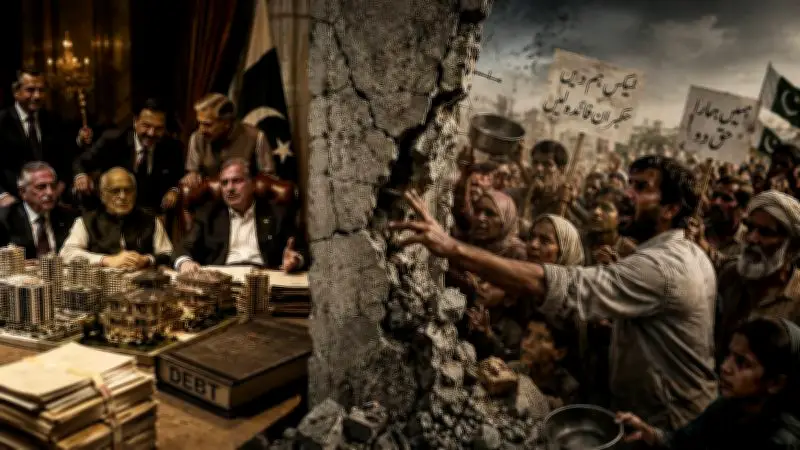
These are not signs of a system on the verge of breakdown. They are signs of a system that has learned how to survive. The state extracts enough from society to remain solvent, but not enough to transform itself. It borrows enough to postpone adjustment, but not enough to trigger immediate collapse. It preserves equilibrium without producing development. That is why the wall appears unbreakable. Because the wall is not a defect in the structure. It is the structure.
So many suggest: tax agricultural income effectively, eliminate entrenched subsidies, enforce market-based property taxation, fundamentally alter state-business relationships — and the consequences would extend far beyond fiscal accounts. Landed elites would lose rents. Protected industries would lose privileges. Developers would lose margins. Banks would lose a highly profitable business model. These are not marginal adjustments. They are direct challenges to powerful interests.
History suggests those interests have not accepted such losses voluntarily, and there is little evidence that they are prepared to do so now. That is the central paradox.
What Is Possible Instead?
The first possibility is managed continuity. The system will continue to extract, borrow, service and survive. Growth will remain below potential. Debt burdens will remain heavy. IMF programmes will come and go. Bilateral partners will continue to provide periodic support. Budgets will continue to prioritise debt servicing over development. This equilibrium can persist far longer than most observers expect. Argentina offers one example of how economic underperformance can coexist with political durability for generations.
The second possibility is an external shock large enough to disrupt the equilibrium: a global financial crisis, a severe climate event, or a major regional conflict. Something beyond the capacity of domestic actors to manage through familiar mechanisms. If such a shock arrives, the wall may fall. Not because anyone chose to remove it. But because the ground beneath it shifted.
Until then, the budget will continue to struggle with debt, not because policymakers lack technical knowledge, nor because every government lacks political will, but because the debt burden has become embedded in a broader system of power. The debt is not merely a fiscal problem. It is part of the political architecture. The budget is not a failure of the system. In many respects, it is the system. And the wall is not an obstacle standing in the way of reform. It is the structure that keeps the entire edifice standing.
Bottom Line: It Is the Establishment
James Carville's famous phrase during Bill Clinton's 1992 campaign was "the economy, stupid". Every political system has a defining reality around which all others revolve. For the United States, Carville argued, it was the economy. For Pakistan, it is the establishment. The landlord, industrialist, developer and banker are important beneficiaries of the existing order, but they are not its ultimate centre of gravity.
The establishment shapes the bureaucracy that administers the state, influences the coercive institutions that sustain authority, affects the flow of resources through public projects and commercial networks, and occupies a uniquely powerful position within Pakistan's political economy. This is how the system functions. The system is the wall. The wall is the system.